
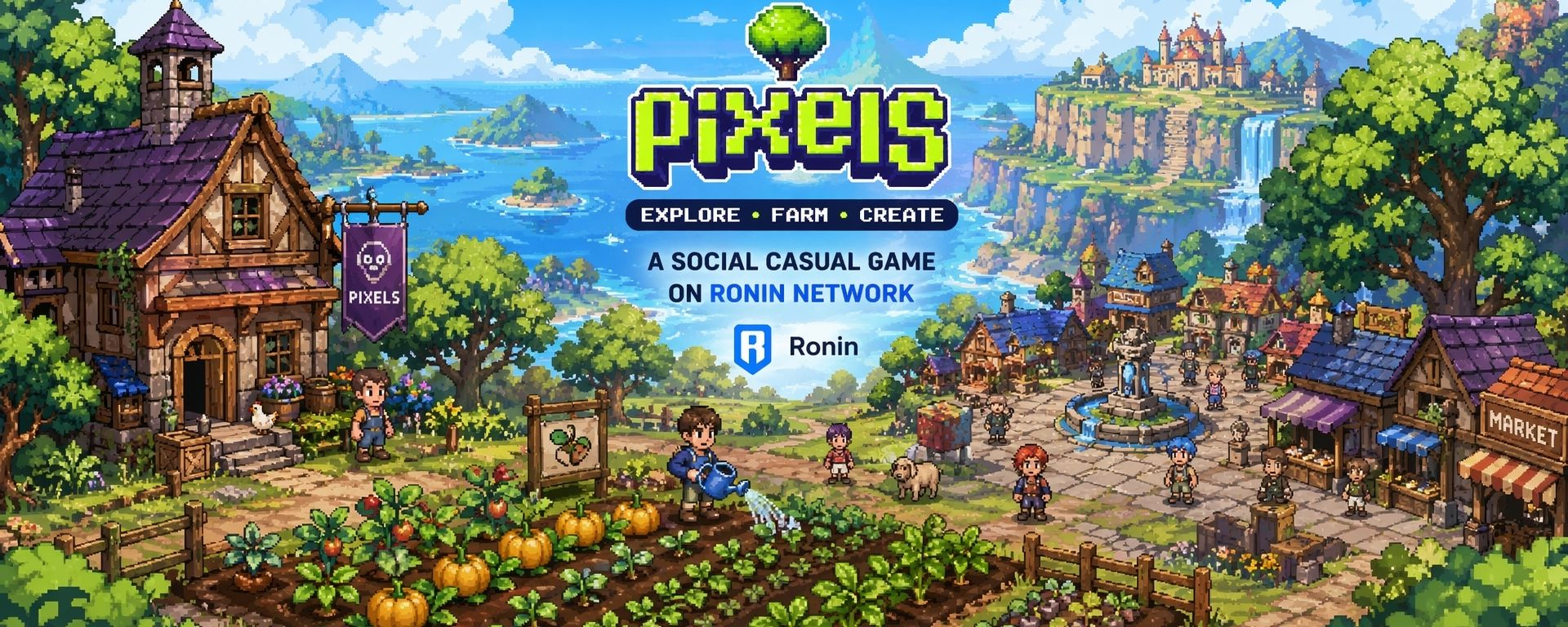
I’m watching Pixels with the kind of attention I usually reserve for projects that feel quieter than the market around them. In crypto, the loudest narratives are often the weakest ones. The projects that survive are usually the ones that spend less time trying to prove they are revolutionary and more time trying to make people come back tomorrow. I’ve spent a lot of time looking at Web3 games after the excitement wears off, after the token launch, after the first wave of users, when the charts stop telling the story and behavior starts to matter. That’s where I think Pixels becomes interesting.
Most blockchain games fail because they misunderstand what makes people stay. They assume ownership is enough. They assume if users can earn, trade, or speculate, engagement will naturally follow. But games are not financial products. People don’t build attachment because something is tokenized. They stay because a world starts to feel familiar, because progress feels personal, because routine quietly becomes part of daily life.
Pixels understands this better than most. On the surface, it looks simple—farming, gathering resources, building land, interacting with other players, moving through a pixelated open world that feels intentionally casual. But simplicity in game design is often misunderstood. Simplicity is not weakness. In many cases, it is the strongest form of retention. The daily act of planting crops, upgrading land, checking in with your farm—these are small actions, but small actions repeated over time create habit. And habit is where real value begins.
That matters even more in Web3, where the industry has spent years confusing activity with loyalty. Wallet connections are not community. Marketplace volume is not retention. A token being traded is not proof that a game matters to people. We’ve seen entire ecosystems built on financial momentum collapse the moment that momentum slowed down. The lesson should have been obvious by now: speculation can attract users, but it cannot hold them.
Pixels is operating inside that lesson, especially because it lives on Ronin. Ronin carries history. It is impossible to talk about gaming on Ronin without thinking about Axie Infinity, because Axie was both the biggest proof of concept and the clearest warning. It showed the world that blockchain gaming could create massive economic activity, but it also showed how fragile that activity becomes when the system depends too heavily on extraction. When players are there primarily to earn, the economy becomes vulnerable to the moment earning stops feeling worthwhile.
That shadow still exists, and every game on Ronin has to deal with it whether they want to or not. Pixels feels like part of the ecosystem’s attempt to answer that problem differently. Instead of starting with token incentives and building gameplay around them, it starts with behavior. It asks a more useful question: what would make someone log in even if token prices were boring?
That question is far more important than people realize.
The strongest part of Pixels, in my view, is that it behaves like a place before it behaves like a protocol. The farming loop is not there to justify a token. It exists because farming games work. They create repetition, and repetition creates attachment. Players optimize because they care, not the other way around. That sequence matters.
Land ownership follows the same logic. Crypto has spent years selling digital land as if scarcity alone creates value. It doesn’t. Empty land inside an empty ecosystem is just an expensive concept. Ownership only matters when the world itself has gravity—when your land reflects effort, when it improves your progression, when other people see it, when it becomes part of your social identity inside the game.
Pixels gets closer to that than many projects do. Land is tied to participation, not just speculation. It supports productivity, visibility, and progression. That makes ownership feel functional rather than symbolic. And in gaming, utility always matters more than narrative.
Then there’s PIXEL, the token, which is where the conversation becomes more difficult. Every game token faces the same tension. If the token exists mainly to reward players, it becomes inflationary by design. People extract value faster than the system can create reasons to hold it. If the token has no real utility, it becomes a speculative shell. And if the token becomes too necessary for progress, the game starts to feel like a financial gate instead of entertainment.
The challenge is building utility that feels natural.
Players will spend when spending feels like progression. They will resist when it feels like forced participation. That difference sounds small, but it decides everything. In gaming economies, psychology is more important than tokenomics decks. A token sink only works if people emotionally accept why they are spending.
This is why I pay more attention to behavioral design than emission schedules. Most investors still approach game tokens like they are analyzing DeFi protocols. They focus on unlocks, circulating supply, exchange listings. Those things matter, but they are incomplete. A game economy survives because people voluntarily re-enter it. If players are constantly earning but rarely choosing to spend in meaningful ways, inflation becomes inevitable no matter how elegant the spreadsheet looks.
Pixels seems aware of this. The token is meant to exist inside progression rather than above it. That is the right direction, but it is still a narrow path. Too much friction and users feel taxed. Too little and the token becomes irrelevant. Sustainable game economies are difficult because they require balance between finance and emotion, and most projects are only good at one.
I think the social layer is where Pixels has the strongest long-term edge. People stay where they feel visible. They return to spaces where their effort is recognized. A farm that reflects time invested, a guild that depends on your presence, a social structure where your identity matters—these things create retention in ways token rewards never can.
Crypto often underestimates how powerful lightweight belonging is. Not everyone wants deep complexity. Most people want consistency. They want a world that remembers them. Pixels works best when it delivers that feeling. It feels less like a product being monetized and more like an environment people gradually settle into.
That’s also where Ronin helps. Distribution is one of the hardest problems in Web3 gaming, and Ronin already has users who understand how gaming assets work. They understand wallets, marketplaces, ownership, progression. That familiarity removes friction, and friction kills consumer products faster than bad ideas do. Building where users already exist is often more valuable than building something theoretically perfect somewhere else.
Still, I remain cautious.
Crypto communities have a habit of turning games into spreadsheets. The moment players discover the most efficient path, the world starts collapsing into optimization. Every action becomes yield strategy. Every social mechanic becomes an economic calculation. Wonder disappears. Leisure disappears. What remains is labor disguised as play.
This is the quiet danger for Pixels.
The project has to protect the game from the market around it. It needs enough unpredictability, enough social friction, enough human inefficiency to remain alive as a world. Good game economies look more like cities than financial systems. They need status, aspiration, visible effort, and reasons to participate that cannot be fully reduced to profit.
That is where I think the real test lives.
Not whether PIXEL performs well on a chart.
Not whether a token unlock creates short-term volatility.
But whether people are still logging in months later because the game itself matters to them.
That is harder to measure and much more important.
If Pixels succeeds, it won’t be because people are excited about blockchain. It will be because they stop thinking about blockchain entirely. They will simply feel that their time matters, their assets persist, and their effort compounds instead of disappearing. Ownership becomes invisible because it works.
That is a much stronger model for Web3 than the earlier cycles ever produced. The best crypto products are often the ones where the crypto disappears into the background. Infrastructure should support behavior, not demand attention.
I keep coming back to that idea because I think it explains why Pixels deserves serious attention. It is not trying to convince people that tokens are exciting. It is trying to make the world itself feel worth returning to, and letting value emerge from that.
That inversion is rare in this space.
Usually the token comes first and meaning is added later.
The healthier model is the opposite. Build the place first. Let people care first. Let behavior create value rather than forcing value to manufacture behavior.
That is the real project here.
Not just a farming game on Ronin.
Not just another gaming token.
But a test of whether Web3 can finally learn that sustainability comes from routine, not spectacle. From habit, not hype. From people choosing to stay even when nobody is telling them they should.
If blockchain gaming is going to work in the long run, I suspect it will look much more like this—quiet, persistent, and almost ordinary. And honestly, that may be the most bullish signal of all.