

At the start, everything feels open.
You log in, you play, you progress. Nothing feels restricted. No hard walls, no obvious limits. The system feels fair enough that you don’t question it.
And that’s exactly why you don’t notice anything at first.
Because the limitation isn’t obvious.
It’s not a block.
It’s a slowdown.
Not something that stops you…
Just something that slightly delays you.
I’ve seen that kind of behavior before, but outside of games.
In trading environments.
Two people react to the same setup. Same timing, same idea. But one executes instantly, while the other hesitates—or gets delayed—and misses it.
From the outside, it looks random.
But it rarely is.
The difference usually comes down to how quickly you can move when it matters.
Not skill. Not knowledge.
Just execution speed.
Pixels gave me that same feeling, but in a quieter way.
At first, it didn’t look like anything special.
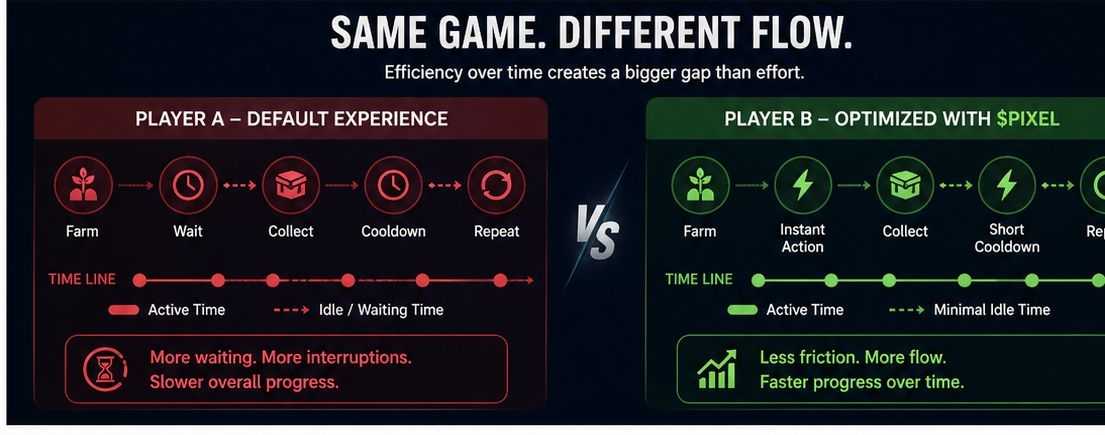
Just a relaxed loop. Farm, collect, repeat. No pressure, no complexity. You can play casually without thinking too much.
And that’s what makes it easy to overlook what’s actually happening underneath.
Because over time, something starts to shift.
Not in the rewards.
In the rhythm.
You begin to notice where your flow breaks.
Small pauses.
Short delays.
Moments where the system subtly slows you down.
Nothing major.
But enough to interrupt momentum.
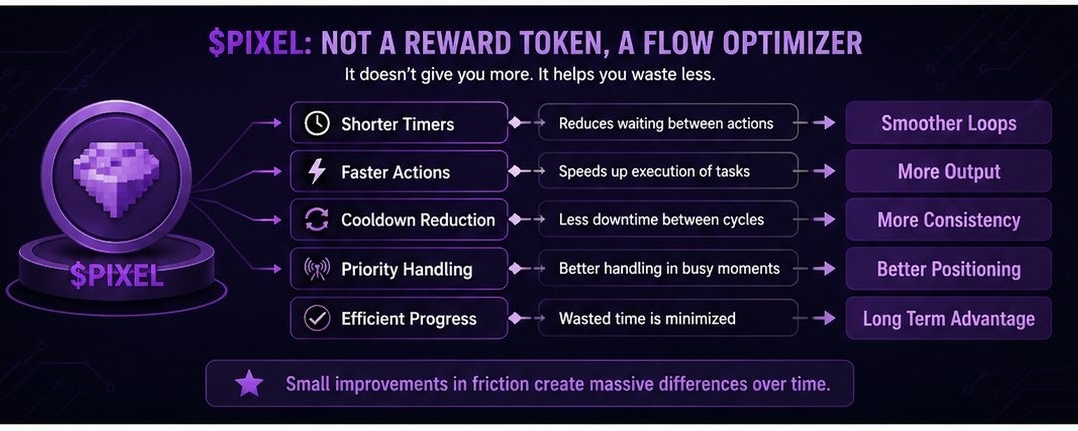
And that’s when PIXEL starts to make more sense.
Not as something you grind for.
But as something that quietly changes how those interruptions behave.
You don’t need it to play.
That’s what makes it easy to ignore.
But without it, you’re experiencing the system at its default pace.
And default pace is consistent… just not efficient.
That’s where the difference begins.
This isn’t about increasing output.
It’s about maintaining flow.
Because once flow breaks, everything feels slower—even if the system itself hasn’t changed.
Some players move through their loops almost continuously.
Others keep stopping, restarting, waiting.
Same game. Same actions.
Different experience.
And over time, that difference compounds.
Not in a dramatic way.
In a quiet, steady way.
I’ve seen similar patterns in other systems.
Not where access is restricted, but where performance isn’t equal.
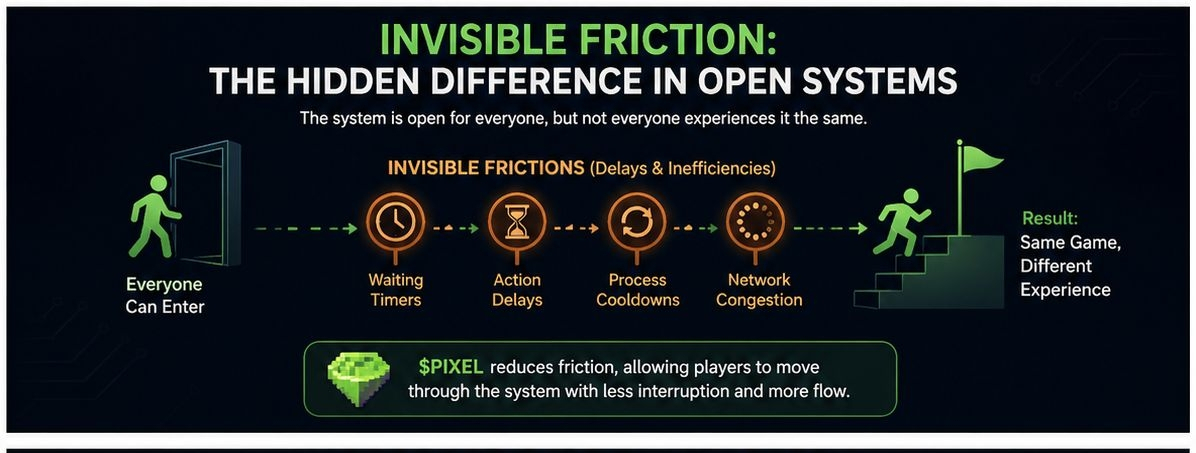
Everything is technically open.
But when things get busy, some actions move faster than others.
The system doesn’t deny access.
It just prioritizes efficiency.
That’s what PIXEL feels like inside Pixels.
Not a gate.
More like a subtle advantage in how smoothly you move.
What makes it interesting is how indirect it is.
There’s no moment where the game forces the decision.
No clear message telling you to use it.
Instead, you feel the inefficiencies first.
You notice where time gets lost.
Where your loop becomes uneven.
And naturally, you start adjusting.
Not because you’re told to.
Because you want a cleaner experience.
That’s where demand builds.
From small decisions.
Speed this up.
Reduce that delay.
Keep things moving.
None of those choices feel big on their own.
But together, they reshape how you interact with the system.
That’s when it becomes clear.
Pixels isn’t really rewarding how much you do.
It’s responding to how smoothly you can keep doing it.
That’s a different layer than most people expect.
Two players can reach similar outcomes.
But one gets there with fewer interruptions.
Less downtime.
Less friction.
Less wasted movement.
And that difference adds up faster than it looks.
Which brings a slightly uncomfortable realization.
The system isn’t unfair.
But it isn’t identical for everyone either.
Everyone has access.
Not everyone has the same flow.
And flow is what defines progress over time.
That’s how quiet layers start forming.
Not visible ranks or locked tiers.
Just differences in how efficiently people operate.
Some players stay in the default rhythm.
Others move closer to the system’s optimal state.
And that gap doesn’t need to be large.
It just needs to be consistent.
Maybe that balance is intentional.
If everything is equal, systems slow down.
If everything is paid, systems collapse.
This sits somewhere in between.
But it still points to something important.
If PIXEL influences friction…
Then it also influences positioning.
And positioning is what usually determines outcomes in the long run.
Even when it’s not obvious at first.
I don’t think this is something most players notice immediately.
It takes time.
Repetition.
Attention to small details.
But once you see it, it’s hard to ignore.
Because the question changes.
It’s no longer about what you earn.
It’s about how cleanly you move while earning it.
And that’s where things get interesting.
Not because of what PIXEL gives you.
But because of everything it quietly takes out of your way.
