
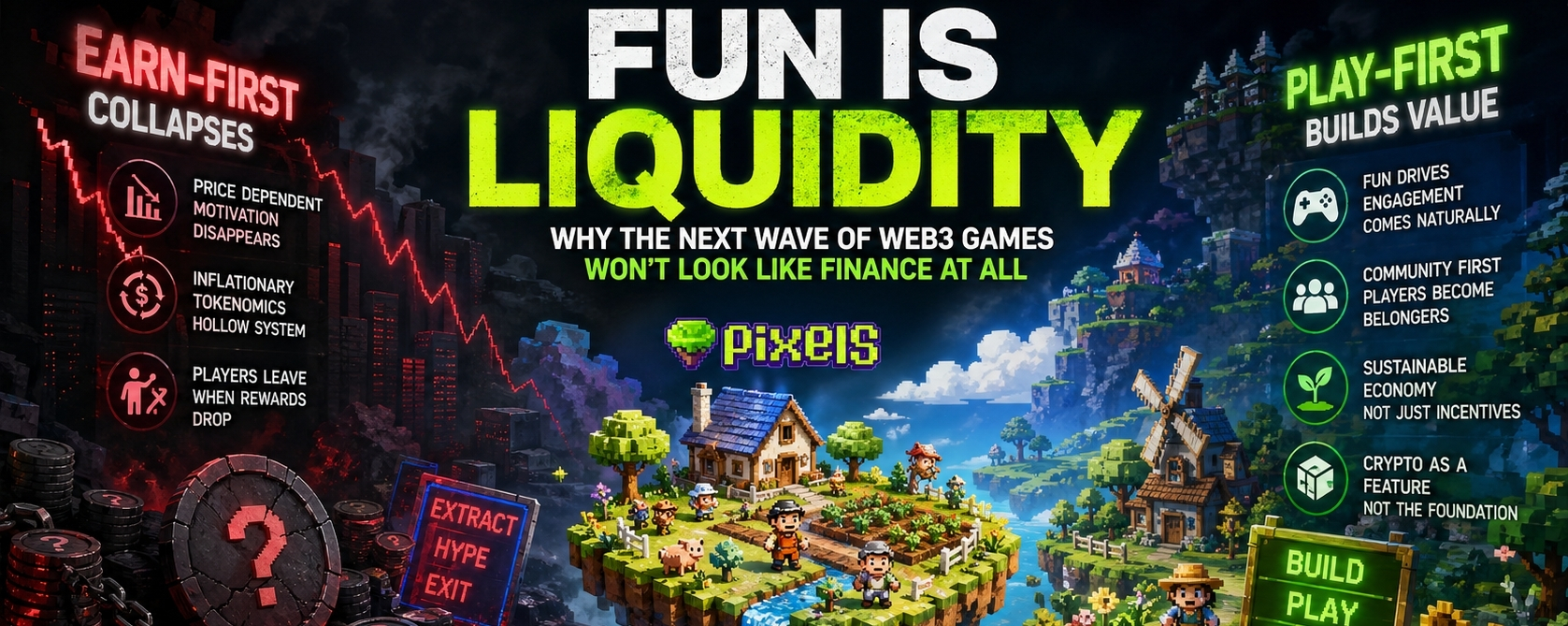
Sometimes it feels like we’ve been measuring the wrong things from the start. Not just in one project, but across the entire Web3 gaming space. We tracked token prices like stock charts, counted wallets like user growth, and called it success. But somewhere in that process… we forgot to ask a simpler question are people actually enjoying being there?
What’s interesting now is that a quiet shift is happening. Not loud, not hyped but visible if you look closely. Projects like @Pixels aren’t trying to “prove” anything anymore. They’re not shouting numbers or promising upside. Instead, they’re doing something less attractive in the short term they’re designing behavior.
And behavior is a strange thing. You can’t force it. You can only shape the environment around it.
Earlier systems tried to buy attention. Rewards were front-loaded, incentives were aggressive, and participation felt almost like a job. For a while, it worked. But when people start calculating every move in terms of profit, the experience becomes transactional. You log in not because you want to… but because you feel like you should. And the moment that feeling disappears, so do you.
Now compare that to a system where rewards are uncertain, slower, even slightly hidden. It sounds counterintuitive… but it changes everything. Because when the outcome is not guaranteed, the focus shifts back to the process. Exploration matters. Small decisions matter. Time spent starts to feel less like extraction… and more like presence.
That’s where things start getting interesting.
Instead of asking “how much can I earn today?”, the question becomes “what do I feel like doing today?”
And that’s a completely different loop.
But here’s the part that’s easy to miss — this model is harder to scale psychologically than technically.
When a game is small, communities are tight, expectations are flexible. Players forgive rough edges. They experiment. They stay longer without demanding immediate value. But as the system grows, a subtle pressure builds. New users arrive with different intentions. Some are curious, some are opportunistic, some are just following noise.
And suddenly… the environment changes.
Now the system is not just managing gameplay it’s managing intent.
Can the same slow, behavior-first design survive when thousands of new players expect clarity, rewards, and speed? Or does it gradually bend under that pressure and become what it originally tried to avoid?
This is where most systems lose their identity. Not because they fail technically… but because they start optimizing for the wrong crowd.
There’s also another layer that rarely gets discussed fatigue. Not the obvious kind, but the quiet one. The kind where even enjoyable systems start feeling repetitive over time. In traditional games, this is solved with content updates, storytelling, progression arcs. In Web3, it’s often patched with incentives. But incentives don’t remove fatigue… they just delay it.
So the real challenge is deeper than token design or user growth.
It’s about sustaining meaning.
Can a system keep giving players a reason to return… without increasing rewards?
Can it evolve without breaking its own balance?
Can it remain interesting when the novelty fades?
Right now, it feels like we’re watching a transition phase. The first wave proved that money alone can attract people but not keep them. The second wave is trying something riskier. It’s trying to earn attention instead of buying it.
And that’s a slower game.
Maybe that’s why projects like @Pixels don’t look explosive from the outside. They look… steady. Almost quiet. But sometimes, stability is not a lack of growth it’s controlled growth.
Still, uncertainty remains.
Because if fun really becomes the core “liquidity” of these systems… then everything changes. Metrics change. Strategies change. Even expectations change.
And not every project or every player is ready for that shift.
So maybe the real question is not whether this model works today.
It’s whether people are willing to engage with a system where the main return… isn’t immediate, isn’t guaranteed… and isn’t always measurable.
Because if they are, then this space might finally move from extraction to experience.
If not… we may just repeat the cycle in a different form.
Either way, what’s happening right now doesn’t feel like a conclusion.
It feels like a quiet reset.