

Crypto has a strange way of repeating itself. Every few years the story changes, but the feeling stays the same. New narratives arrive dressed as innovation, influencers suddenly become experts overnight, and timelines get flooded with people talking like they discovered the future before everyone else. First it was ICOs, then DeFi, then NFTs, then metaverse land, then AI tokens glued onto random projects that barely needed AI in the first place. The cycle never really ends. It just changes branding.
Honestly, after watching crypto long enough, you stop reacting to announcements. You stop believing every “next big thing” deserves excitement. Too many projects arrive with confidence and disappear quietly. Too many founders talk about changing industries while building products nobody actually uses. The market gets louder every year, but somehow trust gets thinner.
That’s why projects like Pixels feel strange to look at. Not because they scream innovation, but because they don’t seem to be trying so hard to pretend they’re revolutionary. Pixels exists in a part of crypto that has already disappointed people more than once: blockchain gaming.
And crypto gaming has history attached to it. Not good history either.
People remember play-to-earn. They remember games that looked less like games and more like work disguised as entertainment. Clicking repetitive tasks for token rewards. Grinding because numbers mattered more than enjoyment. Entire communities forming around earning potential instead of actual gameplay. It created this weird environment where people stopped asking whether a game was fun and started asking how quickly they could recover their investment.
That shift damaged trust.
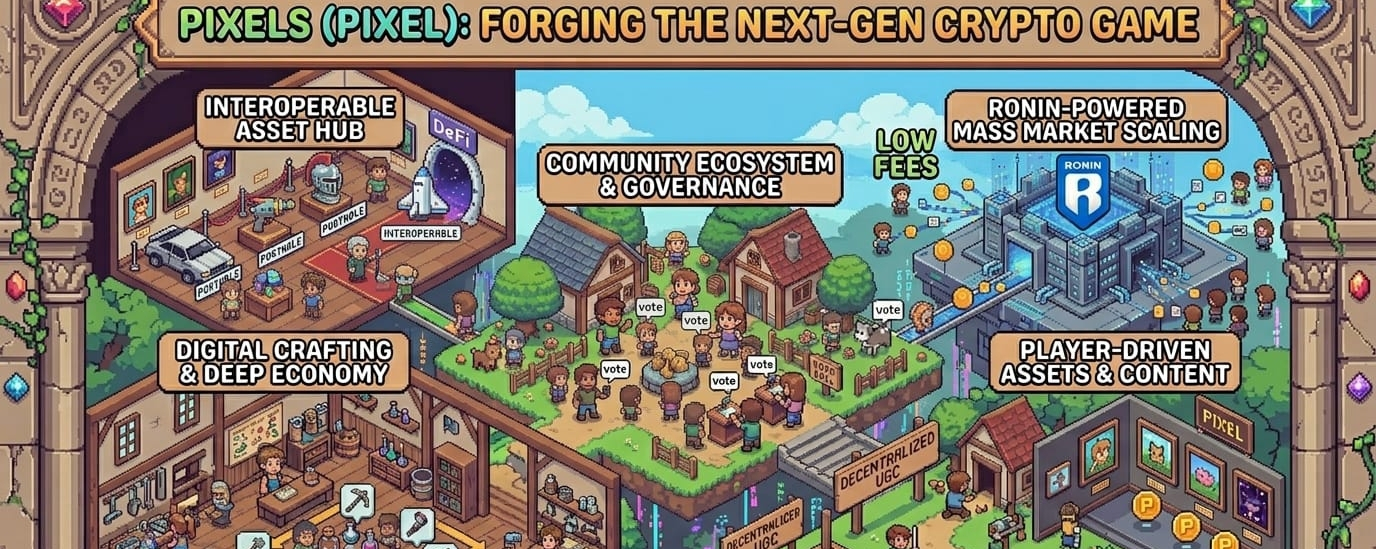
Pixels sits inside that same world, but it approaches things differently. It’s a social farming game running on the Ronin Network, built around exploration, farming, crafting, and interacting with other players. On paper, that sounds simple. Maybe almost too simple. There’s no attempt to sell some cinematic fantasy about becoming the next AAA gaming competitor. It doesn’t try to look like a console masterpiece. And honestly, that might be one of its smartest decisions.
Crypto projects often overpromise because they think ambition equals legitimacy. Pixels feels smaller in scale. More grounded. Almost intentionally casual.
The game itself leans into routine. Farming crops, gathering materials, building things, wandering around a pixelated world. It feels closer to an old browser game than some futuristic metaverse concept. That matters because simplicity survives longer than hype sometimes. People understand farming mechanics. They understand progression loops. Not every game needs to reinvent entertainment.
But let’s be real — blockchain gaming still carries baggage.
Even when a game looks approachable, there’s always this lingering question sitting in the background: are people playing because they enjoy it, or because they think there’s money involved?
That question follows every Web3 game whether developers like it or not.
Pixels has attracted attention partly because it found a home on Ronin, which already has an audience familiar with blockchain gaming ecosystems. That helps. Distribution matters more than technology most of the time. A good product without users disappears. A decent product with an existing audience survives longer than expected.
Still, numbers in crypto can be deceptive.
Wallet activity sounds impressive until you realize wallets don’t equal loyalty. Users don’t always mean players. Activity doesn’t automatically mean engagement. Crypto learned this lesson many times already. Projects can manufacture momentum through incentives. Rewards create temporary traffic. But temporary traffic isn’t the same thing as long-term attachment.
That’s the part that worries me.
Games built around token systems always walk a difficult line. They want players to stay because the experience feels rewarding, but crypto naturally attracts speculation. Once a token exists, price becomes part of the conversation whether anyone wants it or not.
Pixels has its own token, PIXEL, which connects to premium functions inside the game economy. There are utility mechanics attached to it, progression layers, access systems, and economic interactions. That sounds normal in crypto. Every project has a token now.
But honestly, token utility always deserves skepticism.
Crypto has this habit of creating tokens first and finding reasons later. Projects describe governance, ecosystems, incentives, utility, and ownership, but the real question remains simple: does the token genuinely improve the experience, or does it exist because crypto expects everything to be tokenized?
That question matters more than marketing explanations.
Because games survived perfectly fine before tokens existed. Players already bought skins, cosmetics, upgrades, and expansions. Traditional gaming figured out monetization years ago. Crypto’s contribution is ownership, portability, and open economies.
And to be fair, that part isn’t meaningless.
The idea behind digital ownership makes sense. People spend years inside online games building progress, collecting items, and shaping identities. When servers shut down, all of that disappears. Crypto tries to create persistence. Ownership that exists outside a company database. That concept isn’t fake. The problem is that ownership alone doesn’t guarantee emotional attachment.
People stay in games because they care.
They stay because mechanics become habits. Because communities form naturally. Because logging in feels comfortable. Not because an asset sits in a wallet.
NFTs taught crypto a painful lesson. Owning something doesn’t automatically make it valuable emotionally. Scarcity can create price, but not connection.
Pixels seems aware of this, at least partially. It doesn’t force intensity. It doesn’t feel obsessed with financial engineering. The atmosphere appears softer. Slower. Less aggressive than many GameFi experiments that came before it.
That might actually help.
The problem with earlier blockchain games was that they became economies pretending to be entertainment. Pixels seems to reverse that order. It tries to be a game first, economy second.
Maybe that works better.
Or maybe it still runs into the same wall every crypto game eventually faces.
Attention fades.
Incentives shrink.
Speculators leave.
Then reality begins.
That’s usually where projects reveal who they actually are.
Crypto communities love to celebrate growth phases, but survival matters more than launch hype. It’s easy to attract people when rewards exist. It’s harder to keep them when rewards become ordinary.
And maybe that’s the real test for Pixels.
Can a blockchain game survive when speculation becomes background noise instead of the main attraction?
I honestly don’t know.
Part of me respects the simplicity. Another part remembers how many times crypto gaming promised sustainability and failed to deliver it. History makes optimism harder. You start analyzing everything through previous disappointments.
Still, Pixels feels less desperate than many projects in the space. Less obsessed with proving itself. That alone makes it easier to watch without immediately dismissing it.
Maybe it works, maybe it doesn’t.
That’s probably the most honest place to stand with crypto now.
Not excitement.
Not cynicism.
Just cautious observation from people who have seen enough cycles to stop pretending certainty exists.