


Honestly, I didn't really notice it at first, the whole full‑chain gaming and metaverse scene is enough to make you shake your head
On one hand, you've got retro graphics straight out of a SEGA comsole on the other, they're recycling stale browser‑game tactics. Then they wrap it all in a come farm, this is a minimalist Ponzi" cloak and dare to call themselves Web3 leaders. This isn't decentralizing fun it's gambling for speculators, a classic hot‑potato game. To make it worse, chains live in their own bubbles: what you earn here can't buy gear over there. This mess of liquidity islands and brutal lack of real gameplay has become an unbreakable anchor dragging down innovation
Just when I was about to write off this whole sector, a beast that dares to break the mold appeared 🤲 @Pixels 🌱

My normie friends (who don't even know what a blockchain is) keep asking me if they should get into $PIXEL. To give them an answer that isn't well, it depends, I've spent the last week glued to data dashboards doing one thing: force‑testing Pixels Chapter 2's resource production and consumption model in the most hostile scenario imaginable. A live autopsy, but on the most chaotic battlefield
If Pixels dares to be the weird kid, where's its strength? My first shiver came when I dissected its economic structure: these guys aren't just making a cute little game they're trying to bend human greed using game theory. Anyone can cook up two tokens and a dividend contract; that's pure financial engineering. But messing around with the value of time and social connections of thousands of real people? That's a different beast
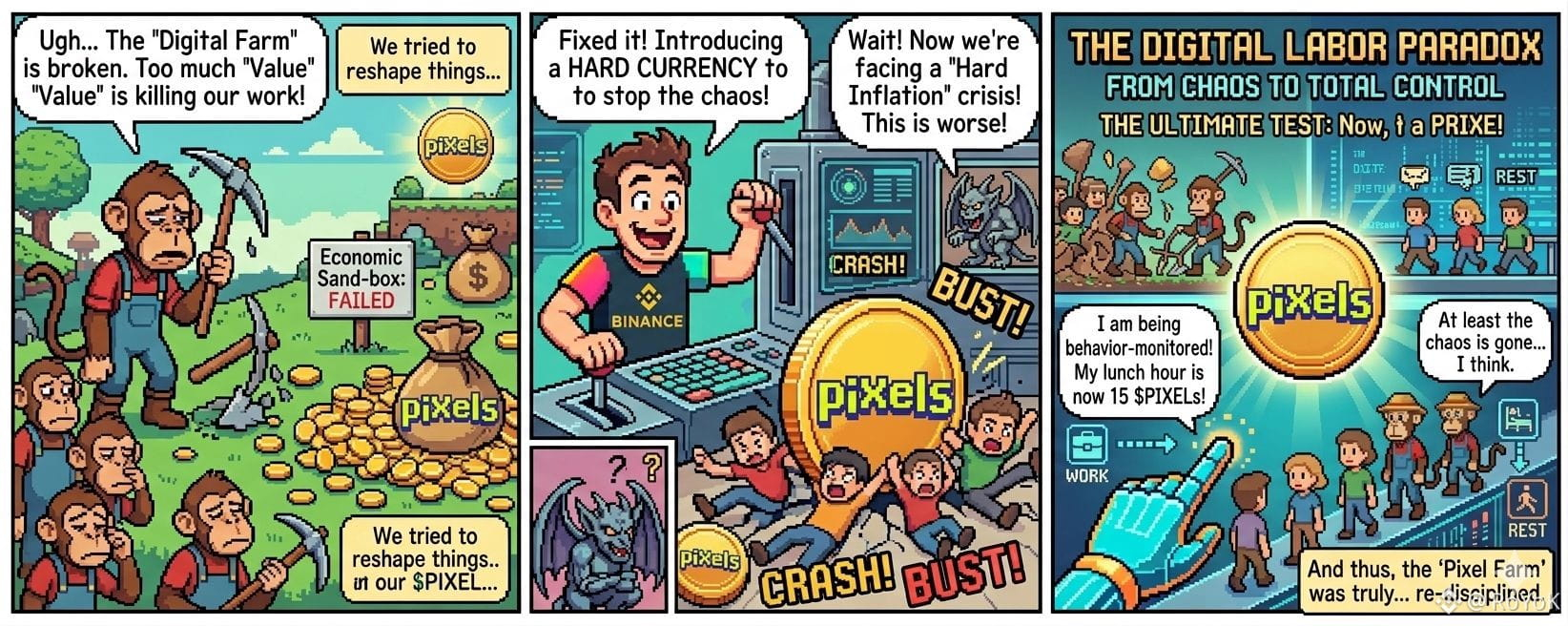
Old‑school blockchain games were soulless ATMs locusts came, mined, cashed out, and left chaos behind. Pixels tells a very different story. Its obsession is precise pricing of behavioral output. When you scratch the surface, you think you're gonna play FarmVille, but you've actually stumbled into a macroeconomic control simulator run by the Federal Reserve 🏦
But their appetite goes beyond watching thousands plant carrots. The whole "Web3 traffic portal" thing has been chewed up by big studios until it's just cheap slogans. The current landscape is broken expecting an NFT swordsman to go kill monsters on another map is a pipe dream. The Pixels crew isn't interested in some floaty 3D metaverse; their plans are chillingly cold
They want to build the melting furnace of attention assets. The message is brutal: whether you're a Bored Ape or a Fat Penguin, inside their pixel continent, you get stripped of your glamour and turned into a "digital body" that has to work for a living. Everyone must bow to their standardized social protocol. To pull this off, they even abandoned their original home and moved without hesitation to Ronin a chain built for gaming. It's not about gas fees; it's about crafting a custom‑built cricket cage for their millions of daily users
But no matter how big the dream, the numbers have to add up. Dig into the rules, and Pixels' game is cruel. The message is clear: future Web3 players can't be passive leeches waiting for handouts they have to be self‑sufficient digital farmers. In this system, every minute online and every swing of the hoe generates a tiny on‑chain state change. And to make that work, the system assigns you a reputation weight and ties you into a complex web of resources. In other words, Pixels aims to anchor your virtual labor to a real, liquid asset
It packages guild distribution, land leasing, VIP privileges, and resource burning into a self‑consistent economic flywheel. And yeah, for being able to cram sociological complexity into a token, it's already lapped those dogshit projects that just copy‑paste DeFi recipes
That said, when millions of users start moving on their own, you hit a black hole: how do you stop witch attacks and studio scripts? Enter its reputation anti‑cheat engine. In pure DeFi, preventing bots is a code problem; in this massive interaction world, it's a defence against entire bot armies
If you don't stop the fake activity, they'll swarm like locusts and drain the system's liquidity. To strangle this parasitic way of life, Pixels goes full draconian: quests are locked behind your trust score. I've seen that by mixing your social network, staked funds, and history, they create an uncrossable barrier. If they tag you as a free‑rider, the smart contract cuts off your high‑value production path. That's how they brutally enforce labor discipline in the virtual world
Once you put a lid on the script chaos, you can finally talk about the project's real engine: the token. And here, forget about overnight riches. There's a golden rule in this business: if someone talks big without considering real consumption, they're selling smoke. The token that drives this pixel empire is my biggest red flag 🚩
Its economic designer is a cold son of a gun: they killed the unlimited inflation of old tokens and elevated PIXEL to the throne of the only indispensable currency. Now, upgrading high‑level resources, buying VIP passes, and founding guilds all require spending it. It's no longer something you just farm and dump it becomes the social mobility pass inside this world. The system tries to avoid the Ponzi death spiral through extremely tight issuance and aggressive recycling
But let's come back to the mud‑and‑blood reality. Let's break down the recent brainwashing campaigns that Pixels' officials ran across communities. Those of us who've been around for years can smell it: same old formula. They know exactly when to flex the whales' wealth effect to pump the hype. The narrative has shifted from let's farm together to redefining the cornerstone of Web3 social economy $AGT
The tactics never change: the pies are bigger than the sky, the barriers seem laughably low, and they spam everyone with profitability charts. It's a carnival of emotion and money that goes straight to your head
But strip away the shiny veneer, and one cold question remains: is this digital farming system creating genuine value that people will pay for out of joy, or is it just a more sophisticated, longer‑term game of capital cannibalizing itself?
Because if it's pure Ponzi, the party will end. A truly sustainable blockchain game needs people willing to pay for the fun of it, not just for "make more money" to reinvest
Facing the potential crash triggered by token volatility, you need a compass. Here are three real‑world checks, more useful than any whitepaper:
1️⃣ The ratio of non‑utilitarian consumption: Watch how much PIXEL gets burned each week on things that don't give direct economic returns decoration, flexing, etc. If it's all about buying stamina to mine more coins, that's slow poison.
2️⃣ The whales' attitude toward sunk costs: Look at guild leaders and landowners are they genuinely investing in $PIXEL for long‑term territory management, or are they just calculating how many months until break‑even before they dump their bags?
3️⃣ The model's anti‑deflation resilience: Pay attention during periods of stagnant user growth do resource prices inside the system collapse? If there's no effective mechanism to smooth out production swings, the narrative rupture is just a matter of time
With these three checkpoints, when you look at Pixels' ultimate fate, you'll see we're standing in the eye of a very unsettling storm. The economic game Pixels has laid out has the ambition to reshape blockchain gaming rules. It's trying to blow a new path between pure financial schemes and traditional games towards digital laborism. If it can successfully run this complex ecological cycle, we'll be witnessing a grand experiment: a Web3 game that escapes its own death spiral $ORCA
That's why I still keep a small 3‑5% observer position. I feel both awe and caution. Pixels has the potential to become the social infrastructure of the next cycle. But don't forget the old saying: the more complex the economy, the more violent the chain reaction when it collapses. The truth in trading is never about who has more faith it's about who can keep their chips before the party ends.
The future of this pixel continent is exciting, but your hard‑earned money is only yours. So until time proves it right, maintain that distance and the dignity of a seasoned trader, and don't lose your ticket to the second half chasing a grand narrative