
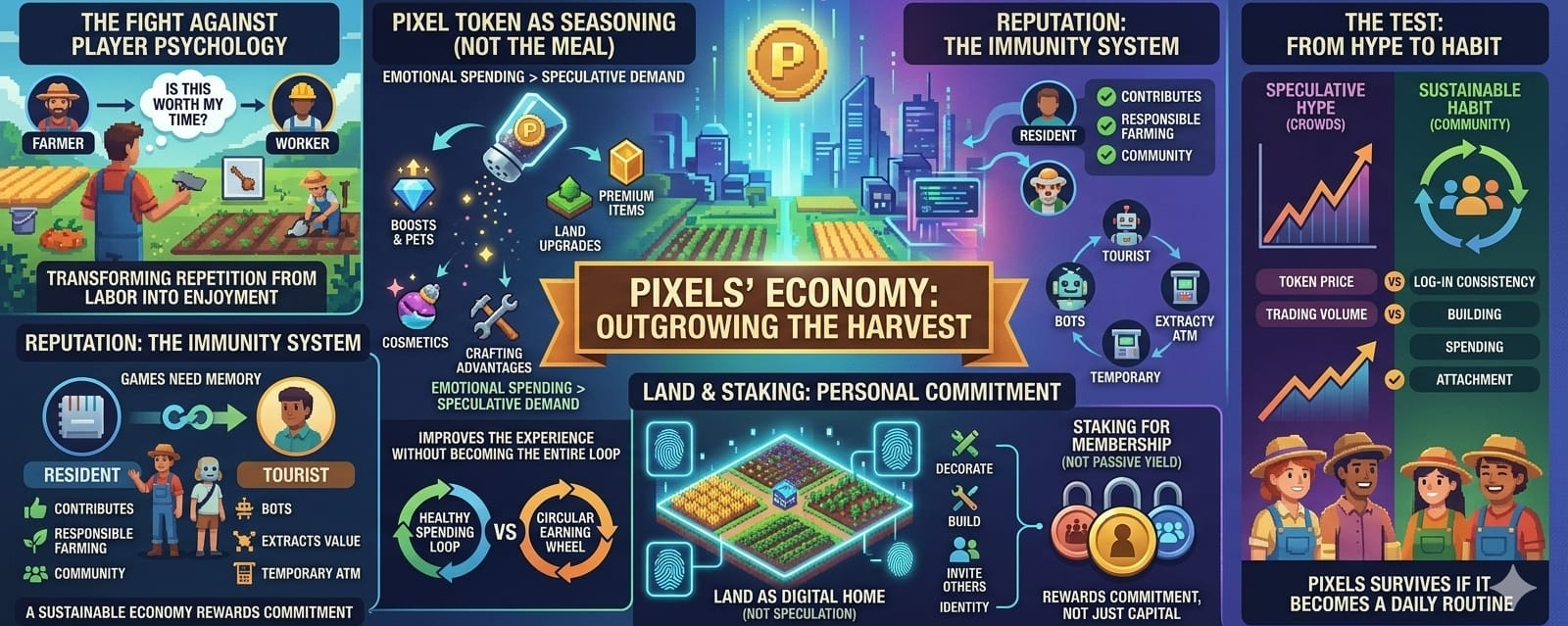
The way I see Pixels, it is not just a Web3 farming game. It is a test of whether crypto gaming can grow up.
Most Web3 games begin with a promise: play, earn, own, trade, repeat. It sounds exciting at first. But after watching this space for a while, I think the real problem is simple. Too many crypto games have been designed like farms where nobody actually loves the soil. Players arrive for the harvest, extract what they can, and leave when the crop is no longer profitable.
Pixels is interesting because it is trying to build something softer and harder at the same time: a game that still has rewards, but does not depend entirely on them.
That is not easy. In fact, it may be one of the hardest things to do in Web3 gaming.
I do not think Pixels is fighting other games. It is fighting player psychology.
The biggest enemy of Pixels is not another Ronin game, another farming title, or even token volatility. The real enemy is the mindset that crypto itself creates.
Once a token is attached to a game, players begin to see every action differently. A crop is no longer just a crop. A task is no longer just a task. A piece of land is no longer just a place to decorate or build. Everything starts to carry a hidden question:
“Is this worth my time?”
That question can quietly damage a game.
In a normal farming game, repetition feels relaxing. You plant because progress feels good. You decorate because the space feels like yours. You return because the world becomes part of your routine. But in a tokenized game, repetition can become labor. The player does not feel like a farmer anymore. They feel like a worker checking the value of their shift.
This is the thin line Pixels has to walk. It must offer economic value without letting economic value become the only reason to play.
PIXEL should feel like seasoning, not the whole meal
My personal view is that PIXEL works best when it acts like seasoning inside the game economy.
Seasoning improves the meal. It gives flavor, speed, personality, and excitement. But nobody eats a bowl of seasoning by itself.
That is how a game token should work. PIXEL should make the Pixels experience richer through boosts, pets, cosmetics, crafting advantages, land-related uses, and premium items. It should help players express themselves, move faster, unlock special things, or feel more attached to their progress.
But PIXEL should not become the entire meal.
If every player’s main goal is to earn more PIXEL, then the game becomes circular. People play to earn the token, then use the token to earn more token, then sell the token because the game itself is not enough. That is not a sustainable economy. That is a wheel.
The healthiest version of Pixels is one where players sometimes spend PIXEL without immediately calculating the return. They spend because they want a pet. They want their land to look better. They want a boost because they are enjoying the session. They want an item because it feels personal.
That kind of spending is emotional, not just financial. And emotional demand is much stronger than speculative demand.
The BERRY shift tells me Pixels understands the danger
One thing I respect about Pixels is that it has not treated every in-game resource like it needs to be fully financialized.
The change around BERRY was important because it helped separate normal gameplay fuel from open-market pressure. To me, that is a sign of maturity. Not every item in a game should become a tradable asset. Not every action should become a financial event.
When a game turns everything into money, it loses quietness. And quietness matters in a farming game.
A farming world needs small actions that are just small actions. It needs resources that exist to support crafting, upgrading, and progression, not to become another chart. If every tomato, tool, and task is tied too directly to speculation, the game stops feeling like a world and starts feeling like a dashboard.
Pixels seems to be learning that a good game economy needs both on-chain value and off-chain breathing room.
That balance is important. Too little ownership, and it feels like a normal Web2 game with crypto branding. Too much financialization, and it becomes exhausting.
Reputation is the most human part of Pixels’ economy
If I had to pick one feature that feels most important for Pixels’ long-term health, I would not pick the token. I would pick reputation.
Reputation matters because games need memory.
A real community remembers behavior. It remembers who contributes, who helps, who farms responsibly, who only appears during reward seasons, and who treats the world like a temporary ATM. Without memory, every wallet looks the same. A bot, a loyal player, a casual farmer, and a real community member can all blend together.
That is dangerous.
A sustainable economy cannot treat every participant as equal if their behavior is not equal. It has to reward people who strengthen the world and make extraction less attractive for those who only drain it.
This is why reputation could become Pixels’ immune system. Not perfect, of course. Any system can be gamed. But the idea is right. Pixels needs ways to tell the difference between a resident and a tourist.
And in Web3 gaming, that difference is everything.
Land only matters if it becomes personal
I am always cautious when Web3 games talk about land. Too often, land is sold as if scarcity itself creates value. But scarcity without purpose is just an empty room with a lock on the door.
Pixels has a better chance than many projects because farming and land naturally fit together. A player can understand why land matters. It can be productive. It can be decorated. It can hold identity. It can become part of someone’s routine.
But land still has to become personal.
If players only hold land because they believe someone else will pay more later, then land becomes speculation. If players build on it, improve it, show it off, use it, invite others, and feel proud of it, then land becomes part of the world.
That is the version of Pixels I find most promising: not land as a price tag, but land as a small digital home.
A good Pixels farm should feel like a place with fingerprints on it. You should be able to look at someone’s land and feel that a person lives there, not just a wallet owns it.
Staking should reward commitment, not just capital
Staking is another area where Pixels has to be careful.
On paper, staking sounds healthy. It encourages long-term holding and gives people a reason to align with the ecosystem. But staking can easily become another passive yield loop. People lock tokens, collect rewards, and still do not care about the game.
That does not build a community. It only parks capital.
For Pixels, staking is most valuable when it feels connected to participation. The best staker should not only be the biggest holder. The best staker should be someone who plays, supports the ecosystem, understands the economy, and has a reason to care about what happens next.
In other words, staking should feel less like a savings account and more like membership in the town.
That is a much stronger model. A savings account asks, “What is my yield?” A membership asks, “What am I part of?”
Pixels needs more of the second.
Ronin gives Pixels a neighborhood, but Pixels still has to build the house
Ronin is a major advantage for Pixels because it gives the game a natural Web3 gaming environment. The chain already has users who understand wallets, assets, marketplaces, and on-chain games. That gives Pixels a better starting point than launching into an ecosystem with no gaming culture.
But infrastructure is not destiny.
Ronin can bring smoother access, distribution, liquidity, and ecosystem attention. It can make Pixels easier to discover and easier to use. But it cannot make the game meaningful by itself.
That part still depends on Pixels.
A good chain is like a good neighborhood. It helps. It brings foot traffic. It gives people confidence. But if the shop itself has no soul, people will not keep returning.
Pixels has the neighborhood. Now it has to keep proving that the farm is worth visiting even when there is no special event, no major reward campaign, and no loud market narrative.
The real test is not hype. It is habit.
This is where my view becomes simple: Pixels will survive if it becomes a habit.
Not a hype cycle. Not a temporary earning route. Not a token trade. A habit.
A real game economy is built when players return for small reasons. They check their land. They finish a task. They improve something. They talk to someone. They prepare for an event. They collect an item. They feel like their progress matters.
These reasons sound small, but they are powerful. Small reasons create daily behavior. Daily behavior creates culture. Culture creates economic depth.
Speculation can bring a crowd quickly, but habit keeps a community alive quietly.
That is why I think the most important Pixels metric is not only token price or trading volume. It is whether players still care during boring weeks. Every project looks alive during announcements. The truth appears when nothing dramatic is happening.
Do people still log in?
Do they still build?
Do they still spend?
Do they still talk?
Do they still feel attached?
That is where sustainability lives.
The speculative loop is still there
I do not want to pretend Pixels has already solved everything. It has not.
The speculative loop is still present because PIXEL is a tradable token. Land can still attract flippers. Staking can still attract yield hunters. Rewards can still attract short-term farmers. Market conditions can still shape player behavior.
That is the reality of Web3.
The question is not whether Pixels can remove speculation completely. It cannot. The question is whether it can make speculation only one layer of the experience instead of the center of it.
If the average player thinks of Pixels mainly as a place to extract value, the economy will struggle. If the average player thinks of Pixels as a world where value is one part of a broader experience, the economy has a chance.
That difference may sound small, but it is everything.
My final take
Pixels feels like a project trying to move from “play-to-earn” toward something more mature: play, belong, build, spend, earn, and return.
That order matters.
If earning comes first, the game becomes fragile. If belonging and building come first, earning can become a bonus instead of the foundation.
I think Pixels has some of the right ingredients: a casual farming loop, Ronin’s gaming ecosystem, PIXEL utility, land, reputation, staking, and a willingness to adjust its economy instead of pretending everything is perfect. But ingredients alone do not make a meal. The project still has to keep turning those systems into reasons people genuinely care.
For me, the future of Pixels depends on whether the farm can outgrow the harvest.
If players stay only when the rewards are attractive, Pixels becomes another speculative loop.
If players stay because their land feels personal, their progress feels meaningful, their reputation matters, and the world becomes part of their routine, then Pixels has a real chance to become one of the rare Web3 games with an economy that feels alive.

Not because everyone is earning.
But because enough people actually want to be there.