
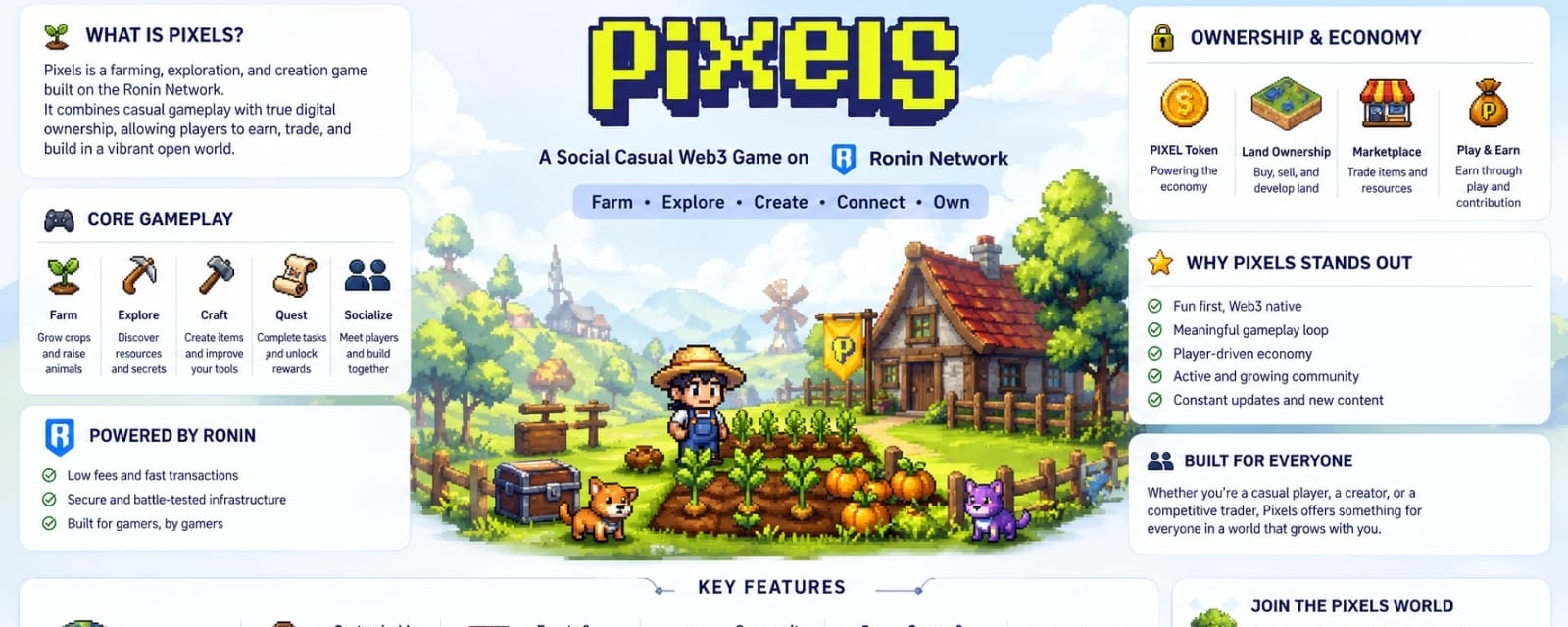
Look, Pixels is not the kind of Web3 game that wins you over with one big dramatic moment.
It does not feel like that.
It starts small. Almost too small. A farm. A few crops. A character walking around a bright little world. Some resources to collect. Some tasks to finish. Other players moving past you, probably doing the same thing. At first, it feels simple enough to ignore.
Then you come back.
That is the part that matters.
Honestly, crypto gaming has trained a lot of people to be suspicious. We have all seen the same pattern too many times. A project launches. The token gets loud. The community gets louder. Everyone talks about rewards, airdrops, future value, earning potential, land, assets, supply, staking, whatever else is being pushed that week.
Then you open the actual game.
And there is barely a game there.
Just menus. Wallet prompts. Empty promises. A few tasks that feel like chores. Maybe some ugly marketplace page pretending to be gameplay. Maybe a token economy already being farmed by bots before normal players even understand what is happening.
That is the trauma Pixels is walking into.
So when people talk about Pixels as a social casual Web3 game on Ronin, I don’t think the interesting part is only the token. PIXEL matters, sure. The blockchain layer matters. Ronin matters. But that is not what makes the whole thing feel worth discussing.
The interesting part is that Pixels tries to give the token somewhere to live.
That sounds basic.
It is basic.
But Web3 keeps forgetting the basics.
A token without a real world around it is just noise. A land system without a reason to care is just another asset page. A farming loop without feeling is just clicking. Pixels at least understands that before people care about ownership, they need something that feels worth owning.
The game gives you that in a quiet way. You plant. You harvest. You gather. You craft. You move through the world. You check what changed. You notice other people. You start building tiny habits around it.
It is not flashy.
It is just necessary.
The thing is, farming games already understand something crypto keeps trying to explain badly. Time has value. Effort has value. Ownership feels better when it is tied to memory. A small piece of land means more when you worked on it, arranged it, returned to it, and slowly made it feel like yours.
Pixels uses that old feeling and puts Web3 plumbing underneath it.
That plumbing is the important part, even if it is not the romantic part. Ronin gives the game infrastructure that actually works for gaming: wallets, assets, marketplace rails, and a player base that already knows what blockchain games feel like when they are done badly and when they are done with some care.
Is that enough by itself?
No.
A chain cannot save a boring game. A token cannot save a weak loop. A marketplace cannot create attachment. But good infrastructure can remove some of the usual pain. It can make the Web3 side feel less like a broken bridge you have to cross every five minutes.
And that matters because people are tired.
Tired of gas fees turning a small action into a financial decision. Tired of bridging assets and wondering if something will disappear into the void. Tired of games where the first boss fight is connecting the right wallet. Tired of airdrops that reward fake users better than real ones. Tired of bots eating the room before humans even sit down.
Pixels does not magically solve all of that.
But it is clearly built with those scars in mind.
You can feel it in the way the game has to think about reputation, bots, rewards, and player behavior. That stuff is messy. It is also unavoidable. In a normal farming game, a bot is annoying. In a Web3 farming game, a bot can poison the whole economy. If rewards have outside value, someone will try to drain them. That is just how this space works.
So Pixels has to deal with the mess under the hood.
Anti-bot systems. Reward tuning. Energy changes. Crafting adjustments. Land progression. Reputation signals. All the boring stuff that players complain about until it is missing.
Because without it, the game turns into a farm for farmers.
Not farmers as in players growing crops.
Farmers as in people extracting value and leaving nothing behind.
That is the danger with any Web3 game. If the economy becomes the whole point, the world dies. People stop playing and start calculating. Every crop becomes a yield decision. Every item becomes a spreadsheet cell. Every update becomes a question of whether the token pumps or dumps.
That is when the game stops being a place.
It becomes machinery.
Pixels is at its best when it avoids that. When it lets the game breathe. When someone can log in just to check their farm, wander around, finish a task, mess with their land, or see what other players are doing without feeling like every second needs to be optimized.
That sounds small, but it is not.
A real game needs useless moments. Little inefficient choices. People decorating badly because they like how something looks. Players doing tasks out of habit, not because a chart told them to. Friends standing around when they could be grinding. Someone returning after a few days just because they remembered something was waiting.
That is how a world starts to feel human.
Pixels has that possibility.
Not perfectly. Not always. And it might take time to get the balance right.
The team has to keep walking a thin line. Make the token useful, but not suffocating. Make rewards meaningful, but not easy to exploit. Add depth, but do not bury casual players under systems. Protect the economy, but do not make the game feel like a security checkpoint. Give land value, but do not make land the only thing anyone cares about.
That is hard to build.
And it is even harder to keep alive.
The Chapter 2 direction showed why this matters. More industries, more crafting, more resource systems, more ways for players to specialize. That is the kind of depth Pixels needs if it wants to last beyond curiosity. A farming game cannot survive forever on “plant crop, harvest crop, repeat.” Comfort is good. Stagnation is not.
But depth can also become clutter.
That is the risk.
Every new system has to earn its place. If the game adds too much without keeping the simple rhythm intact, it loses the thing that made people come back in the first place. Players should not need a finance degree and three Discord threads just to understand what to do next.
Look, this is where Pixels feels more honest than a lot of Web3 games. It is not trying to hide that there is an economy. There is. It is not pretending tokens do not matter. They do. It is not acting like digital ownership is some magical fix for everything. It isn’t.
But it is trying to build around a loop that already makes emotional sense.
Land makes sense in a farming game.
Resources make sense.
Crafting makes sense.
Scarcity makes sense.
Waiting makes sense.
Coming back makes sense.
That is why the Web3 layer does not feel completely forced here. The genre already teaches players that effort, time, and ownership are connected. Pixels just gives that connection blockchain rails.
Again, that does not make it perfect.
The Web3 side can still become too loud. The economy can still get weird. Bots can still be a problem. Casual players can still feel pushed out if things become too optimized. Token talk can still drown out the actual game if the community lets it.
But at least there is a game underneath.
That should not feel rare.
It does.
The social side helps too. Pixels is not only about sitting alone on your land. You see people moving around. You notice activity. You share space. Maybe you do not talk to everyone. Maybe most interactions are small. But the world feels occupied, and that changes everything.
A private farm is satisfying.
A farm inside a living world feels different.
It gives your progress a little more weight. Not because everyone is watching you, but because you are not building in an empty room. Other people are also there, chasing their own routines, making their own small decisions, shaping their own corners of the game.
That is the part crypto often misses. Community is not only Discord noise. It is not only raids, announcements, and reaction emojis. Sometimes community is just seeing other players exist in the same space and feeling like the world has a pulse.
Pixels has that pulse when it is working.
The pixel-art style helps because it does not try too hard. It is soft. Simple. Familiar. It leaves enough blank space for players to project themselves into the world. A hyper-polished game can impress you and still feel sterile. Pixels has a rougher charm. It feels easier to enter.
And maybe that is what Web3 gaming needs more of.
Less grand language.
More places that actually work.
Less obsession with the next huge promise.
More attention to the ordinary things that make someone come back tomorrow.
Because the real test for Pixels is not whether people try it once. Crypto can drive traffic. Ronin can bring attention. Token listings can create noise. Airdrops can pull crowds. None of that proves a game has staying power.
The test is whether someone returns when the noise gets quieter.
When the rewards are not the only story.
When the market is boring.
When there is no big announcement.
When it is just the player, the farm, the world, and whatever they were building yesterday.
That is where Pixels has a chance.
It gives people a reason to return that is not only financial. Not always deep. Not always dramatic. Just enough. A crop ready. A task unfinished. A piece of land to improve. A new system to understand. A few other players nearby. A sense that the world remembers you a little.
That feeling is underrated.
In Web3, everyone wants to talk about ownership. But ownership only matters when there is attachment. Otherwise, it is just a receipt.
Pixels is trying to create the attachment first.
That is why I think it stands out.
Not because it has solved everything. It hasn’t. Not because PIXEL is guaranteed to become something huge. Nobody can honestly say that. Not because every system is perfectly balanced. Live economies are messy, and this one will probably keep being messy.
But Pixels is doing something many crypto games skipped.
It is building the boring parts.
The plumbing.
The routine.
The social space.
The economy that has to be watched carefully.
The anti-bot work nobody wants to praise until it fails.
The small loops that make a player think, “I’ll check in for a minute,” and then somehow stay longer.
That is not a loud kind of success.
But it may be the kind that matters more.
Because after all the token talk, after the charts, after the airdrop hunters, after the bots, after the usual Web3 chaos, a game still has to answer one simple question:
Do people actually want to be there?
Pixels, at its best, gives a real answer.
Yes.
Not because it is perfect.
Because it feels like a place.