
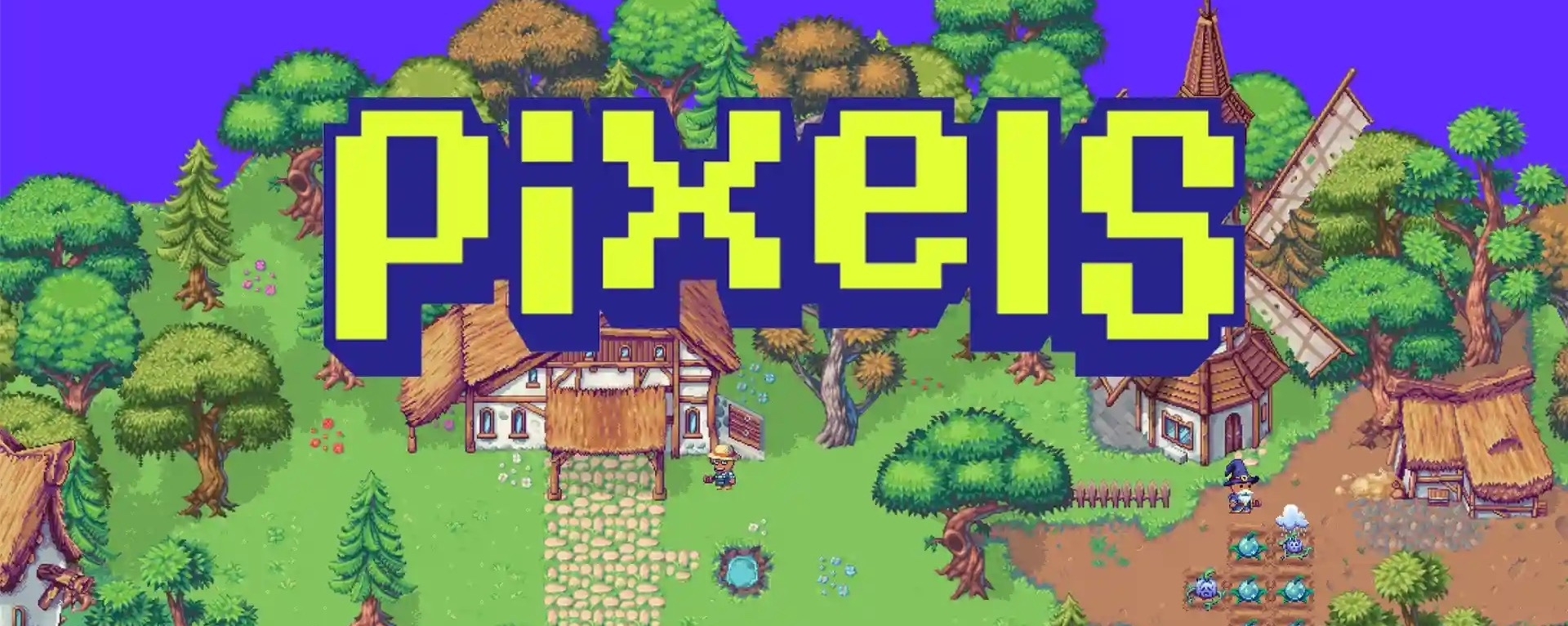

I remember the first time I stepped into something like Pixels on Ronin. It didn’t feel like onboarding into a financial experiment. It felt closer to something simpler almost familiar. A loop of planting, harvesting, upgrading, repeating. The kind of structure games have used for decades, before anyone started attaching tokens, liquidity, or “earn” to it.
At the beginning, everything feels clean in a way that’s easy to underestimate.
You don’t think in terms of efficiency yet. You don’t calculate yield per action or optimize time windows. You just move through the system and it responds in a predictable way. That predictability is important—it creates a kind of quiet trust. Not because the system is transparent in a deep sense, but because it hasn’t yet revealed enough complexity to make you question it.
Early simplicity often gets mistaken for fairness.
But I don’t think it’s fairness. It’s just low resolution. There isn’t enough surface area for contradiction yet.
And that’s the part I’ve learned to pay attention to—the moment when systems stop being experienced and start being analyzed.
In games like Pixels, or any Web3 economic loop dressed as a game, that transition is almost inevitable. At first, players participate. Later, they optimize. And once optimization becomes dominant, participation starts to feel like inefficiency.
I’ve seen this shift enough times to recognize its texture.
It’s subtle at first. A player stops planting what they like and starts planting what yields best per cycle. Another stops decorating or engaging socially and instead tracks cooldowns, reward timing, and extraction efficiency. No one announces the change. It just happens quietly, as if the system itself is nudging behavior toward legibility in economic terms.
What was once play becomes allocation.
And that’s where incentives begin doing real work—not as abstract design principles, but as behavioral gravity.
The system doesn’t need to force anything. It only needs to reward consistently enough that certain actions become statistically rational over others. Once that threshold is crossed, intent becomes secondary. People don’t ask “what do I want to do here?” anymore. They ask “what does the system want me to do if I want to not lose ground?”
It’s a small shift in phrasing, but it changes everything.
Over time, I start noticing something else: signals become harder to interpret.
In early stages, contribution is visible. Activity feels meaningful because there’s little noise. You see who is engaged, who is building, who is experimenting. But as optimization spreads, activity becomes less readable. The same action could mean very different things depending on the strategy behind it. A player harvesting might be participating casually, or they might be running a perfectly timed extraction cycle across multiple accounts.
From the outside, both look identical.
That’s where interpretation starts to break down.
And when interpretation breaks down, trust doesn’t collapse immediately it just becomes heavier. You stop assuming intent and start verifying patterns. You stop reading behavior at face value. Everything becomes conditional.
I think this is one of the quietest transformations in systems like this: trust doesn’t disappear, it becomes procedural.
At first, I assumed trust in these environments would be binary—either the system is fair or it isn’t. But that’s too simplistic. What actually happens is more layered. Trust shifts from being a background assumption to an ongoing calculation. You’re constantly updating it based on new signals: reward distribution changes, behavioral clustering, emergent farming strategies, policy adjustments.
It’s not that you stop trusting the system.
It’s that you never stop evaluating it.
And evaluation has a cost. Not in tokens or time, but in attention.
The more complex the incentive layer becomes, the more mental energy is required just to maintain a working model of what is “real” activity versus what is optimized extraction. And over time, that distinction itself begins to blur.
At some point, I start noticing inconsistencies—not dramatic failures, but small deviations. Slight inefficiencies that feel intentional. Players finding edge cases. Systems rewarding behavior that wasn’t explicitly intended but still technically valid. Nothing breaks, but something feels off in a way that’s hard to articulate.
These are the moments where doubt forms.
Not because the system fails, but because it works in too many directions at once.
And that’s more destabilizing than failure.
Because failure is clear. Optimization is ambiguous.
The platform, eventually, has to respond to this ambiguity. Not necessarily by changing rules drastically, but by adjusting incentives, tightening definitions of contribution, or introducing new layers of validation. Every adjustment, though, creates ripple effects. What was previously optimal becomes inefficient. What was ignored becomes dominant. Players adapt faster than systems stabilize.
And so the system is always slightly behind its own economy.
This creates an interesting tension: the more successful the game economy becomes, the more it must defend its own definitions of legitimacy.
At scale, the question is no longer “is this fun?” or even “is this fair?”
It becomes “what counts as participation?”
And that question never has a stable answer.
I find myself thinking about two tensions that keep resurfacing in these environments.
The first is participation versus extraction.
Participation implies presence without pure intent to maximize return. Extraction implies the opposite: presence as a function of return. In early phases, these overlap. People participate and incidentally extract value. Later, they extract and simulate participation only insofar as it remains necessary for optimization.
The second tension is trust versus verification.
In small systems, trust is cheap. You don’t need to verify every interaction. But as value accumulates, verification becomes unavoidable. And verification scales poorly. The more you verify, the more you assume distrust. The more you assume distrust, the more the system becomes adversarial in structure—even if no individual actor is malicious.
It’s not that players change. It’s that the environment changes how players are interpreted.
And then there’s a third tension that sits underneath both: stability versus adaptability.
A stable system is predictable, but becomes exploitable. An adaptable system responds to exploitation, but loses predictability. Web3 games like Pixels exist in this unstable middle zone, where every adjustment risks either freezing innovation or accelerating extraction loops.
What I find most interesting is that none of this feels dramatic from inside the system.
There’s no singular moment where trust breaks or where incentives collapse. Instead, there is a gradual accumulation of micro-adjustments in behavior. A quiet reconfiguration of what it means to “play” the game. And over time, the original framing the idea that this is a game at all starts to feel less certain.
It still functions. It still runs. People still log in, harvest, trade, optimize. But meaning becomes harder to locate.
And yet, the system doesn’t need stable meaning to continue operating.
It only needs stable incentives.
That distinction matters more than it initially appears.
Because incentives can sustain motion without sustaining belief. And belief is what most people assume is required for persistence. But in practice, systems like this often rely more on inertia than conviction.
I sometimes wonder if the most accurate way to describe these environments is not as games or economies, but as evolving negotiation spaces between human behavior and algorithmic structure. Neither side fully controls the outcome. Both adapt continuously. The result is something that feels alive, but not intentional in any human sense.
And maybe that’s where the discomfort comes from.
Not that the system is broken, but that it is too responsive without being fully understandable.
Even now, I can’t fully decide whether what I’m seeing is progress, decay, or just transformation. Players become more sophisticated, systems become more reactive, incentives become more precise—but something in the middle becomes harder to locate. A shared sense of what the activity is actually for.
And without that shared center, everything becomes interpretation.
Maybe that’s the point where trust stops being a property of the system and becomes a behavior of the participant.
Not “do I trust this system?”
But “how much interpretation am I willing to maintain before it stops feeling coherent?”
There isn’t a clean answer to that.
Only shifting thresholds.
And I suspect that’s what these systems always converge toward not resolution, but continuous adjustment. A space where participation and extraction are never fully separated, where trust is never fully granted or revoked, and where meaning is always partially constructed after the fact.
From the outside, it might look like growth or evolution. From the inside, it feels more like maintenance of uncertainty.
And even that framing might change later.
Nothing here feels fully settled.
