
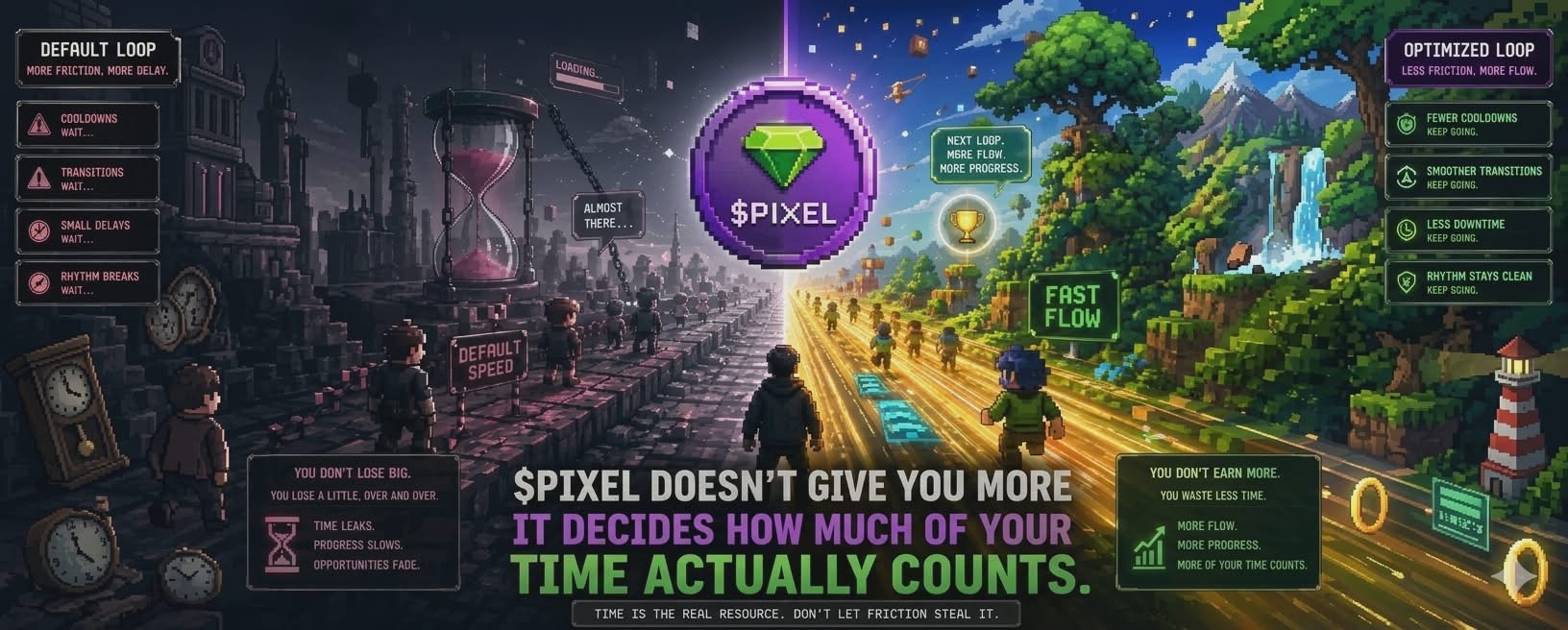
I didn’t notice it at first… and yeah, that’s probably exactly how it’s designed.
Pixels felt easy. Suspiciously easy. I’d log in, run my loops, collect, repeat. Smooth enough that I never stopped to question anything. No friction, no pressure, no moment where the system pushed back on me. It felt open, almost generous.
And I bought into that feeling.
But after a few more sessions, something started to feel slightly off. Not broken. Not blocked. Just… delayed. Like I was always moving, but never quite at the pace I thought I should be. It wasn’t obvious enough to complain about, but it was persistent enough to stay in the back of my mind.
That kind of feeling doesn’t come from nowhere.
I’ve felt it before. Not in games in markets.
There’s this moment traders know too well. You and someone else take the same setup, same logic, same timing. One of you gets filled perfectly, the other watches price move without them. I’ve been the one who missed it more times than I’d like to admit. And the worst part is realizing it wasn’t about being wrong.
It was about friction.
About being just a little slower. Just slightly out of position. Just delayed enough to lose the opportunity.
That’s when something clicked for me inside Pixels.
Pixel is not behaving like a reward token.
It’s behaving like a friction controller.
And once that idea landed, I couldn’t unsee it.
At the surface, Pixels looks like every other GameFi loop. You farm, you collect, you wait, you repeat. Clean system, low barrier, no one is locked out. It gives off this impression that everyone is playing under the same conditions.
But they’re not.
You only realize that after you stop looking at rewards and start paying attention to movement.
Players aren’t really chasing more tokens.
They’re chasing smoothness.
They want their loops to flow without interruption. They want fewer pauses, fewer resets, fewer moments where the system quietly breaks their rhythm. Because the second that rhythm breaks, everything feels slower even if nothing “changed” on the surface.
And here’s the part that actually matters.
Pixels doesn’t remove that friction.
It monetizes it.
There are tiny delays everywhere. Cooldowns, transitions, small waiting windows. Nothing aggressive, nothing that stops you from playing. That’s what makes it clever. You don’t fight the system .You just feel slightly out of sync with it.
Individually, those delays are nothing.
Stack them over hours?
They become the system.
I had a moment a couple days ago that made this painfully clear. I was running my usual loop same route, same actions and I hit one of those small waiting points. Normally I’d just ignore it. This time I didn’t. I actually paused and thought, why is this even here?
Then it hit me.
That tiny pause wasn’t there to stop me.
It was there to be noticed later.
Because once you notice where time is leaking, you can’t go back to playing the same way. You start seeing every delay, every break in flow, every unnecessary transition. And without realizing it, your mindset shifts.
You stop playing.
You start optimizing.
That’s where $PIXEL quietly enters the picture.
Not as a requirement. Not as a paywall. You can ignore it and the system will still function. You’ll still progress, still earn, still move forward.
But you’ll be doing it at default speed.
And default speed is a trap.
Not because it’s slow but because it feels normal.
Until you see someone else moving differently.
Smoother. Cleaner. Less stopping.
Not dramatically ahead… just consistently ahead.
That kind of difference doesn’t look important in a single session.
Over time, it compounds like crazy.
Because Pixels isn’t rewarding output the way people think. It’s rewarding how efficiently you cycle through that output. Two players can end the day with similar results, but one got there with less friction, less downtime, less wasted motion.
They didn’t do more.
They just lost less.
And that’s the part most people underestimate.
In a loop-based system, time isn’t just a factor.
It’s the main resource.
$PIXEL doesn’t increase your rewards directly. It increases how much of your time actually converts into progress. That’s a completely different dynamic than most people are used to.
At that point, it stops feeling like a game mechanic and starts feeling like infrastructure.
It reminds me of how networks handle transactions. Nothing is blocked. Everyone can participate. But not everything moves equally. Some transactions glide through, others sit and wait. The system stays “open,” but efficiency isn’t evenly distributed.
It’s the same thing I’ve seen on Binance during volatile moves. Everyone has access to the same market, but not everyone gets the same execution. Some orders go through instantly, others slip, lag, or miss entirely. The system is open but efficiency isn’t equal.
Pixels mirrors that idea almost perfectly.
Everyone can play.
But not everyone experiences the same system.
Some players operate close to an ideal state continuous, efficient, uninterrupted.
Others stay in the default loop functional, but constantly slowed in small, almost invisible ways.
No one is excluded.
But not everyone is equal.
And yeah, that’s where it gets uncomfortable.
Because this isn’t pay to win in the usual sense. You can’t just throw money at it and dominate. But you can buy a smoother experience. You can reduce friction. You can position yourself closer to the system’s optimal flow.
And once you understand that, you’re not just playing anymore.
You’re making decisions about friction, constantly.
Do I accept this delay?
Do I remove it?
Do I stay in the default loop, or do I step slightly outside it?
These aren’t big decisions. That’s what makes them powerful. They’re small, repeated, and easy to ignore. But they shape everything over time.
That’s where the real demand for pixel comes from.
Not hype.
Not narrative.
Behavior.
And here’s the part most people won’t say out loud.
Pixels isn’t selling rewards.
It’s selling positioning.
Positioning inside its own system.
If you’ve spent any time in markets, you already know how this ends. The people with better positioning don’t look special at first. They just move slightly cleaner, slightly earlier, slightly more efficiently.
Then one day, the gap is obvious.
Not because they worked harder.
But because they weren’t losing time the whole way through.
So if I strip everything down, this is the only line that really matters to me:
Pixel does not give you more.
It just decides how much of your time actually counts.
And once that clicks, the question changes completely.
You stop asking how much you can earn.
And you start asking something way more uncomfortable:
How much time have I already lost without realizing it?