
A tiny farm should not have this much weight on its shoulders.
That is the strange thing about Pixels. At first glance, it looks soft, simple, and almost harmless. A little pixel world. A character walking through fields. Crops growing. Resources waiting to be collected. Quests asking for attention. Other players moving around, probably doing the same small jobs you are doing.
Nothing about it looks like a major experiment.
And yet Pixels is carrying one of the most interesting questions in Web3 gaming right now: can a blockchain game feel like a real game before it feels like a crypto project?
That is what makes Pixels worth talking about.
Not because farming games are new. They are not. Players have loved farming games for decades because they offer something simple and strangely comforting. You begin with very little. You work a little. You wait. You return. You improve something. Slowly, a place that once felt empty begins to feel like yours.
Pixels takes that familiar feeling and places it inside a Web3 world powered by the Ronin Network. It combines farming, crafting, exploration, land ownership, quests, social interaction, and the PIXEL token. On the surface, it is a casual farming and creation game. Underneath, it is part of a much larger attempt to make digital ownership feel natural instead of forced.
That difference matters.
Many Web3 games have made the same mistake. They talk about tokens before they talk about fun. They show marketplaces before they show personality. They explain earning before they give players a reason to care. The result often feels cold, as if someone built a financial system first and then added trees, animals, and characters afterward.
Pixels works better when it does the opposite.
It starts with the farm.
You plant. You harvest. You gather. You craft. You complete tasks. You move through the world. You see other players. Slowly, you begin to understand how the economy fits around the game instead of having it pushed into your face from the first minute.
That is a more human way to bring people into Web3.
Most players do not want a blockchain lecture when they open a game. They want to know what they can actually do. Can I grow something? Can I build something? Can I own land? Can I trade? Can I play with others? Can I make progress without feeling lost?
Pixels answers those questions in a familiar way. Its pixel-art style helps too. The game does not feel heavy or intimidating. It has a colorful, approachable look that makes it easier for new players to enter the world without feeling like they need to understand crypto first.
At its core, Pixels is a social farming game. That means the world does not feel empty. Players are not hidden away on private farms with no connection to anyone else. The game has a shared-world feeling, and that gives it more life. You see people moving, working, gathering, visiting, trading, and participating in the same economy.
That social layer is one of the biggest reasons Pixels feels more alive than many Web3 games.
A token can create activity, but people create atmosphere.
That difference is important. A marketplace can make users buy and sell. Rewards can make users click. But community is what makes people return when the reward is no longer the only attraction. A player might come for the token once, but they come back for the place, the progress, the group, the routine, or the simple feeling that their little corner of the world is waiting for them.
Pixels has that possibility.
The PIXEL token is the main token of the ecosystem. It supports different in-game and ecosystem functions, including utility, governance, premium features, NFT-related activity, guild systems, and quality-of-life upgrades. It gives the game an economic layer that goes beyond a traditional farming game.
But this is also where things become complicated.
Tokens change how people behave.
In a normal farming game, a crop is just a crop. Maybe you need it for a recipe. Maybe you sell it for in-game coins. Maybe you grow it because you enjoy the routine.
In a Web3 game, that same crop can start to feel like part of a larger calculation. Players begin asking what earns more, what is more efficient, what holds better value, and what might matter later. That can be exciting, but it can also turn play into pressure.
Pixels has to be careful here.
If the token becomes too important, the game risks losing its charm. Farming should not feel like factory work. Crafting should not feel like accounting. Land should not feel only like an investment. The world needs to remain a world, not just a dashboard with cute graphics.
That is the challenge every Web3 game faces, and Pixels is no exception.
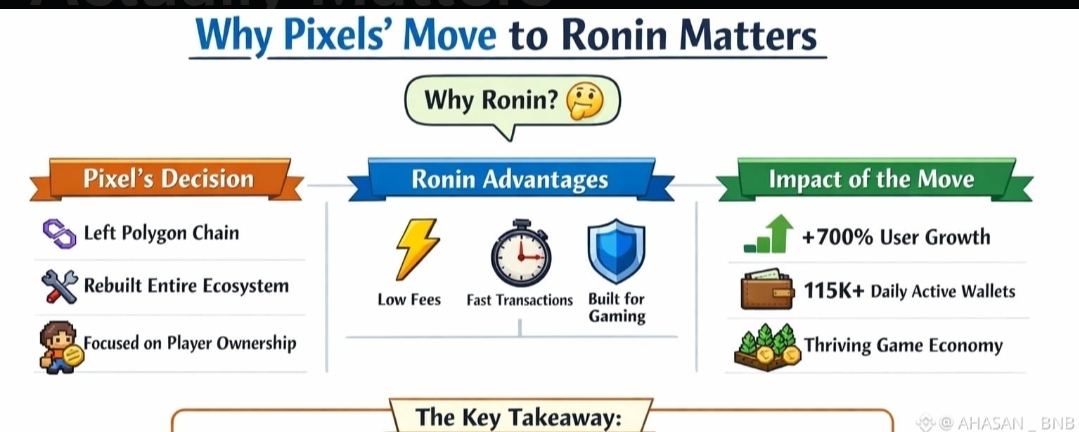
Its move to Ronin is an important part of the story. Ronin is a blockchain network focused on gaming, and it already has a Web3 gaming audience. For Pixels, Ronin offers stronger gaming infrastructure, a more suitable ecosystem, and a community that understands blockchain-based games.
That does not mean everything becomes easy. Web3 still has friction. Wallets, assets, transactions, and tokens can confuse new users. But Ronin gives Pixels a more natural home than a general-purpose blockchain would. It places the game inside an environment where gaming is the main focus, not an afterthought.
Still, technology only matters when it supports the experience.
Nobody keeps playing a farming game just because the network is impressive. They keep playing because the loop feels good. Because they planted something yesterday and want to harvest it today. Because they need one more item to finish a task. Because their land looks better than it did last week. Because a friend is also playing. Because the world has become part of their routine.
Pixels needs that feeling more than anything.
The farming theme is actually a smart choice for a Web3 game. Farming already works like an economy. You use resources to create other resources. You make decisions about time, effort, land, and production. You plan ahead. You wait. You improve slowly.
That fits Web3 better than many other game styles.
A farming game can teach economic ideas without sounding like a business lesson. Players naturally understand that some items take longer to produce. Some resources are more useful. Some choices are better for short-term progress, while others help later. You learn by doing.
That is the beauty of it.
Pixels does not need to explain every system with heavy language. A player can feel the system through simple actions.
Land is another important part of the game. In farming games, land is never just empty space. It becomes personal. Players organize it, improve it, decorate it, and slowly turn it into something that reflects their choices.
In Pixels, land also connects to digital ownership. That makes it more meaningful, but also more difficult to balance.
Ownership sounds great until a game has to manage it.
If land gives too much advantage, newer players may feel left behind. If it gives too little, landowners may feel disappointed. If assets become too powerful, the economy can become unfair. If everything is too equal, ownership may feel pointless.
That is a difficult line to walk.
Traditional games can change rules whenever they need to. Web3 games have to be more careful because players may own assets that carry real value. A balance update is no longer just a balance update. It can affect expectations, marketplaces, and trust.
This is why Pixels is more complex than it looks.
A simple farm can hide a very serious design problem.
The game’s Chapter 2 changes show that the team is thinking about these issues. Pixels adjusted its economy to reduce pressure on PIXEL, rethink the role of BERRY, and make rewards more connected to strategy and cooperation. That kind of change may not sound exciting to casual readers, but it matters because it shows the team is trying to protect the game from becoming only a reward machine.
That is important.
Early play-to-earn games often gave too much away too quickly. People joined, earned, sold, and left. The economy depended on constant new attention. Once that attention slowed, the system became weak.
Pixels appears to be trying to build something more controlled.
It wants rewards, but not reckless rewards. It wants ownership, but not chaos. It wants an economy, but not one that consumes the game itself.
That balance will decide its future.
The best version of Pixels is easy to imagine. It is a busy, friendly farming world where people play because they enjoy the rhythm. They own things, trade things, earn things, and take part in the economy, but the game still feels like a place first. Players return because their land matters to them. Because their guild needs them. Because there is something to finish. Because the world feels active.
The weaker version is also easy to imagine. Pixels becomes mostly about the token. Players stop talking about the world and only talk about rewards. Every update becomes a price discussion. Every action becomes a calculation. The farm turns into a workplace.
That would be a loss, because Pixels has more personality than that.
What makes it stand out is not just PIXEL, Ronin, or Web3 ownership. It is the way the game uses a simple and familiar format to make these ideas less intimidating. Farming gives people a gentle way into a complicated space.
That may be the real lesson here.
Web3 gaming does not need to feel like a pitch deck. It does not need to shout about revolution every few seconds. It does not need to turn every player into a trader. The best version of Web3 gaming may be quieter than that. It may look like a small world where people build, trade, socialize, own, and return because the place feels worth returning to.
Pixels has not solved every problem. No game in this space has. It still has to manage token pressure, player expectations, economic balance, land utility, onboarding, and long-term retention. Those are serious challenges.
But Pixels is at least asking the right question.
Not, “How do we make people earn?”
Not, “How do we create hype?”
Not, “How do we make every item financial?”
The better question is this: how do we make ownership support play instead of replacing it?
That is where Pixels becomes interesting.
Because underneath the crops, quests, land, and pixel art, this game is testing whether Web3 can become normal enough to be enjoyable. Not loud. Not confusing. Not dressed up in empty promises. Just useful, social, and woven into the game in a way that feels natural.
A player may enter Pixels to farm. They may stay because they own something. They may return because they feel connected to the world.
And if that happens, even a tiny digital farm can become something much bigger than it first appears.