
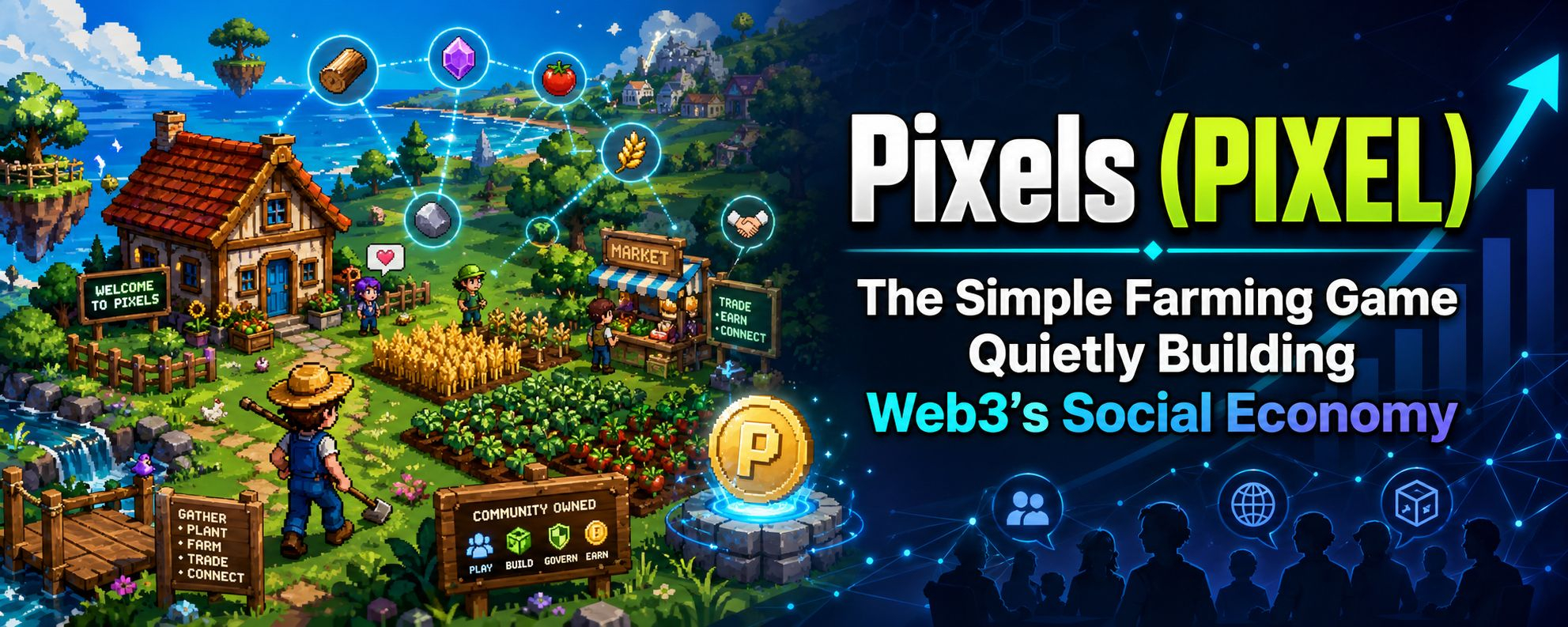
Sometimes the strongest Web3 stories do not begin with loud promises, complicated DeFi models, or futuristic graphics. Sometimes they begin with something as simple as planting crops, collecting resources, walking around a digital world, and meeting other players who are also trying to build something of their own. That is why I believe Pixels deserves real attention. On the surface, it looks like a casual farming game. But when I look deeper, I see something more meaningful: a social, player-driven economy that makes Web3 feel less intimidating and more human.
Pixels is built around farming, exploration, creation, quests, and community interaction. That may sound simple, but I see this simplicity as one of its biggest strengths. A lot of blockchain games make the mistake of trying to impress people with complex systems before giving them a reason to care. Pixels does the opposite. It gives players something familiar first. You plant, harvest, craft, upgrade, trade, explore, and slowly become part of the world.
I pay attention to this because normal users do not enter gaming through tokenomics. They enter through enjoyment. They stay because the game gives them progress, identity, and a reason to return. If a player has to understand every technical detail before having fun, the game has already lost most of its audience. Pixels feels different because the Web3 layer does not have to be the first thing a player notices. The game loop comes first. Ownership comes after.
That matters.
Pixels runs on Ronin, a network already known for Web3 gaming. I see this as important because a social farming game needs constant activity. Players are not just making one transaction and leaving. They are farming, crafting, moving items, completing tasks, and interacting with land and other users. For that kind of world, the experience has to feel smooth. If every action feels slow or expensive, the social economy breaks before it can grow.
What interests me most is the idea of a player-owned economy. In traditional games, players can spend hundreds of hours building progress, but most of that value remains locked inside the company’s system. You may own your account emotionally, but not really economically. Pixels tries to shift that relationship. Land, items, rewards, and token-based systems give players a stronger connection to what they build inside the game.
I see this as the real story behind Pixels.
It is not only about farming crops. It is about giving players a role inside a living economy. When people gather resources, trade items, build relationships, and participate in events, they are not just consuming content. They are helping shape the world. That is where Web3 gaming becomes interesting to me. The player is no longer only a user. The player becomes part of the system.
Of course, this also creates pressure. A player-owned economy has to be balanced carefully. If rewards become too aggressive, the game can turn into a farming machine where people only care about extraction. If rewards are too weak, players may lose interest. I believe Pixels has to keep walking this line carefully. The long-term strength of the project will depend on whether people keep playing because they enjoy the world, not only because they expect financial upside.
That is a major lesson for Web3 gaming.
Fun must come before earning. Community must come before speculation. A token can support the economy, but it cannot replace the emotional reason people play. I am watching this closely because many earlier play-to-earn games failed by making money the main attraction. Once the rewards dropped, the attention disappeared. Pixels has a better chance because its foundation is social and casual. Farming games naturally encourage routine, patience, creativity, and interaction.
Another thing I like is that Pixels does not need to look overly serious to be important. In crypto, people often assume valuable projects must sound technical. But sometimes a simple product reaches more people than a complicated one. A farming game can teach ownership better than a whitepaper. A marketplace can become easier to understand when it is connected to items players actually use. A token makes more sense when it supports real activity inside a world people already care about.
That is why this topic matters now.
Web3 gaming is still rebuilding trust. Players have seen too many projects promise massive rewards and deliver weak gameplay. Investors have seen too many economies collapse because they were built on hype instead of behavior. Pixels represents a more practical direction. It does not need to convince everyone with theory. It can prove itself through daily activity, player retention, community culture, and the strength of its in-game economy.
I believe the future of Web3 games will belong to projects that feel less like financial products and more like real digital worlds. Pixels is trying to move in that direction. It takes something familiar, farming and social play, and connects it with ownership, rewards, and player participation.
That combination is powerful when done correctly.
In the end, Pixels is not interesting because farming is complicated. It is interesting because farming is simple, social, and easy to understand. People know how to build, collect, trade, and improve. Pixels uses that natural behavior and adds a Web3 layer that can make the experience more meaningful.
I see Pixels as a reminder that Web3 does not always need to shout. Sometimes it can grow quietly through communities, habits, and small daily actions. A player plants something. Another player trades. Someone upgrades land. Someone joins an event. Slowly, an economy forms.
That is why I am watching Pixels closely. It makes Web3 gaming feel less cold and more alive. And in a space full of noise, that kind of simplicity may become its biggest advantage.
