

I've been in this crypto game for a decade, and I've gotten used to the narrative rhythm of 'opening at the peak and closing at zero.' Back in the day, we talked about 'changing the world' and 'the decentralized utopia.' Then, everyone dropped the act and started discussing 'gold farming,' Axie, and how to improve life in Southeast Asian farms with just a few clicks. But let's be real, back then, Web3 gaming was like a massive, outdoor, even somewhat heartwarming Ponzi feast. We all knew that as long as there were folks willing to dive in for those pixel blocks, the drinks on the table wouldn’t stop flowing.
But all parties must come to an end eventually, or say, the liquor runs out.
I recently flipped through Pixels' newly released V3 whitepaper. After reading it, I lit a cigarette, feeling quite complex inside. This isn’t any game manual; it's a cold, almost corporate 'internet user acquisition KPI assessment handbook.' It marks the end of an era: the time when simply 'painting a dream' and 'emotions' could make freeloaders rich is completely dead in the hands of this precise calculator.
What does Pixels want?
There's an interesting term in the whitepaper called RORS. Put simply, it's the 'gold investment return ratio.' The project team now stands at the entrance with an abacus, watching every person who enters. Previously, you came in to farm, and they gave you tokens, and everyone was happy. Now they have to calculate: if I give you one dollar's worth of tokens, can you return me ten cents of value through buying VIP, skins, or bringing in new users? If your return is only eighty cents, you're seen as a 'vampire,' and they’ll cut your connection or give you tokens that can only be spent within the game.
This transition is pretty brutal. It shatters the previous 'come in and pick up money' FOMO illusion. In Pixels' new logic, you are no longer an 'early contributor'; you are just a quantified 'data label.'
Look at it from another perspective.
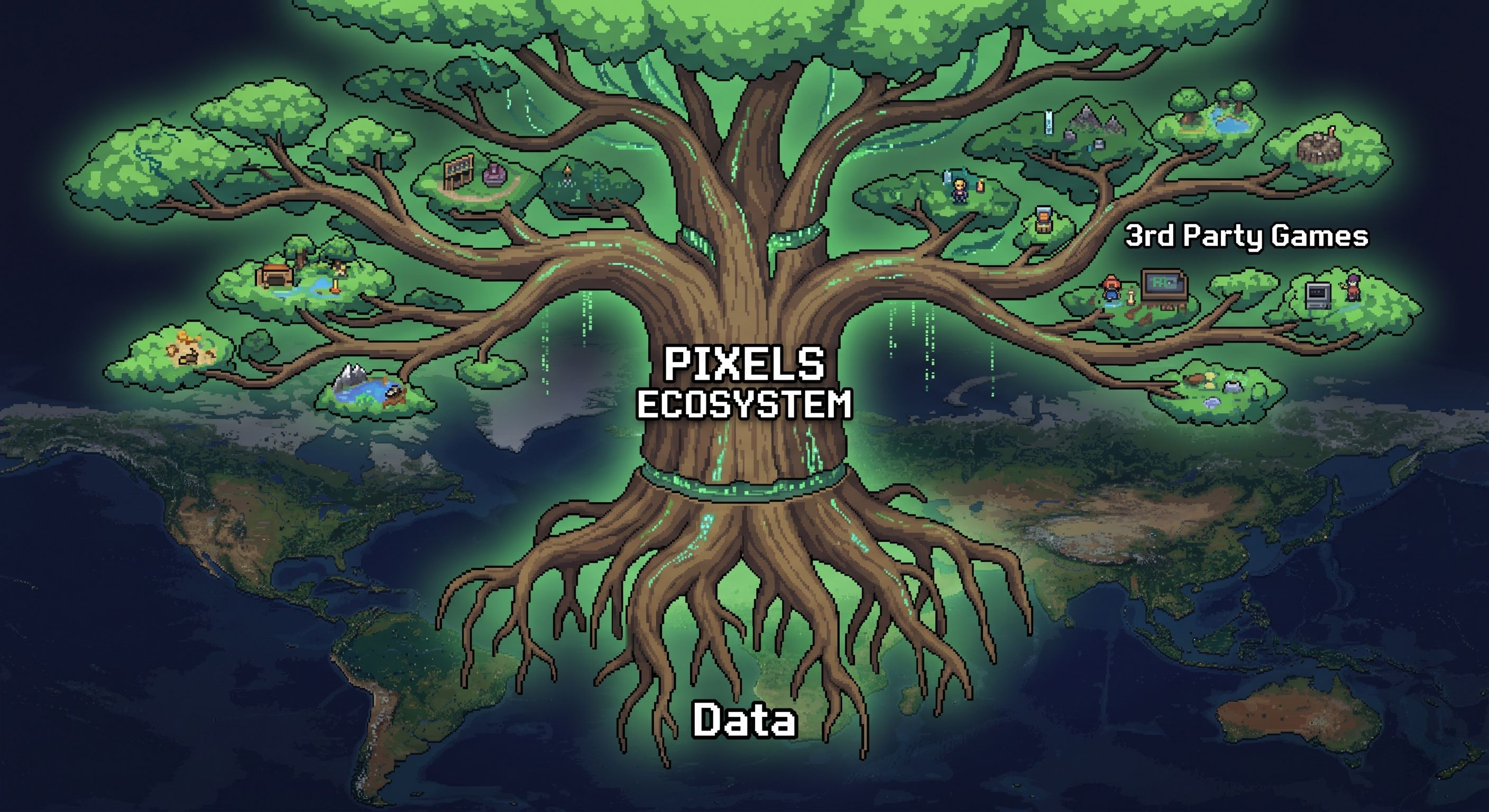
If you see Pixels as a game, you might think it's becoming more stingy and boring. But if you view it as an 'on-chain advertising intermediary alliance,' everything makes sense. It mentions in the whitepaper that it wants to become a 'decentralized AppsFlyer;' sounds fancy, but it essentially wants to be the middleman profiting from the price difference. It helps other games find users, using PIXEL tokens as bait, herding players like cattle into different games.
Its logic is clear: I have data, and I know who the real spenders are and who just clicks the mouse. I sell this data to game developers in desperate need of traffic and take a cut.

But what's this called?
This is what we call 'Web2 resurrecting itself.' We used to mock Web2 companies for selling users as products, and after all the fuss, the leaders in Web3 discovered that the safest way to make money is still to sell users as data packets to advertisers. Just this time, they’ve made the whole process more transparent and harder to refuse with code and tokens.
Pixels' whitepaper spends a lot of time figuring out how to reward those who actually spend money, not just the freeloaders who come in to click a few times. They created vPIXEL, a non-withdrawable utility token. The meaning is clear: want to freeload? Sure, but any money you earn here must be spent back on my project or my brother's. Want to cash out and leave? Sorry, you’ll first need to pay a hefty 'toll,' which they call the Farmer Fee.
This extreme sense of 'stinginess' actually makes me feel the project team is quite honest.
In this hypocritical circle that constantly shouts about the 'metaverse dream,' Pixels has boldly written 'I am just here to calculate' on its face. It no longer talks about gameplay; it simply checks whether you spend more in this system than the tokens it gave you. This is a counter-narrative. It acknowledges that the essence of Web3 games is indeed a battle for traffic and admits that tokens, if not tied to real consumption, will ultimately just be a pile of worthless paper.
Can this model succeed?
The whitepaper mentions that their gold investment return ratio is now 0.8. That means for every dollar's worth of tokens issued, the ecosystem can reclaim eighty cents. Their goal is to surpass 1.0. As long as they cross this threshold, this perpetual motion machine can be considered operational. But there's a huge blind spot: if a game becomes as detailed as a job, and every action has to be measured for its investment return ratio, can it even be called a game?
Players are here to find joy, not to become KPI metrics.
Once the 'freeloaders getting rich' dream shatters, can the remaining pixelated micro-farm of Pixels really retain those users spoiled by Web2 games? I have my doubts. The current Pixels feels more like a meticulously crafted social experiment draped in a game facade. It tests the limits of human nature: without the expectation of windfall profits, how much time are people willing to spend for that meager rebate?
The project teams have gotten smarter now.
They've learned to use the most boring Web2 business logic to counter human nature. Previously, it was a cat-and-mouse game between project teams and the exploiters; now, the project teams have turned the cat into a supervisor. Want to stake tokens? Fine, I’ll give you voting rights to decide which game gets a bigger 'user acquisition budget.' You own land? Great, I’ll give you extra staking bonuses.
Essentially, this shifts the risk onto the holders. If the game you staked in flops or fails to convert the marketing budget into real income, your returns will shrink. The project team acts as the referee, making players the risk bearers.
Lastly, let me speak from the heart.
Pixels is undergoing a painful transformation from a 'gold farming Ponzi' to a 'user acquisition factory.' It’s trying to pull the tubes out from those vampires and forcibly move the ecosystem to an operating table called 'sustainability.' Whether this surgery succeeds or not, it doesn't depend on code but on human nature.
We veterans have seen plenty of projects that have 'become unrecognizable to survive.' Pixels is very much like that now. It’s becoming less like a game and more like a financial report. This extreme realism may allow it to survive longer in this scam-filled industry, but it also means it has lost that thrilling romanticism.
Don't expect this game to return to the FOMO era when everyone was madly farming gold. It’s turning into an on-chain abacus, where every bead moved represents the harvesting or distribution of surplus value called 'traffic.' In this world, code doesn't lie, but it also doesn't offer warmth. It only tells you whether your RORS meets the standard today.
Ponzi schemes always collapse, but advertising intermediaries will always profit. Pixels has chosen the safest, yet most boring path. For us spectators, this might be a cold ending to an era; but for those still gambling in the arena, this is probably the conclusion they must accept, named 'Web3 realism.'
As for whether you should buy this token?
Don’t kid yourself; veterans never give advice. I just stand by the operating table, watching this precise machine gradually consume the last illusions. In this world full of gold farming vampires, project teams have finally learned not to act like saints but to be competent creditors. This is probably the only evolution in this industry.