
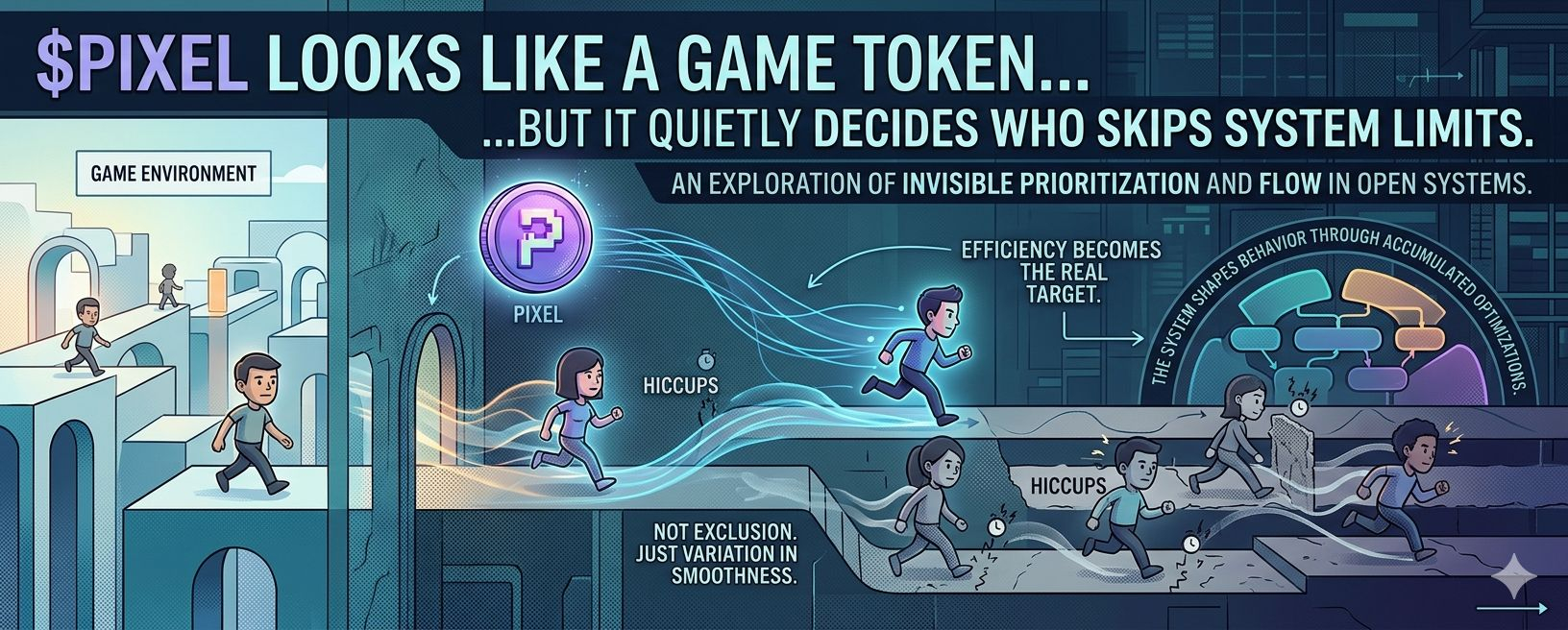
There’s a pattern in systems that feel completely open — they rarely announce where the limits actually are.
At the start, everything looks available. You move freely, interact normally, nothing resists you in any visible way. It feels like a space without pressure, almost neutral. And because nothing interrupts you, you assume nothing is being prioritized either.
But that assumption only works until you spend enough time inside it.
Then you start noticing something harder to describe.
Not restriction. Not blockage.
Just differences in how smoothly things happen.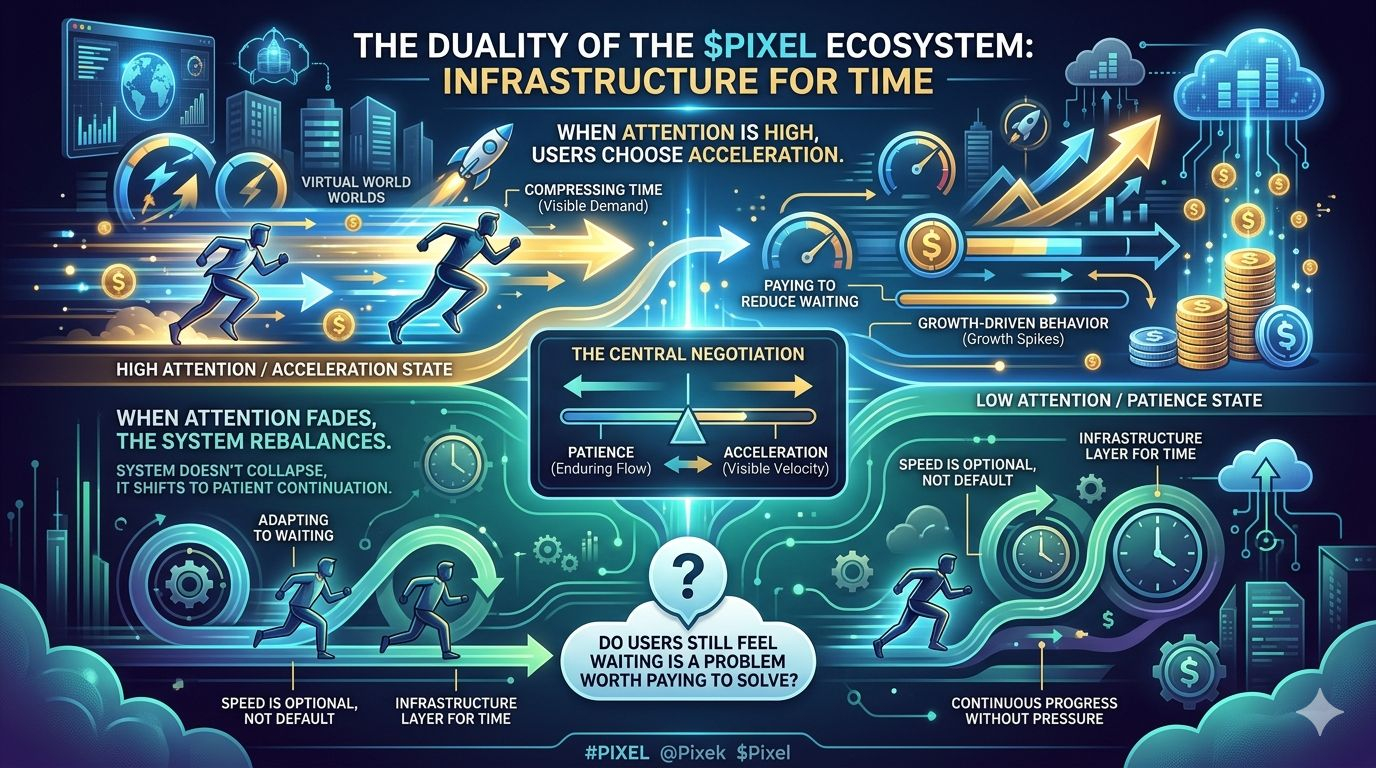
Some actions pass through instantly. Others feel slightly delayed, like the system is adjusting something in the background that you’re not fully seeing. Nothing dramatic. Nothing obvious. Just enough to interrupt the sense of continuous flow.
And flow is something you only realize you were relying on once it changes.
At first, Pixel doesn’t look like anything beyond a standard game token inside a familiar loop. Tasks, progression, rewards, repetition — the usual structure. Everything feels intentionally light, almost designed to keep attention relaxed rather than focused.
You don’t question it, because nothing is asking to be questioned.
But over time, behavior inside the system starts to reveal something else.
Players aren’t really reacting to rewards as much as they’re reacting to continuity.
The ability to keep moving without interruption becomes more important than what is actually being earned.
That shift is subtle enough that it doesn’t register as a decision. It shows up instead as preference. Then habit. Then optimization.
Fewer pauses.
Fewer breaks in rhythm.
Fewer moments where momentum drops.
And slowly, without anyone stating it directly, efficiency starts replacing output as the real target.
That’s where $PIXEL begins to feel less like a reward layer and more like something positioned around flow itself.
Not controlling actions. Not restricting access.
Just sitting close enough to influence how movement feels between actions.
I’ve seen similar behavior in other systems where everything appears equally accessible, but performance changes under load. Markets behave like that when timing becomes critical. Infrastructure behaves like that when demand concentrates. Even open networks develop invisible prioritization without ever changing the formal rules.
Nothing is explicitly blocked. But not everything moves at the same speed.
And speed, in systems like this, quietly becomes a form of structure.
What makes this harder to notice is that the system never points at it directly. There’s no moment where you’re told that smoother flow matters more. You only realize it indirectly, through how you start adjusting yourself.
You begin to notice where time is lost. Where actions don’t connect cleanly. Where small interruptions accumulate just enough to break rhythm.
And then you start optimizing around that.
Not consciously at first. More like gradual alignment.
Choose this path instead.
Skip that delay.
Avoid that interruption.
Stay inside smoother loops.
Individually, none of these choices feel meaningful. But systems are rarely shaped by individual choices. They’re shaped by repetition — by the accumulation of small optimizations pointing in the same direction.
And here, that direction quietly becomes continuity over everything else.
What’s interesting is that nothing about the system needs to feel unfair for this to happen. Access remains open. Participation remains equal. Progress remains possible for everyone.
But the experience of moving through that progress is not identical.
Some participants stay closer to uninterrupted flow. Others exist in the same system but with more friction between steps. Not exclusion. Just variation in smoothness.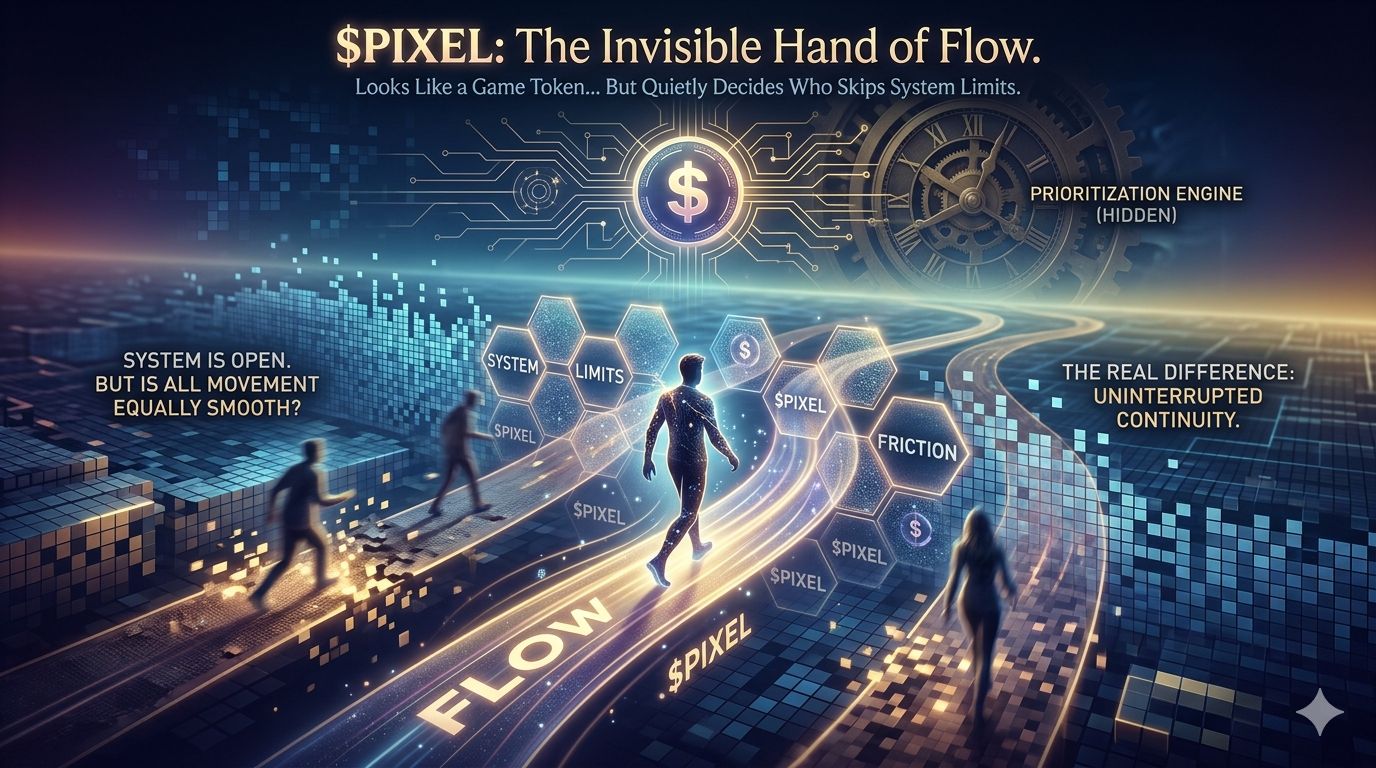
And over time, that variation compounds in ways that are hard to measure but easy to feel.
$PIXEL sits inside that gap — not as something loudly shaping outcomes, but as something that seems closer to shaping how much resistance exists between outcomes.
Which means the real difference is not what players are doing.
It’s how uninterrupted they can remain while doing it.
And that raises a quiet question that never fully resolves.
If the system is open, but not all movement inside it feels equally smooth, then what exactly is being distributed?
Opportunity… or the conditions to act on it without interruption?
It’s not obvious where that line sits.
And maybe it’s not meant to be.
Because the most interesting systems are rarely the ones that tell you what they are doing.
They’re the ones where you only realize what changed after your own behavior has already adjusted to it.
