
Someone in a chat channel of a virtual market said 'out of stock.' Ten minutes later, the price of similar resources jumped nearly 20%. Thirty minutes later, the price came back.
This isn’t abnormal. It’s happened several times: someone shouts, the price moves, and newcomers push the price back down. A complete price pulse, with the window not exceeding forty-five minutes.
In this window, those who act first profit, while those who act later fill the gaps.
In the Pixels market, this isn’t a matter of luck. It’s a designed channel for advantage transfer.
If you’re at the front of the window, your profits double. If you’re at the end of the window, you’re just catching the bag.
To diagnose this phenomenon, there’s really only one core question: Does information count as game assets?
The economic layer of Pixels runs on-chain. Every transaction is confirmed by the blockchain, and resource output has a hard cap (fixed node refresh rate), with the input-output ratio of the crafting chain written in stone. This means the supply side is predictable—how many Popberries you plant, how much Syrup you refine, the system has already framed the boundaries.
But the demand side isn’t. Demand is alive, driven by player behavior. When a 'shortage' signal pops up in chat, it doesn’t trigger a systemic supply change but rather a concentrated release of player demand. Essentially, it’s an expectation-driven demand shock—similar to 'panic buying' in real markets, just scaled down to a game server.
Technically, this creates a classic information arbitrage window. The signal sender (or the person who reads the signal first) builds their position before the price shift, the mid-window players chase the spike, and those at the end of the window take the bag when the price reverts. Profits shift from the end to the front, and the transfer channel is the time lag of information.
In Pixels, it's a solo grind; you’ve got to figure out what to buy and when to sell through trial and error. The cost of trial and error is your information tax. But if you’re in a small group, just by keeping an eye on two or three active players, you basically have a real-time signal source. Same set of on-chain contracts, same production mechanism, but totally different outputs—not because someone works harder, but because someone got the info first. Information asymmetry equals profit disparity; this is a structural issue, not an operational one.
This is the same math as liquidity pool incentives in DeFi. In the first few hours after incentives launch, TVL is low, but actual yields are extremely high (Yield = Reward Pool/TVL; smaller denominator means larger value). Big players get in early, share info, and in one day, TVL balloons 3-5 times, causing a massive surge in the denominator and a rapid collapse in yields. Latecomers are left with scraps. Pixels just brought this formula into the game—substituting TVL with market order volume and yield with resource price differences, maintaining the same mechanism.
Farm airdrops won’t escape this curve either. The best route can yield 80-100% APY in the first 24 hours, but after 48 hours of information diffusion, it drops below 30%. The rate of decay is positively correlated with the speed of information spread—the faster the spread, the shorter the window. Those who arrive first get the meat; the price fluctuations triggered by chat signals in the game follow the same information decay function.
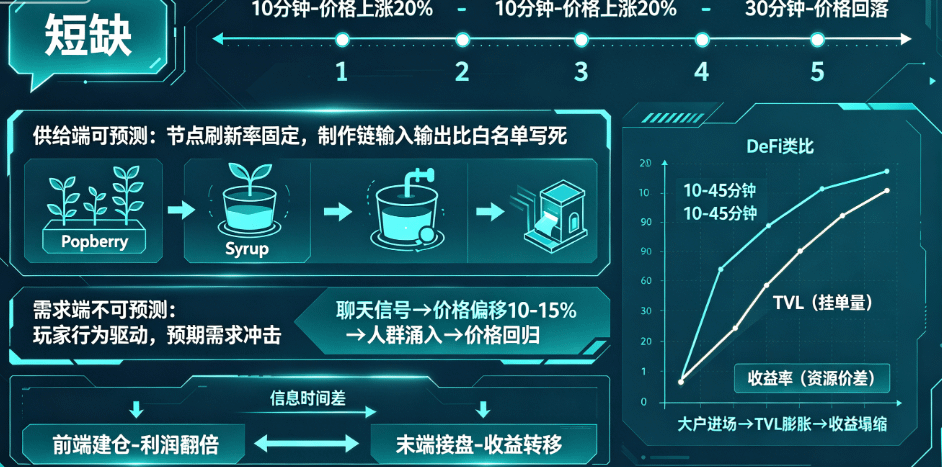
So is this ‘social functionality’ or ‘core economic mechanism’?
If it were just social, it wouldn’t impact economic output so precisely. If it were purely random, the same rhythm wouldn’t repeat with similar amplitudes and cycles 5-6 times. From a system design perspective, Pixels doesn’t limit how chat influences trading behavior, nor does it smooth out short-term price fluctuations (like trading cooldowns or price buffers). This means the information → behavior → price transmission chain is completely open. Openness doesn’t equal design intent, but in an economic system, not blocking = tacit approval.
Pixels doesn’t explicitly tell you 'build a network to earn more.' There are no tutorials, no hints. But the reward system quietly allocates advantages to players who are better connected, quicker to react, and earlier to gather information. The game measures not just what you did, but what you know—and how early you knew it.
This is what’s unsettling. Newbies aren’t just behind on resources; they’re behind on information. And this gap isn’t something you can bridge by grinding a few extra hours—because grinding solves a supply issue, whereas information asymmetry is a structural disadvantage on the demand side.
When blockchain games embed 'information slots' into their economic systems, they’re essentially doing something very real: they’re writing social structures into code.
Cyber farmers, your position in the information flow is your return on investment. Holders of $BTC enjoy the network effect, while the steadfast of $ETH survive on information asymmetry—essentially, it’s all the same game.
Here’s the kicker: when a game subtly rewards 'who you know' rather than 'what you did,' is it still a game?