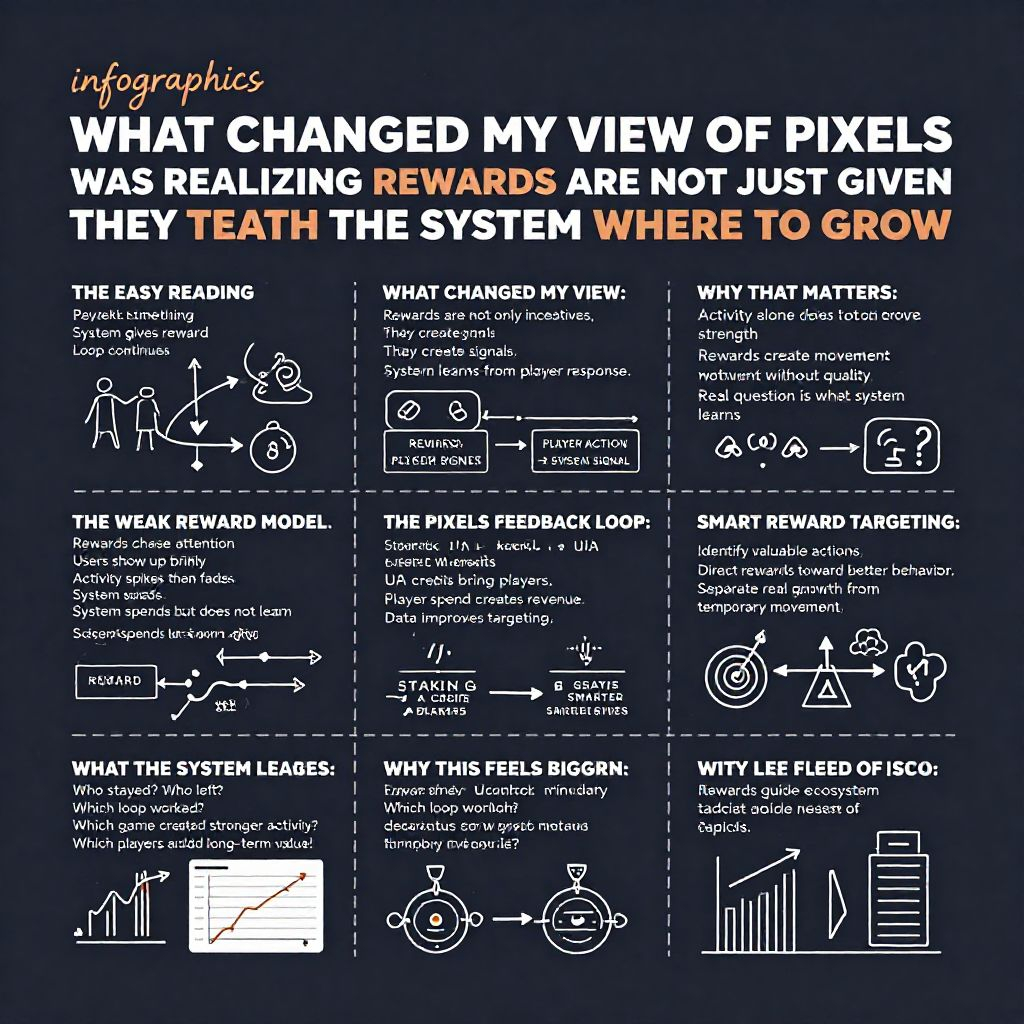
I used to read rewards in Pixels in the most basic way.
A player does something.
The system gives something back.
The loop continues.
That is the easy reading. And honestly, that is how most people still look at rewards in games. Rewards are treated like fuel. Give players enough reason to show up, and activity starts moving. But the more I looked at Pixels’ official direction, the less rewards felt like simple incentives and the more they started looking like signals. Not just something the system gives out, but something the system can learn from.
That is where Pixels started reading differently to me.
What changed my view was the way Pixels connects rewards with data, spend, retention, and ecosystem growth. The official whitepaper does not describe rewards like random giveaways. It describes a loop where staked $PIXEL becomes user acquisition credits, those credits bring players in, player spend creates revenue, revenue flows back into staker rewards, and the data from those actions makes future targeting smarter.
That means rewards are not just leaving the system as costs.
They are also creating information about what actually works.
That difference matters to me.
Because a weak reward system only asks one question: how do we get people to show up? That can create attention for a while, but it does not always create quality. People come for the reward, take what they can, and leave when the next opportunity looks better. The system may look active from the outside, but it is not necessarily becoming stronger. It is just spending.
That is where a lot of projects lose me.
They confuse reward distribution with growth. They think more incentives automatically means more strength. But if those rewards are not teaching the system anything useful, then the whole thing can become expensive noise. You get activity, but not insight. You get movement, but not direction. You get users, but not always the kind of users who actually make the ecosystem healthier.
Pixels feels more interesting to me because the reward logic is tied to feedback.
If a reward brings in players who stay, spend, play deeper, and create value, that tells the system something. If a reward only attracts short-term extraction, that also tells the system something. This is the part I think many people miss. The reward itself is only the visible layer. The deeper layer is what the system learns after that reward is spent.
Who stayed?
Who left?
Which loop worked?
Which game created stronger activity?
Which type of player actually added long-term value?
That is where rewards stop looking like giveaways to me.
They start looking like a learning mechanism.
Pixels’ whitepaper calls this Smart Reward Targeting, where the system uses data-driven infrastructure to identify actions that create long-term value and direct rewards toward those actions. To me, that is a much stronger idea than simply saying rewards exist. It means the system is trying to become more selective over time. It is not only asking how to distribute value. It is asking where that value actually produces the strongest return.
That difference matters more than people admit.
Because in gaming, rewards can easily become a trap. If they are too loose, they attract farmers. If they are too weak, players lose interest. If they are too random, the system never really learns. The harder problem is not giving rewards. The harder problem is knowing which rewards actually improve the ecosystem.
That is where Pixels starts feeling more serious to me.
It seems to be trying to turn rewards into part of a wider feedback loop. And once you see that, the publishing angle becomes more important too. Pixels is not only thinking about one game anymore. Its staking model is built around games competing for support. Players can stake into game pools, and games compete by showing stronger retention, better in-game spend, and better use of ecosystem tools.
That changes the meaning of rewards again.
Rewards are no longer just attached to one farming loop. They become part of how the ecosystem decides which games deserve more resources. A weak ecosystem rewards activity because activity looks good. A stronger ecosystem rewards activity that proves something.
It wants evidence.
It wants retention.
It wants spend.
It wants healthier loops.
That is why I think the real story here is not simply “Pixels rewards players.” That line feels too small. The better reading is that Pixels is trying to use rewards to discover where growth should go next.
That is the part that stayed with me.
The more I think about it, the more rewards in Pixels feel like a conversation between the player and the system. The player responds to incentives. The system watches the response. Then the system learns where future incentives should go.
If that loop works, rewards become more than motivation.
They become market feedback.
They become player-quality signals.
They become a way to separate real growth from temporary movement.
For me, that is where Pixels starts feeling more thoughtful.
Not when rewards make the game look active.
When rewards start helping the system understand what is actually worth scaling.