
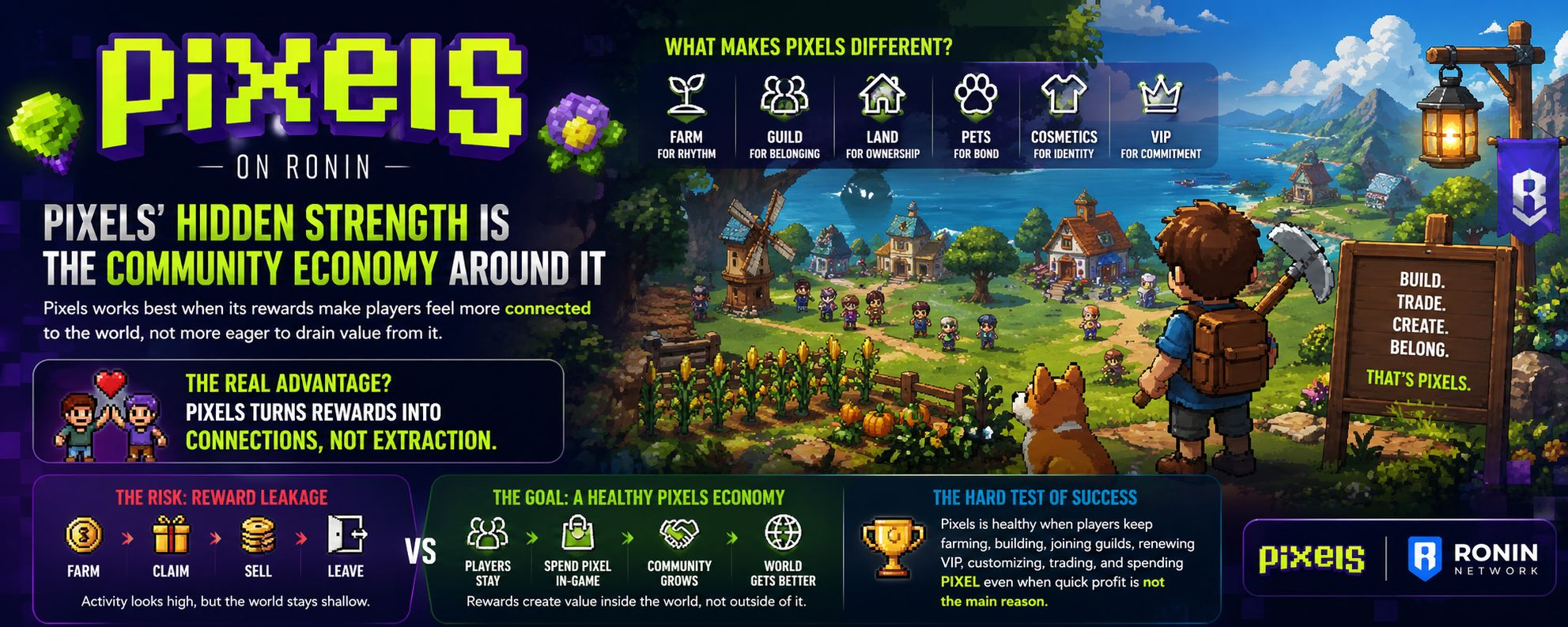
Pixels works best when its rewards make players feel more connected to the world, not more eager to drain value from it.
That is the part many people miss. A lot of Web3 games look active on the surface. People connect wallets, complete tasks, claim rewards, and move on. The numbers may look good, but the world itself can feel empty. There is activity, but not much attachment.
Pixels feels stronger because it is not only asking players to earn. It gives them reasons to stay.
You farm, explore, craft, decorate, join guilds, raise pets, upgrade land, and interact with other players. These are simple actions, but together they create something important: routine. And routine is what turns a game from a quick visit into a place people actually return to.
The biggest risk for Pixels is not that people will ignore it. The bigger risk is that some players may treat it only like a reward machine. They farm, collect, sell, and leave. That kind of activity can make a game look busy, but it does not make the world healthy.
A healthy Pixels economy should feel different. Players should want to use PIXEL inside the game because it gives them better experiences, more identity, more comfort, more status, or more ways to enjoy the world with others.
That is where Pixels has real strength.
VIP is not just a paid feature. It can show commitment. Land is not just an asset. It can become a place people care about. Cosmetics are not just visual items. They help players express who they are. Pets are not just collectibles. They give players something to grow attached to. Guilds are not just groups. They create teamwork, loyalty, and shared goals.
This is why Pixels has more potential than the usual “play-to-earn” project. Its best version is not about players asking, “How much can I take out?” Its best version is players asking, “What can I build here? Who can I play with? What can I improve? What can I become inside this world?”
That matters even more in decentralized games. Once rewards are involved, players quickly learn how to optimize. Some will play for fun, but others will calculate every move. Guilds, markets, bots, and farmers can all push the economy in a more extractive direction. So the game design has to do something difficult: it has to make participation feel more valuable than withdrawal.
Pixels has the right ingredients for that. It has farming for daily rhythm. It has land for ownership. It has guilds for coordination. It has cosmetics and pets for personality. It has PIXEL for economic activity. And it has Ronin behind it, which gives the game a smoother Web3 base.
But the real win will not come from the token alone. It will come from how well Pixels turns token activity into player attachment.
That is the line Pixels must protect. If players only stay while rewards are high, the economy becomes weak. But if players continue farming, building, customizing, joining guilds, renewing VIP, and spending PIXEL even when quick profit is not the main reason, then Pixels has built something much deeper.
The hard test is simple:
Pixels is healthy when players keep spending time and PIXEL inside the world because they care about the experience, not only because they expect a return.
If that becomes true in production, Pixels will not just be another Web3 farming game. It will be proof that a token economy can support a real player community instead of replacing one.
