


At first glance, $PIXEL feels easy to place. It looks like a tool the system uses to keep things moving something that helps coordinate activity, smooth progression, and give people a clearer path forward. In that version, it reduces friction. It makes participation feel more structured, less random.
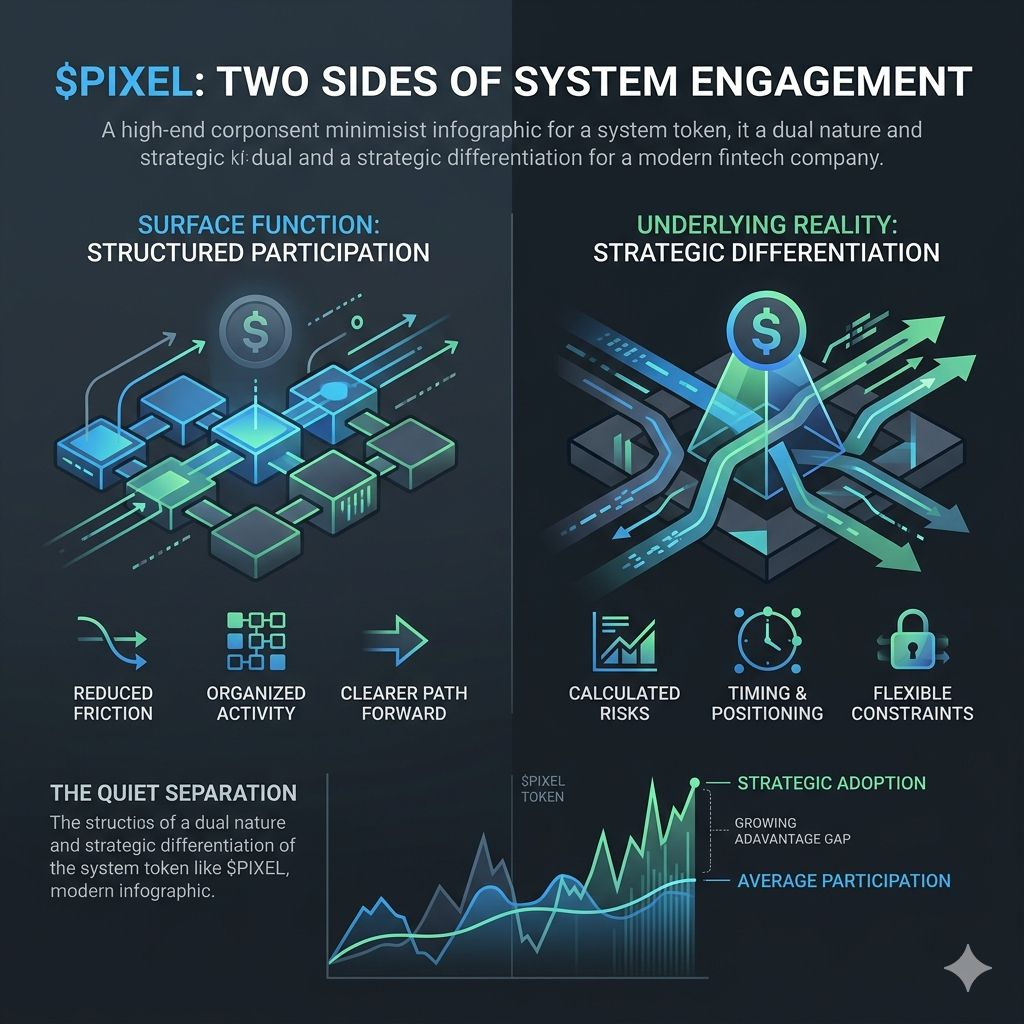
But that clarity depends on how closely you look. The moment people stop just participating and start thinking about how to position themselves, the role of begins to shift. It stops being just a layer inside the system and starts becoming a way to move differently through it.
No system really gets rid of its constraints. It can’t. Limits around time, access, and capacity are always there, even if they’re hidden well. What changes is how those limits are experienced. A token like can turn those limits into something more flexible something you can manage, delay, or sometimes bypass. But that flexibility doesn’t apply evenly.
Some participants will always figure out how to use that layer more effectively than others. Not necessarily because they’re better in any absolute sense, but because they learn faster, take on more risk, or simply spend more time understanding where the system bends. Over time, that creates a quiet separation. Everyone appears to be in the same environment, but they’re not moving through it in the same way.
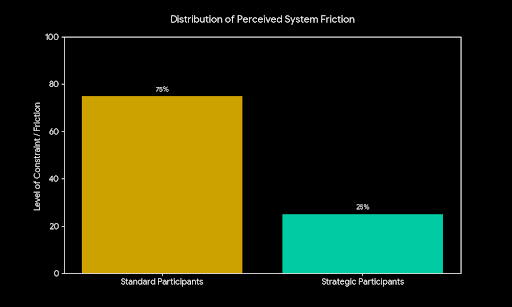
That’s where the tension sits. The system presents itself as more organized, more predictable. And in a surface-level sense, that’s true. Things become easier to track. Activity flows through a visible channel. But underneath, the unpredictability hasn’t disappeared. It has just been shifted into how people interact with that channel.
What looks like control can actually be a kind of redistribution. Instead of uncertainty being spread across the whole system, it becomes concentrated in the decisions people make around the token—when to use it, when to hold it, when to wait. The uncertainty becomes quieter, but also more strategic.
And that changes behavior in ways that aren’t always obvious. People stop focusing only on what they’re doing inside the system and start thinking about timing, positioning, and optionality. They begin to treat participation less like a straightforward path and more like a series of calculated moves. The system doesn’t just guide behavior anymore it reacts to it, and then people react back.
Once that loop forms, the token is no longer just supporting the system. It’s shaping it. It influences who can keep momentum when things get crowded, who can recover quickly from setbacks, and who ends up absorbing the system’s friction instead of moving around it. None of this needs to be explicit to be real. It emerges gradually, through repeated interaction.
The difficult part is that this doesn’t necessarily look like a problem while things are stable. In calm conditions, the system can appear balanced. The token seems to be doing exactly what it was meant to do. It’s only when activity intensifies when more people start optimizing, when strategies begin to overlap that the underlying structure becomes visible.
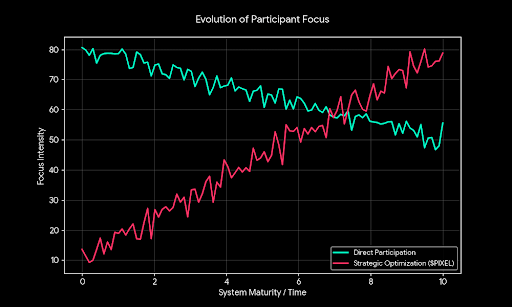
That’s when you start to see whether $PIXEL is actually making the system more capable, or just making it feel more organized. Because those are different outcomes. One expands what the system can handle without breaking. The other makes the system easier to navigate for some, while quietly increasing the load on others.
The distinction is subtle, but it matters over time. If the token continues to act as a way to manage access without distorting behavior too heavily, then it can help the system grow while staying coherent. But if it becomes the main way people gain advantage if navigating the token matters more than participating in the system itself then the balance starts to shift.
At that point, the system isn’t really reducing uncertainty. It’s shaping it into something that looks more controlled, while still being driven by the same underlying pressures. And those pressures don’t disappear. They build, they adapt, and eventually they test whatever structure has been put in place.
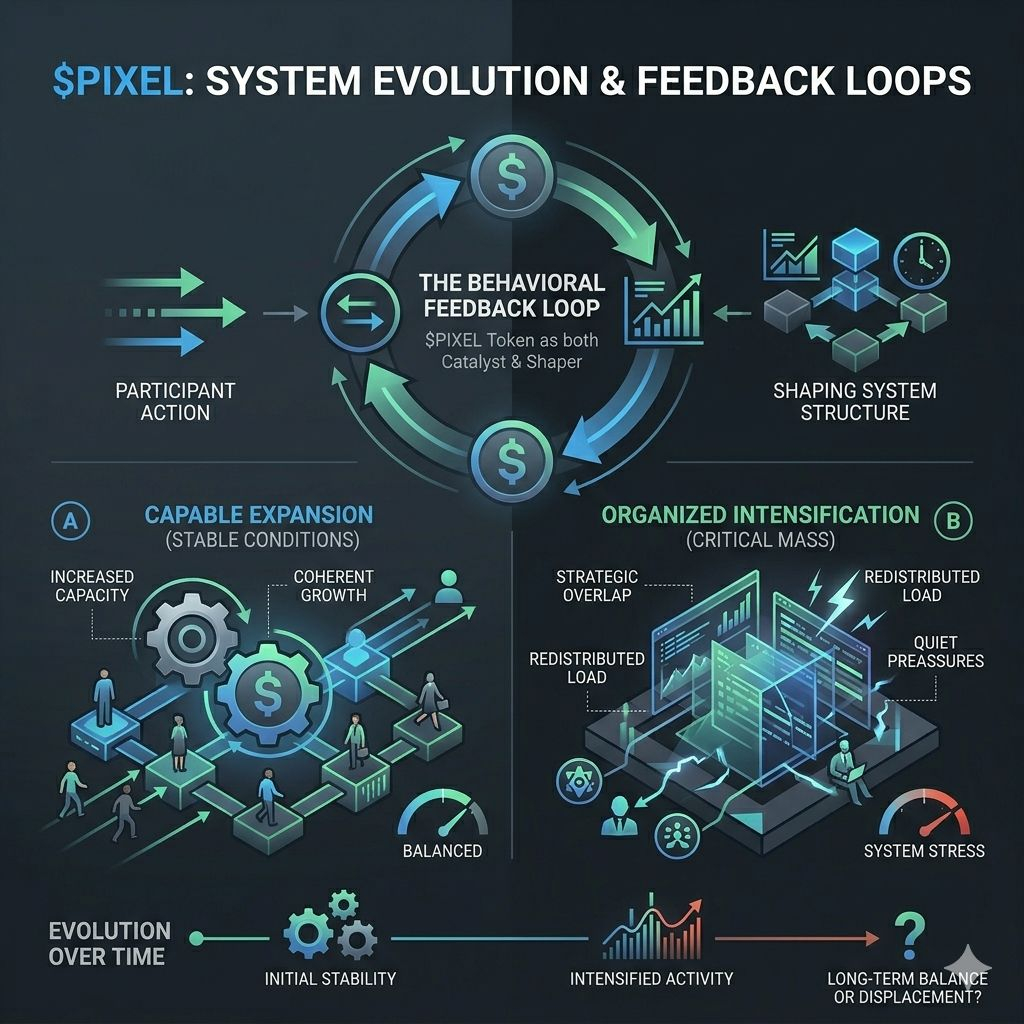
So the outcome doesn’t depend on how convincing the idea of $PIXEL is. It depends on how it behaves when people lean into it when they start using it not just as intended, but as strategically as possible. If the system can hold together under that kind of use, then the token may be doing something meaningful. If not, it will still function, but in a way that reveals its limits only after those limits have already started to matter.