

I don't know when exactly the system started sorting people. It didn't announce it. It didn't need to.
I mean… think about it for a second.
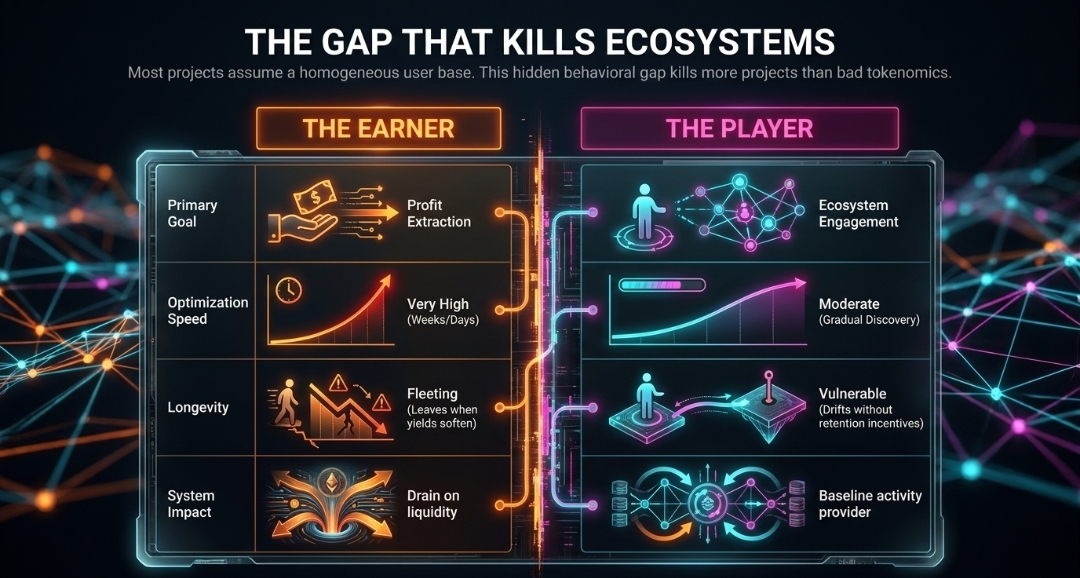
Most Web3 games have this obvious divide, people who are here to earn and people who are here to play. And usually, you can tell which is which within the first week. The earners optimize fast, pull out as soon as returns soften, and vanish. The players stay a little longer, but without incentive design that keeps them, they drift too.
That gap has killed more projects than bad tokenomics ever did.
But Pixels just made a move that I've been sitting with for a few days now. And the more I think about it… the more it feels less like a product decision and more like a question being asked directly to the player.
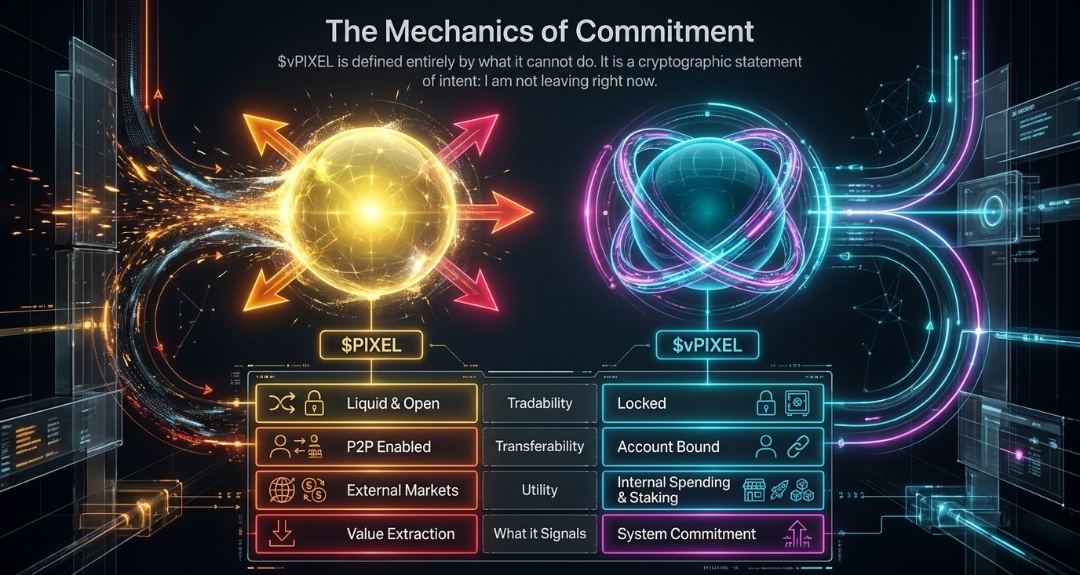
There is now a choice inside the ecosystem pay withdrawal fees to extract $PIXEL , or skip the fees entirely and use vPIXEL within the network.
Simple, right? On the surface, yes.
But what it's actually doing is something much quieter. It's building a mirror. And whoever you are as a player, your answer to that choice shows it.
The thing about vPIXEL that most people gloss over is what it cannot do. It cannot be traded, sent to other players, or sold. It only works for spending or staking within the ecosystem.
So it's not a reward. It's not an asset in the traditional sense. It's more like... a statement of intent. If you choose vPIXEL, you are essentially telling the system, I'm not leaving. Not right now.
And the system responds to that differently.
Higher-reputation users pay lower withdrawal fees. The fees collected get redistributed to stakers. So the people who stay longer, participate more, maintain reputation they operate under lighter conditions than everyone else. Not blocked. Not restricted. Just... lighter.
That's a functional layer forming underneath the visible game. You can ignore it. But ignoring it means you're experiencing Pixels at its default settings, while others are experiencing a quietly different version of it.
I've thought about this kind of design before. Not in games, in markets. Two participants in the same system, same access, same information. But one has built positioning, reputation, history. The other hasn't. Over time, the outcomes start separating. Not because the system is rigged but because it was designed to respond to consistency.
Pixels is doing that. Just inside a farming game.
And then there's the number that actually surprised me.
For the first time, more $PIXEL entered the game economy than left it.
That is not a small thing. Most Web3 games run in the opposite direction their entire lives emission goes out, extraction follows, the pool slowly empties, the token inflates, players leave. That's the standard pattern. It has played out so many times that people just expect it now.
When a system flips that even once, something different is happening.
Over 100 million PIXEL staked just over a month after the staking program launched. That's not people sitting and waiting for the next hype cycle. That's people deciding, actively, to stay inside. To lock in. To say okay, I'll give this more time.
Whether that holds is a completely different question. And I won't pretend it's answered.
But the behavior is real. And behavior is usually the first signal before anything else becomes visible.
There's also something happening at the ecosystem level that I think people are underreading.
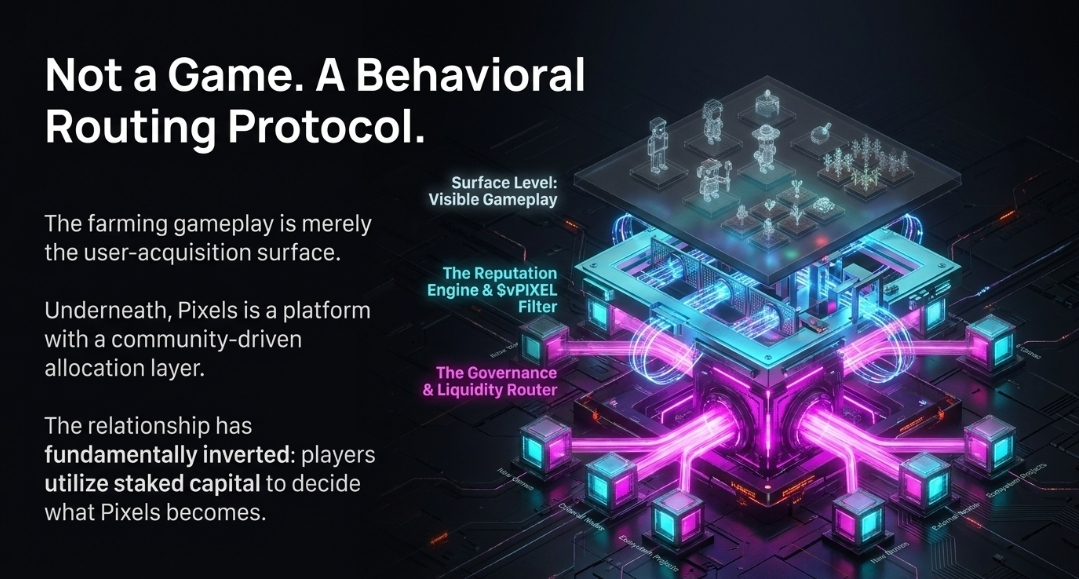
The staking model lets users who stake PIXEL influence which games inside the ecosystem receive token emissions. The community effectively determines resource distribution.
So it's not just a game anymore. It's becoming a platform with a community-driven allocation layer underneath it. Players aren't just earning inside one game, they're essentially voting on which games get to exist and grow.
That changes the relationship between player and system in a way that's hard to describe cleanly. Because now you're not just adapting to what Pixels decides. You're partially deciding what Pixels becomes.
That loop is strange. And interesting. And honestly a little uncomfortable if you think about it long enough. Because it means the system isn't fixed. It's being shaped by whoever chooses to participate deeply enough.
Which quietly answers a question most Web3 games never even asked, who should the system be designed around?
Not the ones who came for one cycle and left. The ones who stayed when it got slower, when the price dropped, when the friction increased. The ones who are still here.
Now. I won't sit here and call this a success. That would be dishonest.
PIXEL reached a fully diluted valuation of over $2 billion before falling roughly 95% from its all-time high. That history is real. The people who came in at the top and held they know what that felt like.
And the broader web3 gaming environment has worsened over recent months. The team admitted it directly. That kind of transparency is not nothing, but it also doesn't fix the underlying market conditions.
So what are we actually looking at here?
Not a finished system. Definitely not.
More like a system that is actively trying to figure out what kind of participation sustains it. And unlike most projects, it is making design decisions that reflect that question not just in whitepapers, but in actual mechanics that players feel.
The choice between PIXEL and vPIXEL is one of them. The reputation-based fee structure is one of them. The community staking model is one of them.
Each of these, individually, is small. But together, they are building something directional. A game that is slowly trying to know not just how many people are here, but who is actually here.
And maybe that's the real question worth watching.
Not the token price. Not the DAU. But whether the people who chose to stay are building something that makes staying worth it.
That answer isn't clear yet.
But the question finally feels like the right one.
What do you think, is staying inside better than extracting? Or does holding eventually always feel the same regardless of the system around it?
NFA ~ DYOR
