
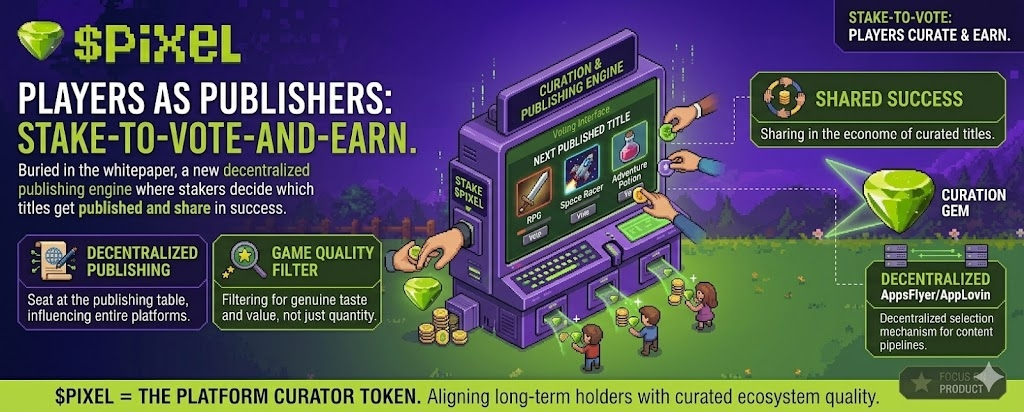
I almost scrolled past it. It was buried in the whitepaper between tokenomics mechanics and platform metrics, phrased in a way that made it sound like a minor feature update. Stake-to-vote-and-earn. Three words connected by hyphens. Easy to gloss over.
But the more I sat with it, the more it felt like the most unusual thing Pixels has quietly introduced. Not unusual in a complicated way. Unusual in a way that shifts who actually has power inside the ecosystem.
Most GameFi systems give token holders one real option. Hold and hope. Maybe stake for yield. But the yield is usually just more of the same token, and the power stays concentrated at the top. Holders participate in the upside if things go well. They don't really participate in decisions.
What Pixels seems to be building is different. Players stake $PIXEL, and in return they get influence over which games enter the ecosystem. Not just exposure to those games. Actual input into whether they get published. And then they share in the economic outcome of whatever they voted in.
That's not a staking mechanism. That's a seat at a publishing table.
I've been thinking about why that distinction matters more than it sounds. Most people interacting with a game have no relationship to the business decisions behind it. They play what exists. If a new title launches badly, they move on. If a good one gets passed over, they never know it existed. The feedback loop between players and publishers is usually one directional. Players respond to whatever gets built. They don't shape what gets built.
Pixels is trying to close that loop. Or at least partially close it.
What I can't quite figure out is whether players actually want that responsibility. There's a version of this that works beautifully. Engaged holders with genuine taste in games, filtering for quality, directing rewards toward titles that add real value to the ecosystem. The kind of curation that a centralized team honestly can't do as well because they're too far from the actual play experience.
And then there's the version where it doesn't work. Where voting gets dominated by whoever holds the most tokens. Where decisions get made based on financial positioning rather than game quality. Where smaller holders disengage because their vote doesn't feel like it counts.
I've seen both versions play out in other decentralized governance experiments. The ratio of good outcomes to bad ones isn't great.
What's interesting is that Pixels seems aware of this tension, even if they don't address it directly. The framing around prioritizing quality DAU over quantity DAU keeps appearing throughout the whitepaper. They're not chasing everyone. They want the players who reinvest, who stay, who contribute something back beyond just playing. That's the cohort they want voting.
Whether their data infrastructure can actually identify and surface that cohort is a different question. It might. The machine learning layer they describe for reward targeting is designed precisely for this. Identifying which behaviors signal long-term alignment versus short-term extraction. If those signals can be used to weight participation in governance, not just reward distribution, then the system gets more interesting.
But I'm speculating. The whitepaper doesn't go that far explicitly.
What I keep returning to is the publisher analogy they use. Decentralized AppsFlyer. Decentralized Applovin. Those are platforms that sit underneath apps, not inside them. They don't make the games. They decide which games get seen, which get funded, which get the distribution advantage that makes the difference between obscurity and scale.
If $PIXEL stakers are functionally operating as decentralized publishers, then holding the token is less about exposure to one farming game and more about participating in a content selection mechanism for an entire platform. The risk profile is completely different. So is the upside.
Most holders I've observed are still thinking about this like a single-game token. Check the price, check the DAU numbers, watch for announcements. That's not wrong exactly. But it might be looking at the wrong layer.
There's also something I find genuinely hard to evaluate. Publishing decisions require judgment. Not just capital. Knowing which games are good before they're proven is a skill, and decentralized groups don't always exercise it well. Sometimes collective decisions converge on obvious choices. Sometimes they get gamed. Sometimes the best games are the ones no large voting bloc would have predicted.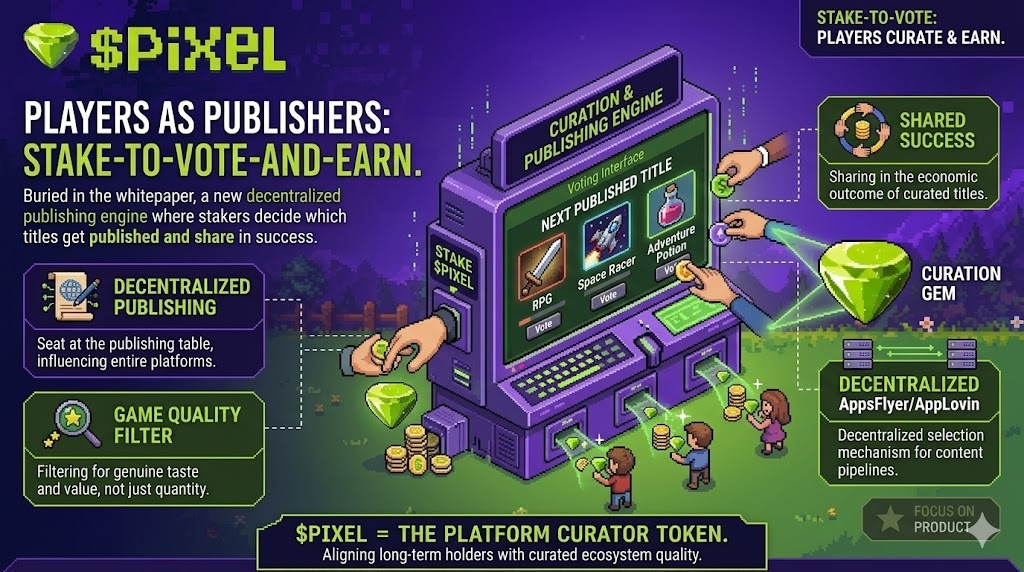
So I don't know how this plays out. The mechanism is novel enough that there isn't a clean precedent to point to. GameFi governance has mostly failed. But most GameFi governance was governing token parameters, not actual content pipelines. That's a meaningful difference.
If Pixels can make this work, and that's a real if, then the stake-to-vote model might be the thing that separates it from everything else in this space. Not the farming loops. Not the timers or the energy mechanics. The idea that players are also, quietly, curators. And that curating well means sharing in whatever gets built.
That's either a genuinely new model for how games grow. Or it's governance theater dressed in publishing language.