
that was a thoughtful evaluation. It was more like reflex. I’ve seen too many games in this space that were really just incentive tunnels with a cute coat of paint. You log in, you do the loop, you feel a little spark, and then almost inevitably the loop starts feeling like a spreadsheet you can’t unsee.
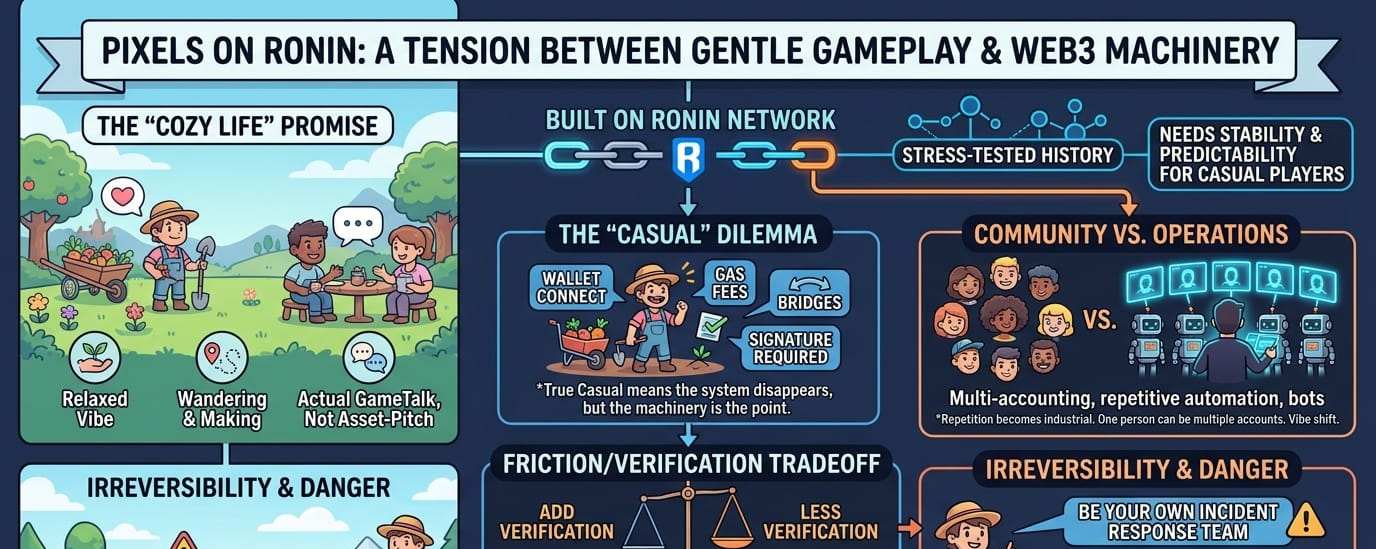
Pixels kept getting described to me in this annoyingly gentle way. People weren’t pitching it like an asset. They’d just mention they were farming a bit, wandering around, making things, running into other players. The kind of talk you’d expect around an actual game, not around a crypto project. That stuck with me longer than it should’ve, mostly because I’m not used to anything in Web3 sounding relaxed.
Maybe that’s too harsh on the space. There are honest attempts. But I keep coming back to what casual really means once you bolt it onto on chain rails. Casual means the system has to disappear. Not philosophically practically. The player shouldn’t have to notice the machinery. And yet the machinery is the whole point: wallets, ownership, transactions, bridges, all the stuff that tends to surface at exactly the wrong moment.
Ronin is sitting underneath Pixels, and I can’t ignore the symbolism there. Ronin has history. It has been stress-tested in public, the kind of stress test that makes you stop talking about ideals and start talking about boring reliability. Because under load, or during an outage, or during one of those “everything’s fine but also nothing’s working afternoons, a casual game doesn’t get sympathy. People don’t troubleshoot. They don’t read updates. They just decide it’s not worth the friction and quietly move on.
That’s where things start to feel uncomfortable because the world Pixels is trying to be a place you can drop into and just do small things depends on the least glamorous layers staying stable. Not just uptime, but predictability. Clear failure states. A flow that doesn’t randomly demand you sign something when you were in a calm little rhythm. If the chain experience leaks into the game experience too often, the cozy part becomes a costume you only tolerate when you’re in a very specific mood.
I keep coming back to identity, too. Pixels is social, and social is built on the assumption that the things around you are people. Wallets don’t really solve that; they blur it. One person can be five accounts. Five accounts can be one automated routine. In a farming-and-crafting world, repetition is the heartbeat, so repetition becomes the easiest thing to industrialize. You don’t even need villains. You just need incentives that reward consistency, and suddenly the most “active” presence in the world isn’t a community, it’s an operation.
And then what? You add verification and you add friction, and friction kills casual play fast. You don’t add verification and you accept that bots and multi accounts will shape the economy and, eventually, the vibe. I keep coming back to that tradeoff because it’s where most projects decay: not a dramatic collapse, just a slow change in who sticks around. The patient optimizers stay. The normal humans drift.
There’s also the quiet terror of irreversibility. In Web2 games, if someone loses access or gets tricked, it’s a support problem. In Web3 games, it can become a moral lesson delivered too late. Maybe that’s too harsh but I’ve watched “be your own bank” turn into “be your own incident response team,” and I’m not sure that belongs in a world that’s trying to feel friendly.
So I’m watching Pixels less for how charming it looks on a good day and more for what it does on a bad one congestion, confusion, exploit rumors, market mood swings, the slow hardening of a relaxed loop into an optimized routine. I can’t tell yet if it’s building something that stays soft under pressure, or if it’s just early enough that the pressure hasn’t arrived in full. And when it does, do people keep tending the farm because they want to or because they feel they have to?
@Pixels$PIXEL #pixel
PIXELUSDT
دائم
0.00
8461
+1.7%