
I used to think most Web3 games were built around visibility—everything needed to be obvious, clearly defined, and immediately understandable for players to engage.
Systems were designed so that rewards, mechanics, and outcomes were easy to see and predict, because the assumption was that clarity drives participation.
If players could instantly understand what to do and what they would get in return, they would stay active. So when I first looked at Pixels, I expected the same approach—transparent systems, visible incentives, and a structure that makes everything easy to follow from the start.
But the more I spent time observing how things actually work, the more I started to notice something different—not everything is immediately visible, and that seems intentional.
There are layers to how the system operates that don’t fully reveal themselves at first glance. Some patterns only become clear after repeated interaction, and some advantages only emerge after you’ve spent time paying attention to how different parts of the system connect.
It’s not hidden in a confusing way, but it’s also not fully exposed. And that creates a feature that isn’t often talked about—depth through partial visibility.
In many systems, everything is laid out from the beginning. You know the most efficient path, you know the optimal strategy, and over time, players converge toward the same approach.
That creates efficiency, but it also reduces variation. Once the best path is known, exploration fades, and the system becomes about execution rather than discovery.
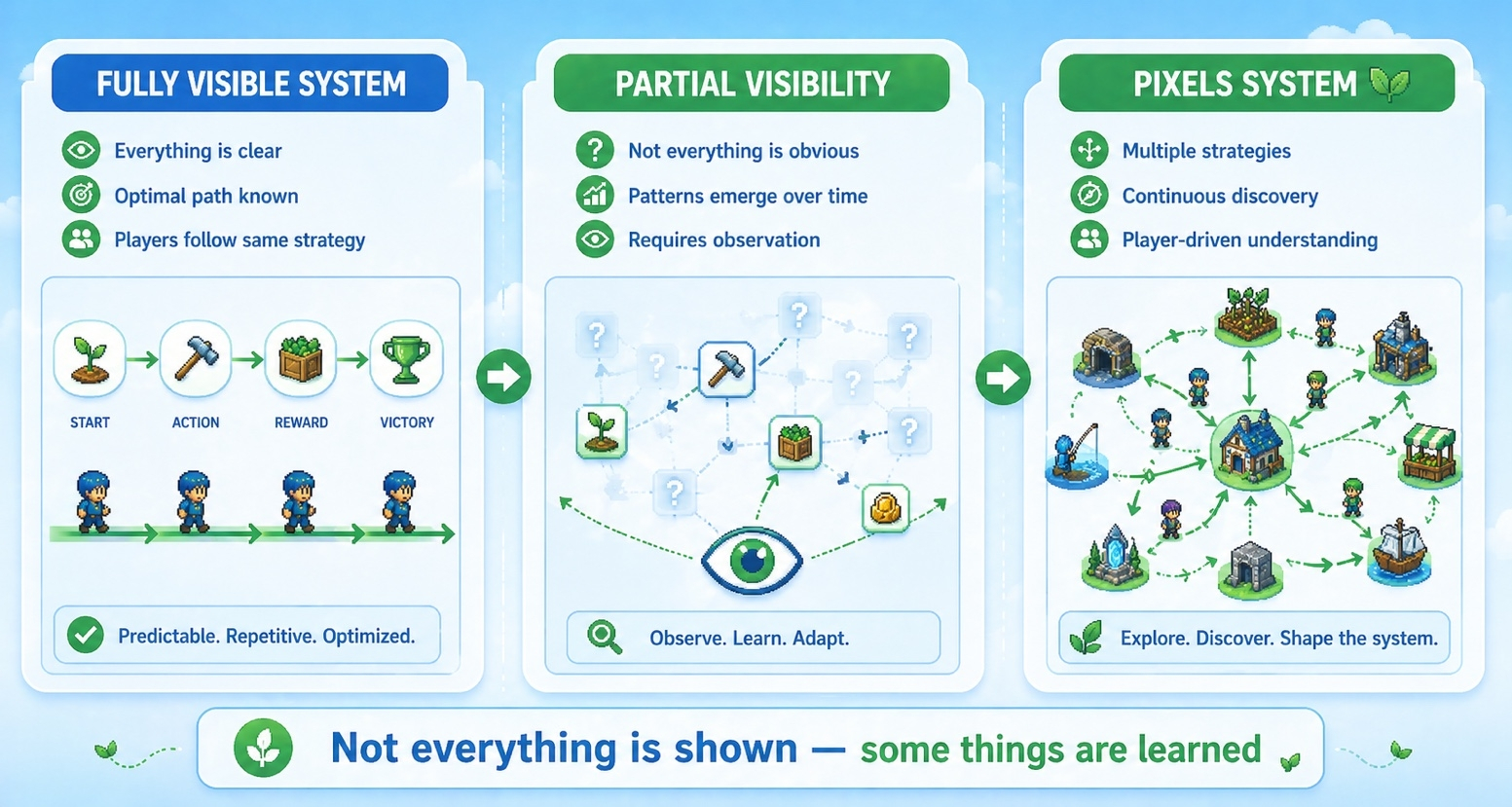
But in @Pixels , because not everything is immediately obvious, players don’t all move in the same direction at the same time. They experiment, they adjust, and they gradually uncover different ways of engaging with the system.
That creates diversity in behavior.
Instead of everyone optimizing toward the same outcome, players begin to develop slightly different approaches based on what they notice and how they interpret the system.
Some might focus on timing, others on positioning, others on consistency. And because those approaches are not fully predefined, they evolve over time. The system doesn’t just support one “correct” way to play—it allows multiple paths to exist simultaneously.
This has a deeper impact on engagement than it might seem at first.
When everything is fully visible, players tend to move quickly toward optimization and then plateau. But when visibility is partial, the process takes longer. Players remain in a state of learning, where they are constantly refining their understanding of how things work.
That learning process becomes part of the experience, not just a step before it. It creates a sense that there is always something more to figure out, even if the core mechanics remain the same.
It also changes how players perceive value.
In fully transparent systems, value is often immediately clear. Players know what is worth more, what is worth less, and how to maximize returns. But in a system with partial visibility, value can feel less obvious.
It becomes something that players discover rather than something they are told. That discovery creates opportunity, because players who understand the system earlier or more deeply can position themselves ahead of others—not through unfair advantage, but through insight.
Of course, this approach comes with trade-offs.
A system that isn’t fully visible can feel slower to understand, especially for new players. There’s a balance between depth and accessibility, and if that balance shifts too far, it can create confusion instead of engagement.
Players need enough clarity to participate, but enough depth to stay interested. Managing that balance is one of the more complex aspects of system design, especially in environments where player behavior is constantly changing.
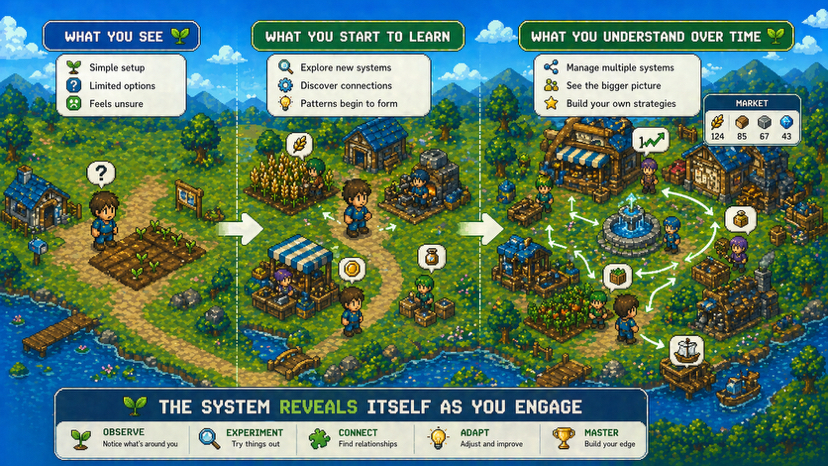
But when it works, it creates something different.
Instead of a system that is immediately solved, you get one that unfolds over time. Instead of a single optimal path, you get multiple evolving strategies. And instead of players simply following instructions, you get players interpreting, adapting, and learning.
Looking at it now, I don’t see Pixels as a system that tries to show everything upfront. It feels more like a system that reveals itself gradually, depending on how much attention you give it. And that changes the nature of engagement, because it shifts the experience from pure execution to ongoing understanding.
And that raises an interesting question.
If a system is fully visible, it’s easier to learn—but easier to exhaust. If a system reveals itself slowly, it’s harder to master—but potentially more engaging over time.
So which one actually keeps players longer?
Curious how others see this.