
I’ve spent enough time watching this market to realize that scams in crypto aren’t random events. They’re not rare anomalies either. They’re embedded in the structure of how this space evolves. Every cycle brings new narratives, new tools, new liquidity—and alongside them, new ways to exploit attention, ignorance, and urgency. The uncomfortable part is that scams don’t succeed because they’re sophisticated. Most of them succeed because they align perfectly with how people behave when money and speed collide.
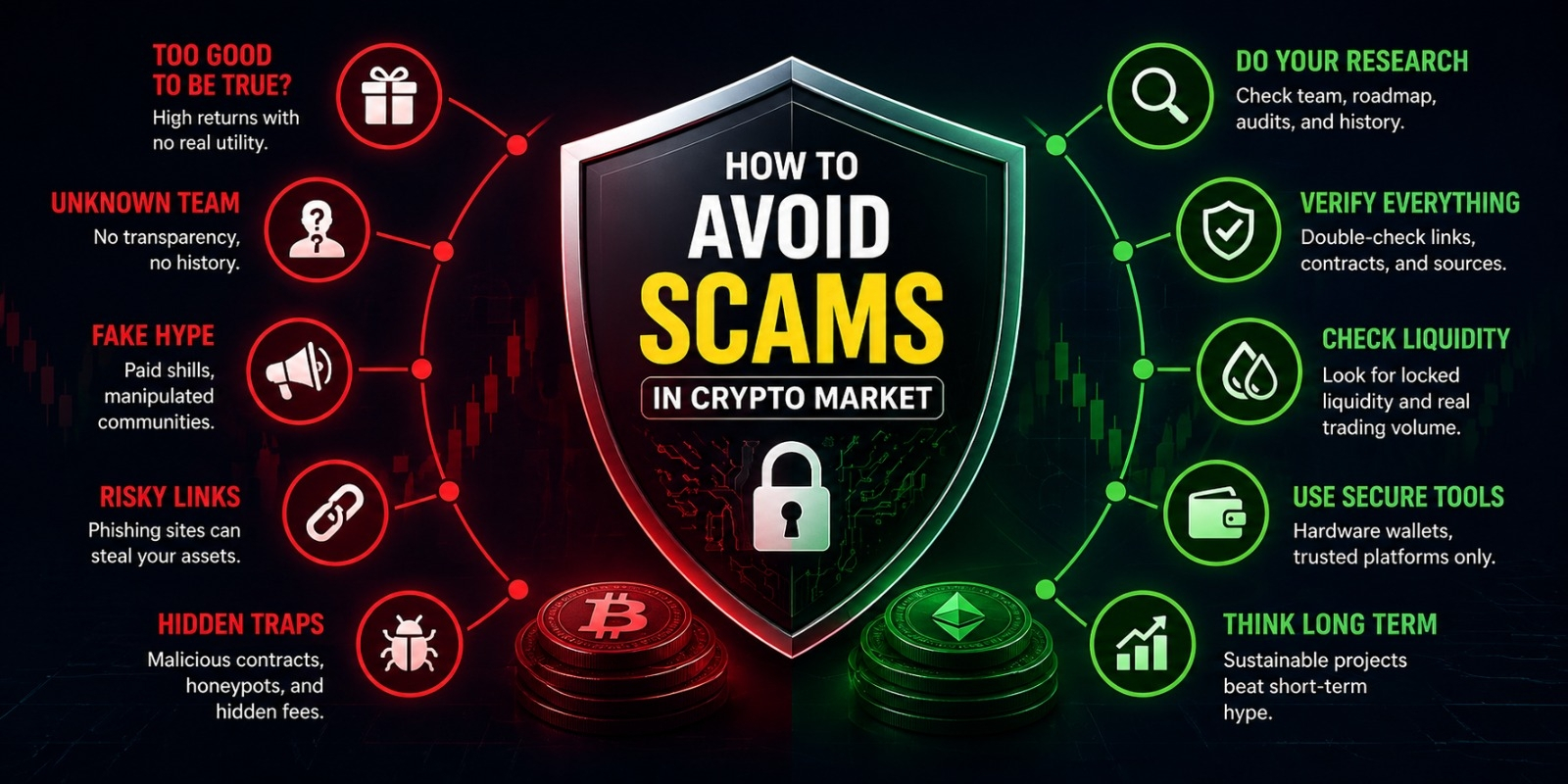
What I keep noticing is that scams tend to appear exactly where the market is expanding fastest. When something new enters the scene—whether it’s DeFi protocols, NFT minting waves, or new token launch mechanics—there’s always a gap between innovation and understanding. That gap is where scams live. It’s not about technology failing. It’s about people interacting with systems they don’t fully understand, often under pressure to act quickly.
At its core, most crypto scams aren’t technical attacks. They’re behavioral traps. The scammer doesn’t need to break the blockchain. They just need to influence your decision-making process. That’s why urgency is almost always present. Limited-time mints, “last chance” airdrops, exclusive early access—these are not just marketing tactics, they’re psychological levers. When I see urgency combined with complexity, I immediately slow down. That combination is rarely healthy.
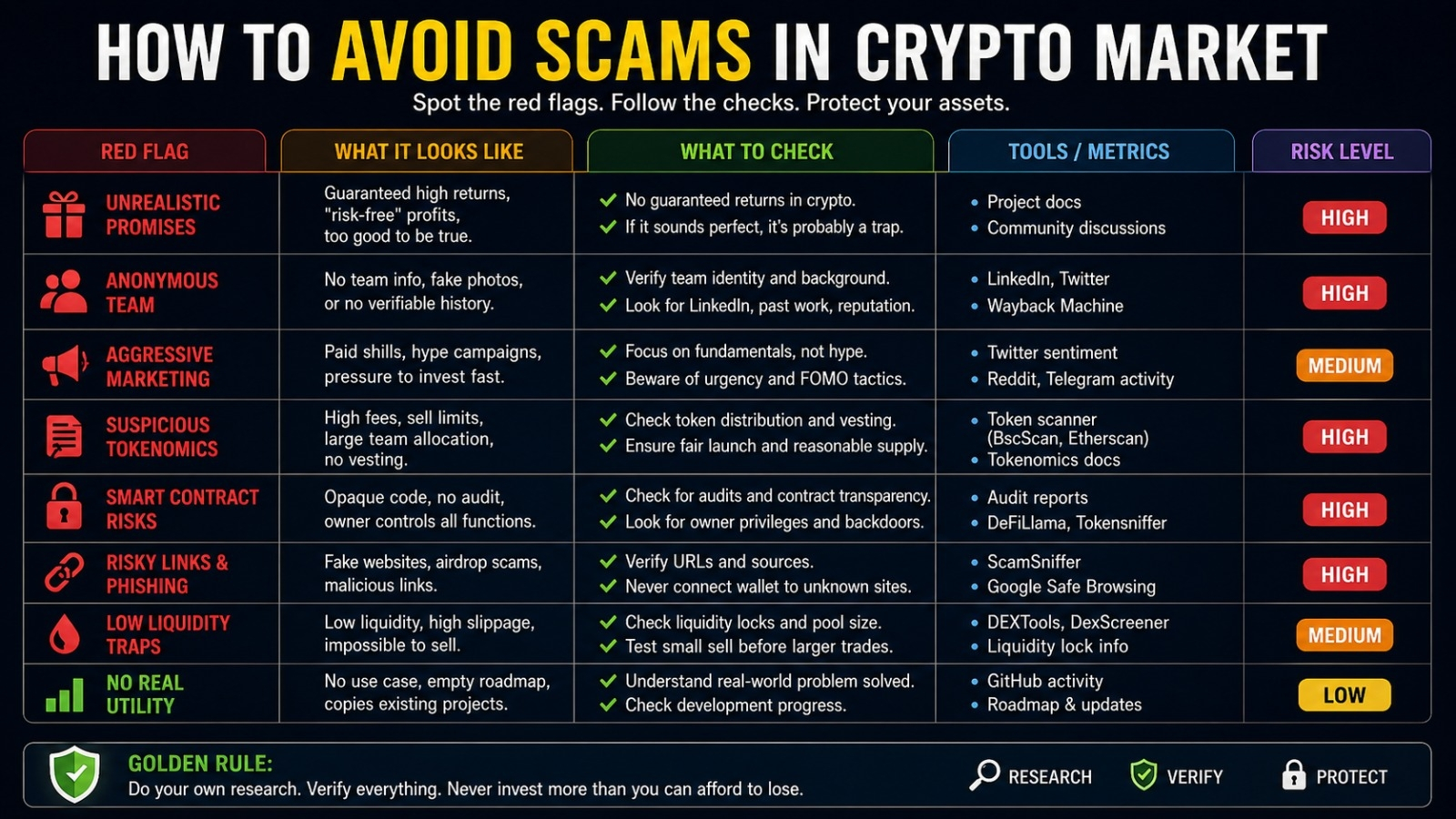
Another pattern that stands out is how scams mimic legitimacy rather than trying to appear hidden. Fake projects don’t look suspicious at first glance. They look polished. Clean websites, active social feeds, even fake community engagement. In many cases, they look more organized than real projects. The difference is subtle and usually shows up when you look at consistency over time. Real projects evolve gradually. Scam projects often appear fully formed, with everything already in place, but no real history behind them.
The underlying mechanism here is surprisingly simple. Trust in crypto is often outsourced to surface signals—follower counts, interface design, token price movement. These are easy to fake. What’s harder to fake is time. A project that has existed through different market conditions, with visible changes and imperfections, carries a different kind of credibility. I’ve learned to weigh time more heavily than presentation.
When it comes to how users actually get caught, it’s rarely through a single mistake. It’s usually a chain of small decisions. Clicking a link without verifying the source. Connecting a wallet to a site without understanding permissions. Approving a transaction without reading what it actually does. None of these actions feel dangerous in isolation. But together, they create exposure. The system itself is neutral—wallets and smart contracts execute exactly what you approve. The risk comes from assuming that every interface is trustworthy.
One of the more overlooked aspects is how token mechanics themselves can be used as a trap. I’ve seen tokens designed with restrictions that aren’t obvious at first. You can buy them easily, but selling becomes difficult or impossible due to hidden contract conditions. On the surface, price pumps look organic. But in reality, liquidity is engineered in a way that benefits only the creators. If you’re not paying attention to how a token behaves during both entry and exit, you’re only seeing half the picture.
Price behavior often reveals more than marketing ever will. Sudden spikes with no clear source of demand, followed by sharp liquidity drains, are not random. They’re structured movements. In many cases, early wallets accumulate quietly, then distribute into rising momentum. When I look at a chart now, I’m not just seeing price. I’m trying to infer intent. Who benefits from this movement? Who is providing liquidity, and who is extracting it?
There’s also a broader shift happening that makes scams harder to detect. As tools become more accessible, the barrier to creating tokens, launching websites, or deploying contracts has dropped significantly. This is good for innovation, but it also means that the line between a legitimate experiment and a malicious setup is thinner than ever. Not every risky project is a scam, but every scam will present itself as an opportunity.
What complicates things further is that some scams don’t look like scams even after they unfold. They exist in a gray area where intent is difficult to prove. Projects that overpromise and underdeliver, teams that disappear after raising funds, ecosystems that inflate metrics without real usage—these aren’t always labeled as scams, but the outcome for users can be similar. Loss doesn’t always come from theft. Sometimes it comes from misaligned incentives.
From a market cycle perspective, scam activity tends to increase during periods of rapid expansion. When liquidity flows in and attention spikes, the environment becomes ideal for exploitation. People are less cautious when everything is going up. Risk perception changes. What would normally feel questionable starts to feel acceptable because others are participating. This is where collective behavior becomes dangerous. Just because something is widely adopted doesn’t mean it’s safe.
Avoiding scams, in my experience, isn’t about finding perfect information. It’s about developing a consistent way of thinking. I’ve stopped asking “Is this project legitimate?” and started asking “What assumptions am I making right now?” That shift changes how I interact with the market. It forces me to slow down, to verify sources, to question incentives. Most importantly, it reduces the influence of emotion on decision-making.
There’s a trade-off here that’s hard to ignore. The same openness that makes crypto powerful also makes it risky. Anyone can participate, but that also means anyone can create. There’s no central filter. Responsibility sits entirely with the user. That’s not a flaw—it’s a feature. But it requires a level of awareness that most people only develop after experiencing loss.
If I had to reduce everything I’ve observed into one idea, it’s this: scams don’t rely on your lack of intelligence. They rely on moments where your judgment is slightly compromised—by speed, by greed, or by trust placed too quickly. Those moments are inevitable. The goal isn’t to eliminate them completely. It’s to recognize them while they’re happening.
I don’t think the market will ever become free of scams. As long as there’s value being created, there will be attempts to extract it unfairly. What can change is how individuals navigate that environment. The more time I spend here, the less I focus on finding the next opportunity, and the more I focus on avoiding unnecessary risk.
Because in a space where gains are uncertain and losses can be permanent, survival itself becomes a strategy. And the longer you stay in the market without major mistakes, the clearer everything starts to look.