
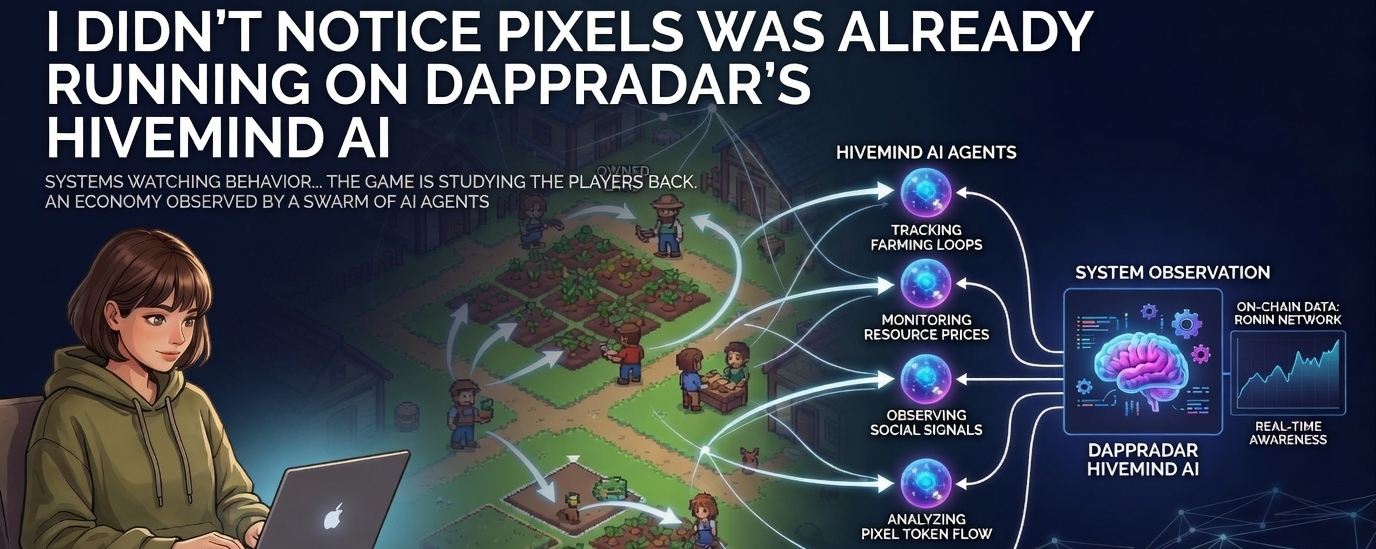

Something’s been shifting quietly in how crypto games operate. Not in what they promise, but in how they observe themselves. It’s less about dashboards made for users, and more about systems watching behavior in real time. Almost like the game isn’t just being played anymore...
I started noticing this while tracking how players move inside Pixels and then I came across something that barely got attention. Pixels became the first game to deploy DappRadar’s Hivemind AI. Not as a side experiment. Inside the game environment itself.
After that, the patterns started making more sense. The farming loops didn’t feel random. Resource prices didn’t drift without reason. Even social activity had a structure that felt... understood at a deeper level than most on chain games.
Because Pixels isn’t just running a player driven economy. It’s running an economy that is being constantly observed by a swarm of AI agents. These agents pull from on-chain data, social signals, and player behavior in real time. Not for marketing dashboards. For internal awareness.
That’s a very different design choice.
When I think about the farming loop in Pixels planting, harvesting, crafting, selling it looks simple. But every action feeds something larger. What crops players choose. When they sell. How fast they progress. Where they slow down. That data doesn’t just sit there.
It’s being watched.
Land makes this even more interesting. Owning land in Pixels isn’t just about passive rewards. It shapes production and efficiency. It decides who can scale and who can’t. If certain land setups start dominating resource flow, that imbalance becomes visible almost instantly in a system like this.
And then there’s the PIXEL token. I used to think of it mainly as an earning layer. Now it feels more like a live signal. When players spend it, hold it, or rush to farm it, they’re revealing intent. Confidence. Even fatigue. If AI agents are tracking that behavior, then the team isn’t guessing anymore.
They’re watching the economy breathe.
On Ronin, where transactions are fast and cheap, player activity is already easier to read compared to most chains. But adding something like Hivemind on top means Pixels can observe changes as they happen. Not after the fact. Not through delayed reports.
Right in the moment.
And still, most players don’t care about this layer.
They focus on earnings. On optimizing their farms. On whether grinding quests is still worth it. Whether new players are coming in. The usual loop. Incentives driving everything, not awareness.
Which makes me think this might be slightly ahead of what the market actually values right now.
Because having AI observe your economy doesn’t fix it by default. Pixels still has to deal with oversupply. With repetitive grinding. With keeping players engaged beyond rewards. It still depends on new demand entering the system.
The difference is... they might see the problems earlier than others.
But seeing isn’t the same as solving.
I’ve watched moments where certain resources flood the market. Where efficiency turns into monotony. Where social gameplay becomes optional instead of meaningful. Even with all that data, the system still leans heavily on incentives to keep players active.
And incentives can flip quickly.
So I keep coming back to this. Pixels deploying Hivemind AI wasn’t just a technical first. It felt like a shift in how seriously they treat their own economy. Not as a feature but as something that needs constant interpretation.
A farming game that analyzes itself in real time is not normal.
But I’m not sure the market fully knows what to do with that yet.
Maybe players just want rewards, not systems watching them.
Or maybe this is one of those ideas that makes sense later... and right now, it’s arriving a bit too early.