

There are some games you open for excitement, and there are some games you open because a part of you remembers that something is still waiting there. Pixels falls into the second category for me. One night, I entered the game with no big plan at all. I only wanted to harvest a few plots, check my progress, and close it before sleeping. But the moment I got in, I noticed that my work was not really finished. A crafting step was still hanging in the middle. A few materials still needed to be gathered. One task was almost ready, but not fully done. None of this felt like a huge prize, yet it kept me inside the game. It felt personal, like I had left a small system running, and I did not want to abandon it before it reached the next step.
That moment made me understand one of Pixels’ strongest qualities: its rhythm.
After watching many Web3 games rise quickly and then fade just as quickly, I feel that the biggest weakness in this space is not always graphics, rewards, or even technology. The deeper issue is often pacing. Many games try to keep players busy by filling every moment with actions, claims, buttons, rewards, and short-term excitement. But being busy is not the same as being attached. A game can make players click a lot and still fail to make them care enough to return the next day. Pixels feels different because it does not only ask players to do more. It gives them a reason to continue what they already started.
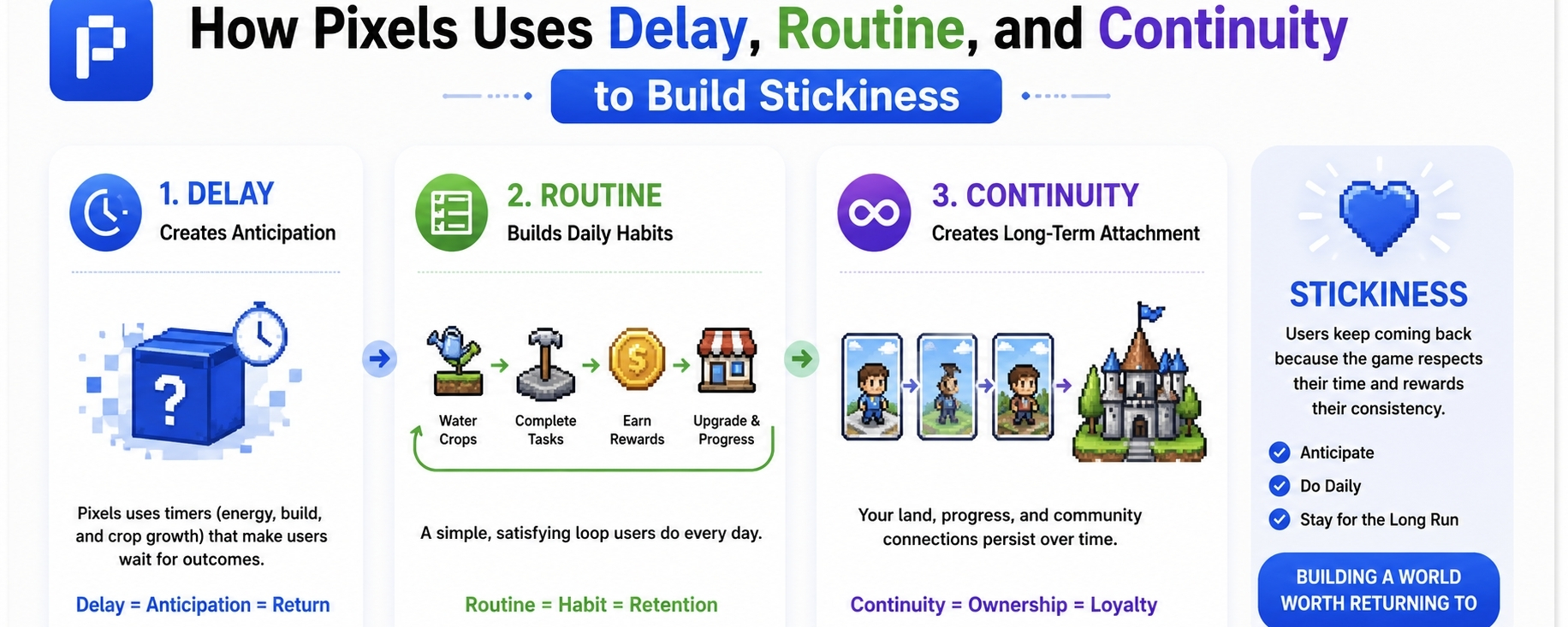
A lot of discussion around Web3 gaming points toward the same important lesson: players may come for rewards, but they usually stay for meaningful gameplay. Financial incentives can bring attention very quickly, but they cannot hold attention for long if the actual game loop feels empty. Long-term engagement needs a sense of progress, routine, ownership, and delayed satisfaction. Pixels understands this in a quiet but effective way. It does not depend only on immediate excitement. It builds a slower kind of connection through tasks that keep unfolding over time.
Pixels’ farming, gathering, crafting, and task systems are powerful because they do not feel like isolated actions. They feel connected. When you plant something, it does not finish instantly. When you craft something, you have to wait. When you need materials, you have to gather them step by step. When you complete a task, it often leads naturally into another small objective. These delays may look simple from the outside, but inside the player’s mind they create memory. You remember what you planted. You remember what you were crafting. You remember which material was missing. You remember that one task was almost complete.
This is the difference between an action loop and a continuity loop.
An action loop says: do something, receive something, repeat.
A continuity loop says: start something, shape it, leave part of it unfinished, then come back because it still feels connected to you.
That second structure is much stronger because it makes progress feel personal. The game is no longer just giving the player a list of things to do. It is giving the player a small ongoing story made from their own decisions. The player starts thinking, “I planted this earlier,” “I prepared this material,” “I still need one more item,” or “I should finish that task before moving on.” These are small thoughts, but they matter. They make the player feel that their time has left a mark inside the game. That is where real stickiness begins.
This is also why Pixels’ slower pace should not be misunderstood as weak pacing. A fast game can create instant excitement, but instant excitement can also disappear very quickly. When every action finishes immediately, progress may feel smooth, but it can also feel forgettable. The player clicks, collects, and leaves. There is no unfinished thread pulling them back later. Pixels creates a softer form of pressure. It does not shout at the player. It quietly reminds them that something is still waiting.
That quiet reminder is extremely important in Web3 gaming. Many games in this space have relied too heavily on rewards, and when the reward becomes less attractive, the player’s interest often collapses. Pixels feels stronger because its loop still has life even when the player is not thinking only about profit. You are farming, preparing, crafting, organizing, completing tasks, and planning your next move. The game gives the player enough reasons to care about the process itself, not just the final output.
The attachment Pixels creates is not loud. It builds slowly. At first, it may not feel explosive or dramatic. But after a few sessions, you begin to notice that the game has found a small place in your daily routine. You return to harvest. Then you stay because crafting is ready. Then you check which task can be completed. Then you prepare for the next cycle before leaving. The session expands naturally. It does not feel forced. It feels like one small step keeps leading into another.
This is controlled friction, and Pixels uses it well.
Bad friction makes the player frustrated. Good friction makes progress feel meaningful. Pixels’ delays work because they give time value. A crop planted now becomes a reason to return later. A crafting requirement makes gathering feel useful. A task board gives direction to actions that might otherwise feel random. The player is not only clicking through content. The player is maintaining a small system that they personally started.
That system is what creates stickiness.
In many Web3 games, the relationship between the player and the game feels transactional. The player enters, performs an action, collects something, and leaves. Pixels changes that feeling. The player enters, resumes something, adjusts a plan, completes a task, prepares the next step, and then leaves with a reason to return. That emotional difference is very important. A transaction ends when the reward is collected. A process continues because the player has already placed intention inside it.
This is why Pixels often feels more like a place than just a product. A product is used. A place is returned to. The farming and crafting rhythm gives Pixels a sense of everyday life. Not every moment needs to be intense. Some moments are about checking, waiting, preparing, finishing, and coming back later. That slower rhythm gives the game a warmer feeling. It makes the world feel lived in, not just consumed.
Pixels’ biggest retention lesson is simple but powerful: players do not always stay because the game gives them more rewards. They stay because the game makes their previous actions feel important. When progress has continuity, leaving the game creates a small feeling of incompletion. Returning feels natural because the player is not starting from zero. They are coming back to something that already carries their effort, timing, and memory.
That is why Pixels’ slower gameplay rhythm creates stronger stickiness than many other Web3 games. It does not depend only on speed, spectacle, or reward density. It builds engagement through unfinished loops, delayed outcomes, personal routine, and the quiet satisfaction of continuing what you started. In a category where many games try to move faster and faster, Pixels shows that sometimes the slower rhythm is the one that stays with players the longest.
