

I used to believe it was easy to tell when I was “doing things right” inside a system. In most games, effort and outcome eventually line up—you put in time, you see results. It feels predictable.
That sense of alignment didn’t really hold here.
Some sessions felt smooth, almost perfectly in sync. Others felt slightly disconnected, even though I wasn’t doing anything differently. The same routines, the same approach—yet the results didn’t always follow in a way I could clearly explain. It wasn’t outright failure. It was inconsistency without a clear cause.
Like most people, I assumed the problem was on my end.
That’s the usual instinct in GameFi. If something doesn’t work, you refine your process. So I tightened everything—cleaner loops, less wasted time, more deliberate execution. For a while, it seemed like the answer. Things felt controlled again.
But that didn’t last.
Eventually, the pattern broke again—and this time it wasn’t just me. I started noticing that even players who were clearly optimizing weren’t experiencing the same outcomes. Some moved in a more relaxed way, less structured, yet progressed without friction. Not dramatically faster—just… smoother.
That’s when it stopped being just about efficiency.
It started to feel like something else was at play.
Systems like this don’t behave like traditional games for long. They start acting more like environments—ones that react not only to what you do, but to how behavior is repeated over time. It’s not just activity that matters, but the pattern behind that activity.
Inside Pixels, that pattern becomes more noticeable the longer you stay.
Progress doesn’t always scale evenly. Sometimes results feel compressed, sometimes stretched, sometimes slightly disconnected from expectation. It doesn’t come across as random—it feels like the system is adjusting in response to something broader.
At the same time, nothing moves forward without cost.
Every layer—crafting, upgrades, land use, participation—introduces subtle forms of friction. Not enough to stop you, but enough to shape how you move. Over time, you become more deliberate, even if you don’t consciously realize it. The system isn’t just handing out value—it’s constantly redistributing and balancing it.
With $PIXEL still moving through its own cycles of supply and activity, that balance becomes sensitive. If everything behaved in a straight line, it would be easy to exploit or drain. Instead, behavior itself becomes part of the regulation—not just how much is happening, but what kind of participation sustains the system.
What makes it interesting is how little of this is explicitly communicated.
There’s no clear signal telling you something has changed. But gradually, outcomes begin to separate between players who look similar on the surface. That’s the part that stands out—the system doesn’t explain the difference, it simply reflects it.
And that reflection isn’t static.
Once patterns become visible, they get copied. Once they’re copied, they get optimized. And once that happens, the system shifts again. It creates a constant tension between genuine engagement and calculated imitation.
At that point, the focus starts to move away from rewards entirely.
It shifts toward something more fundamental—continuity.
Because no matter how well something is designed, it only matters if people keep coming back. Not once, but repeatedly. That’s where everything converges—not in a single outcome, but in sustained interaction over time.
And that’s where the loop changes.
It no longer feels like a fixed cycle. It feels like something that reacts, adjusts, and gradually reshapes how you operate within it.
I don’t really see Pixels as just a game—or even just an economy—anymore.
It feels closer to a system that filters behavior, reinforcing certain patterns through outcomes rather than instructions.
Whether that holds up at larger scale is still uncertain. Systems and players influence each other constantly, and intent rarely stays clean once reality sets in.
For now, it feels like the structure is still evolving faster than it can be fully understood.
And maybe that’s the point.
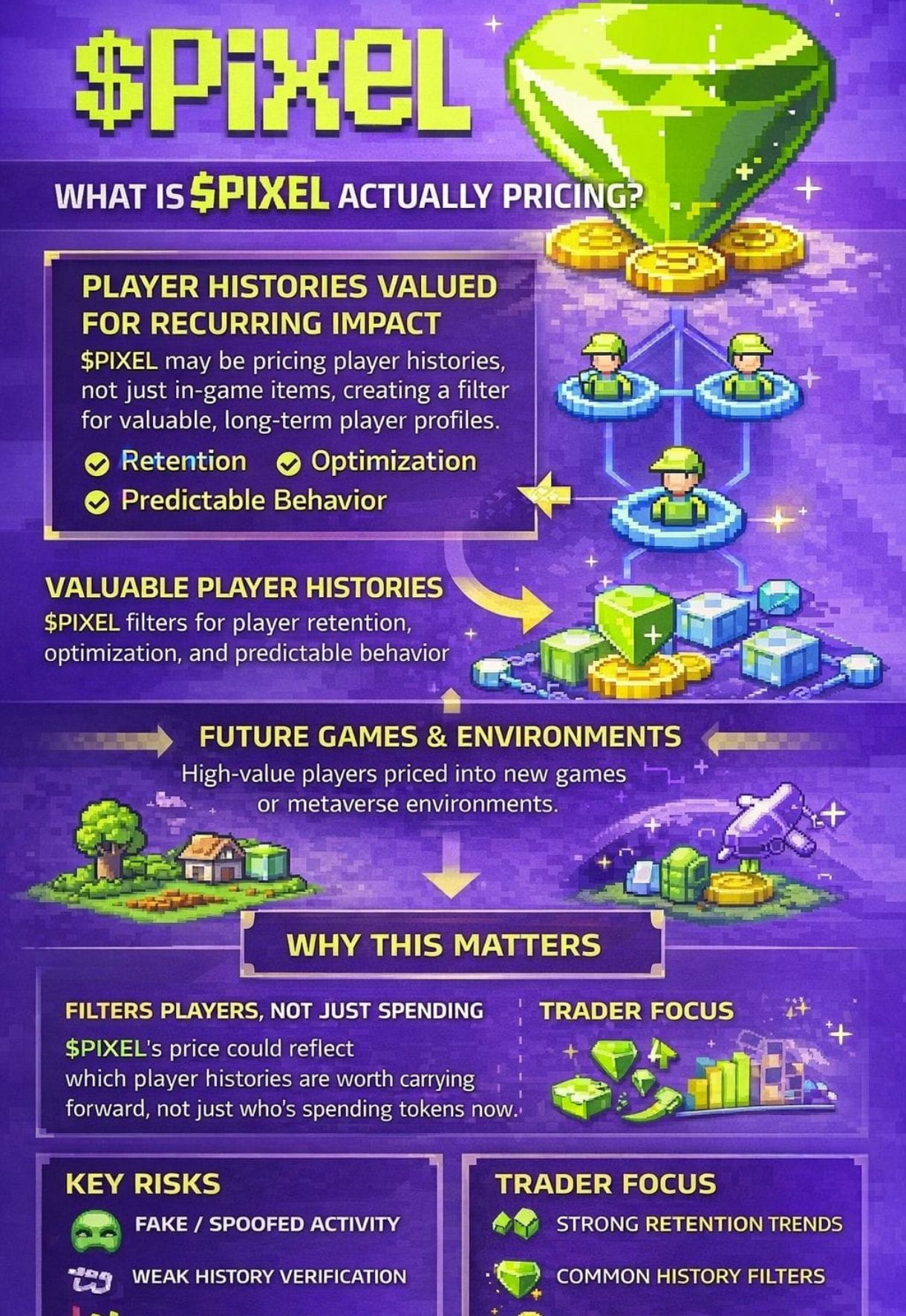

Because in the end, it’s not really about maximizing what you get.
It’s about recognizing what the system chooses to preserve.
What do you think? Curious to hear how others are experiencing it.