
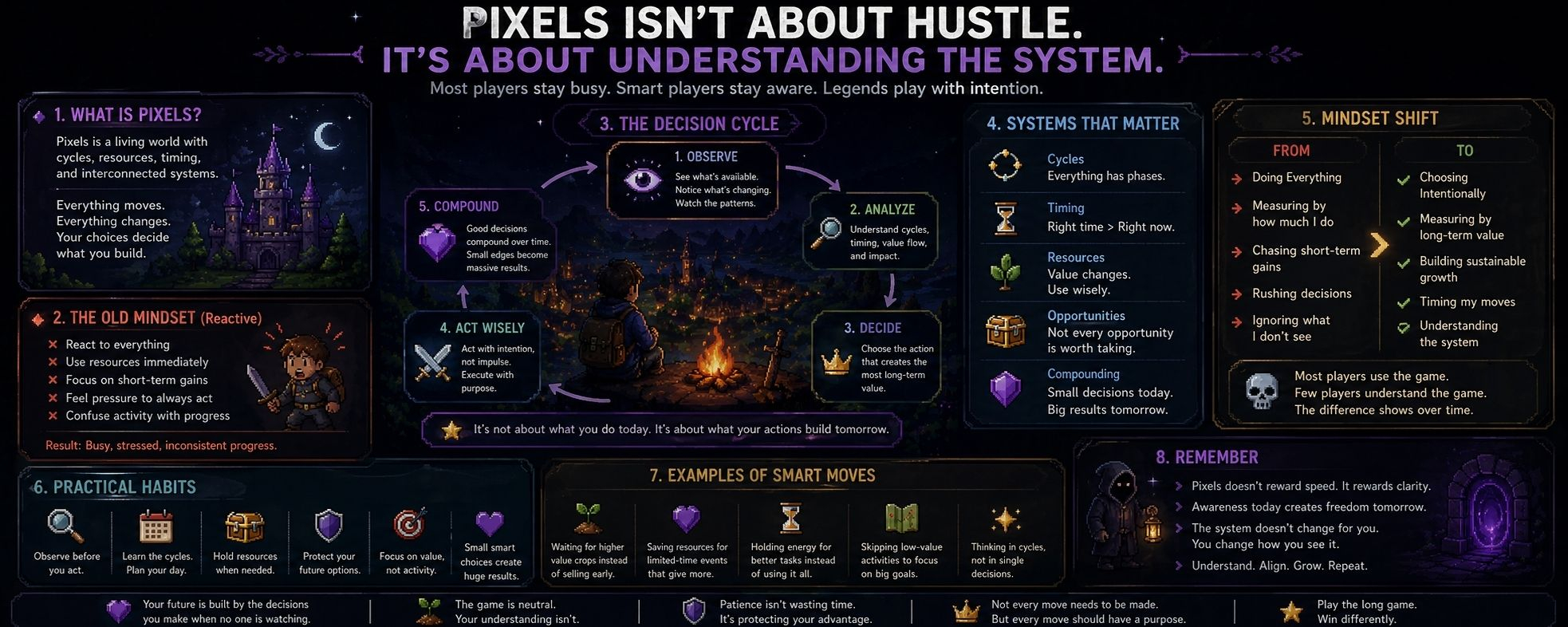
@Pixels If you asked me a few weeks ago what Pixels was about, I would’ve given you a very simple answer: stay active and keep progressing.
That’s how it felt in the beginning.
Log in, do what’s available, use what you have, and don’t let anything sit idle. It created this constant rhythm where being busy felt like being efficient. As long as I was doing something, I believed I was moving forward.
And honestly, that mindset worked at least on the surface.
But over time, I started noticing something I couldn’t quite explain.
I was doing more… but it didn’t always feel like I was gaining more.
Nothing was broken. Nothing felt unfair. But there were small moments where my decisions didn’t feel as effective as they should have been. Like I was following the system without actually understanding it.
That’s when my perspective started to shift.
Not suddenly. Not dramatically.
Just through small observations.
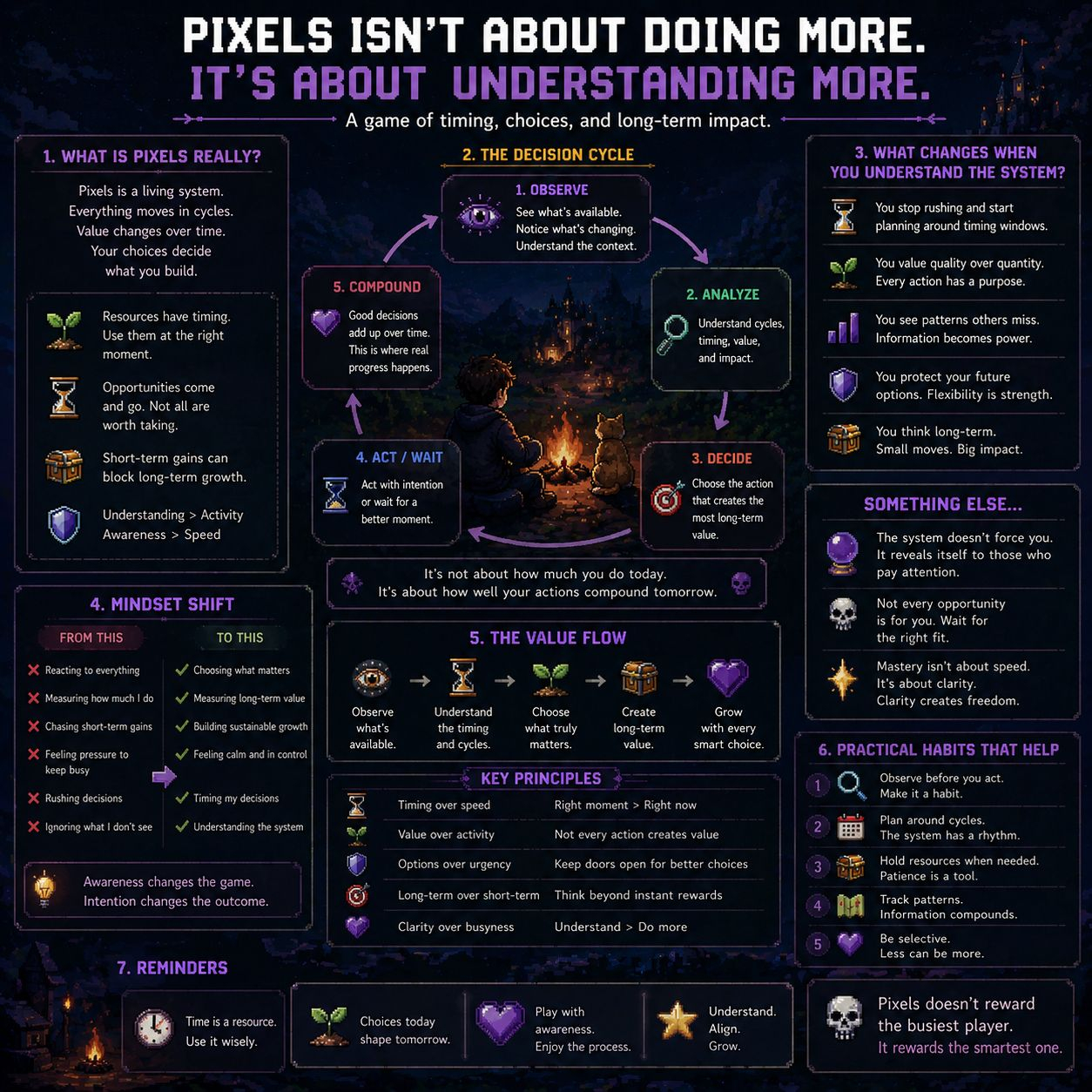
I began to realize that #Pixels isn’t really built around constant action. It just allows it. The game gives you freedom to stay busy, but it doesn’t necessarily reward you for using that freedom without thinking.
That’s a subtle difference but it changes everything.
Because once you see that, you start questioning your own habits.
Why am I using this right now?
What happens if I wait?
Is this actually helping me… or just keeping me occupied?
Those questions slow you down.
And at first, slowing down feels uncomfortable.
You feel like you’re missing out. Like you’re not playing properly. Like you should be doing something instead of just observing.
But that feeling fades once you start seeing the results.
Because waiting in Pixels isn’t empty.
It’s part of the system.
Resources don’t just exist they move through phases. Some become more useful later. Some lose value if you rush them. And some only make sense when they fit into a bigger sequence of decisions.
Once you notice that, you stop treating everything as urgent.
You start treating everything as contextual.
That’s when the game opens up in a completely different way.
You’re no longer reacting to what’s in front of you.
You’re thinking about how your choices connect.
Even simple actions start to feel different. Using a resource isn’t just about using it it’s about when and why. Completing a task isn’t just progress it’s positioning yourself for what comes next.
That layer isn’t obvious at first.
But once you see it, you can’t ignore it.
And it naturally changes how you play.
You stop trying to do everything.
You start trying to do the right things.
I also started noticing how this affects different players.
Some still move quickly, clearing everything, staying constantly active. It looks productive, and it is in a certain way.
But others move with a different mindset.
They’re slower, but more precise.
They don’t chase every opportunity. They let things sit. They wait even when they don’t have to.
And that waiting isn’t hesitation.
It’s awareness.
They understand that value in Pixels isn’t fixed. It shifts depending on timing, on sequence, and on how well your actions align with the system.
That realization changed how I define progress.
It’s not about how much I do in a session anymore.
It’s about how well my decisions fit into the bigger picture.
And that makes the experience feel very different.
Less rushed.
Less reactive.
More intentional.
Sometimes that means doing less.
Sometimes it means waiting longer than I’m comfortable with.
Sometimes it means skipping something that looks useful.
But over time, those choices start adding up.
Not in a dramatic way but in a steady one.
And that’s when it hit me:
Pixels didn’t suddenly become deeper.
I just stopped playing it on the surface.
Because once you move past that surface layer, the game isn’t really about activity anymore.
It’s about understanding how things connect.
How value moves.
How timing shapes outcomes.
How small decisions influence what comes next.
And when you start thinking that way, the game doesn’t feel like something you’re trying to keep up with.
It feels like something you’re slowly learning to read.
