
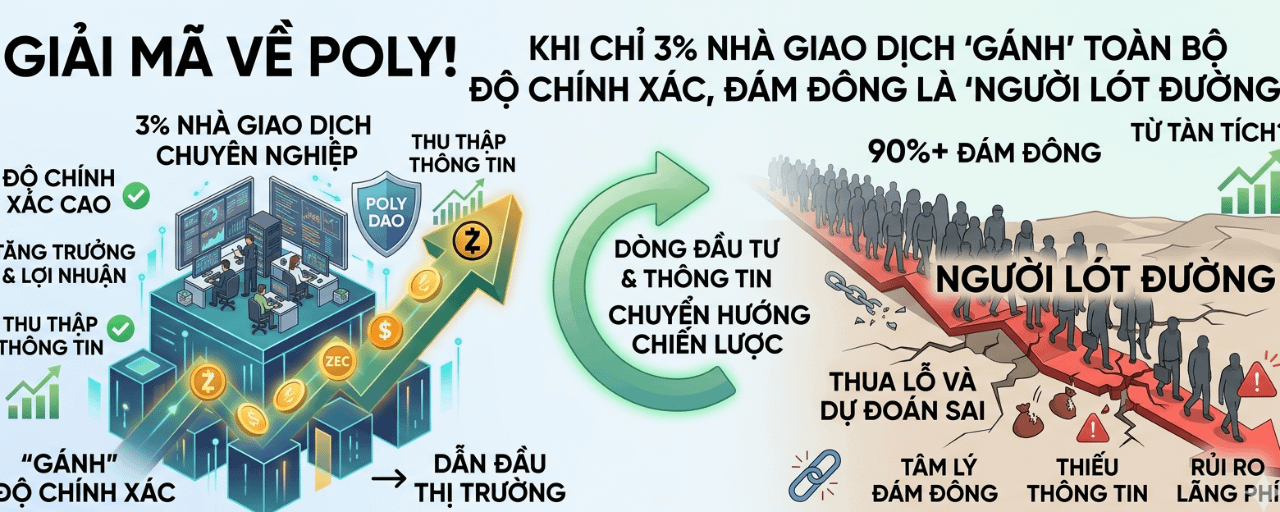
Prediction markets have long been marketed with an alluring concept: "The wisdom of the crowds." However, a large-scale academic study just published has thrown a cold bucket of water on this marketing message.

According to a study by scholars from the London Business School and Yale University, the astounding accuracy of Poly is actually "the wisdom of a well-informed minority, not the crowd."
Here are the groundbreaking findings from this report.
🔷 The Huge Data Picture: When 3% 'Take the Whole' of the Zero-Sum Game
A study revised on April 25, 2026, analyzed every transaction on Poly from 2023 to 2025. The data set is incredibly vast with 1.72 million accounts, 210,322 prediction markets, and a total trading volume reaching $13.76 billion.
The results indicate a brutal polarization:
Just over 3% of accounts are classified as 'skilled winners.' This group, along with market makers, accounts for over 30% of the total profits on the platform.
The majority of users, about 67%, are classified as 'unskilled losers or unlucky.' This group bears the brunt of the aggregate losses on the platform, effectively serving as the capital source that fuels the profits for the aforementioned minority of 3%.
🔶 Luck or Skill?
To determine what truly constitutes skill, the authors ran a randomization test – randomly reversing the buy/sell direction in each person's trading history up to 10,000 times.
The results show that Gross Profit and Loss (P&L) do not accurately reflect true capabilities:
Only 12% of the highest earners match the 'skilled' group.
About 60% of the 'lucky winners' immediately revert to losing status when tested on a different event file.
However, for the elite 3% group, their skills are extremely stable. Up to 44% of accounts maintain a winning streak through cross-validation (for comparison, this rate in actively managed mutual funds is only about 10%).
🔷 The Shadow of Insider Trading
Another concerning dark corner reported is the presence of insider trading. Researchers have pinpointed 1,950 accounts showing unusual activity: opening right before a single event and going 'dormant' permanently after the event resolves.
This group of suspicious accounts has the ability to impact market prices 7 to 12 times more than typical skilled traders per USD. However, because they only focus on individual events, they do not contribute to the overall accuracy of the platform.
The report cites a case from late December 2025 to early January 2026. Three accounts made over $630,000 by betting on Maduro's collapse just before the announcement of the U.S. military campaign. This incident perfectly coincides with the first insider trading lawsuit related to the prediction market filed by the Commodity Futures Trading Commission (CFTC) against a U.S. Army Sergeant for insider trading.
🔶 Pressure Surrounds the Elite Circle
This study emerges at an extremely sensitive time. Polymarket is currently negotiating to raise another $400 million with a staggering valuation of $15 billion.
The data above has dealt a heavy blow to the core message of the industry CEOs. Tarek Mansour and Shayne Coplan have proudly claimed that their platform is proof of the 'wisdom of the crowd' and is 'the most accurate predictor humanity has ever had.'
Now, all eyes are on the lawmakers. Legislators in Washington, New York, and California have begun proposing bills and orders aimed at tightening regulations and preventing insider trading on these platforms.
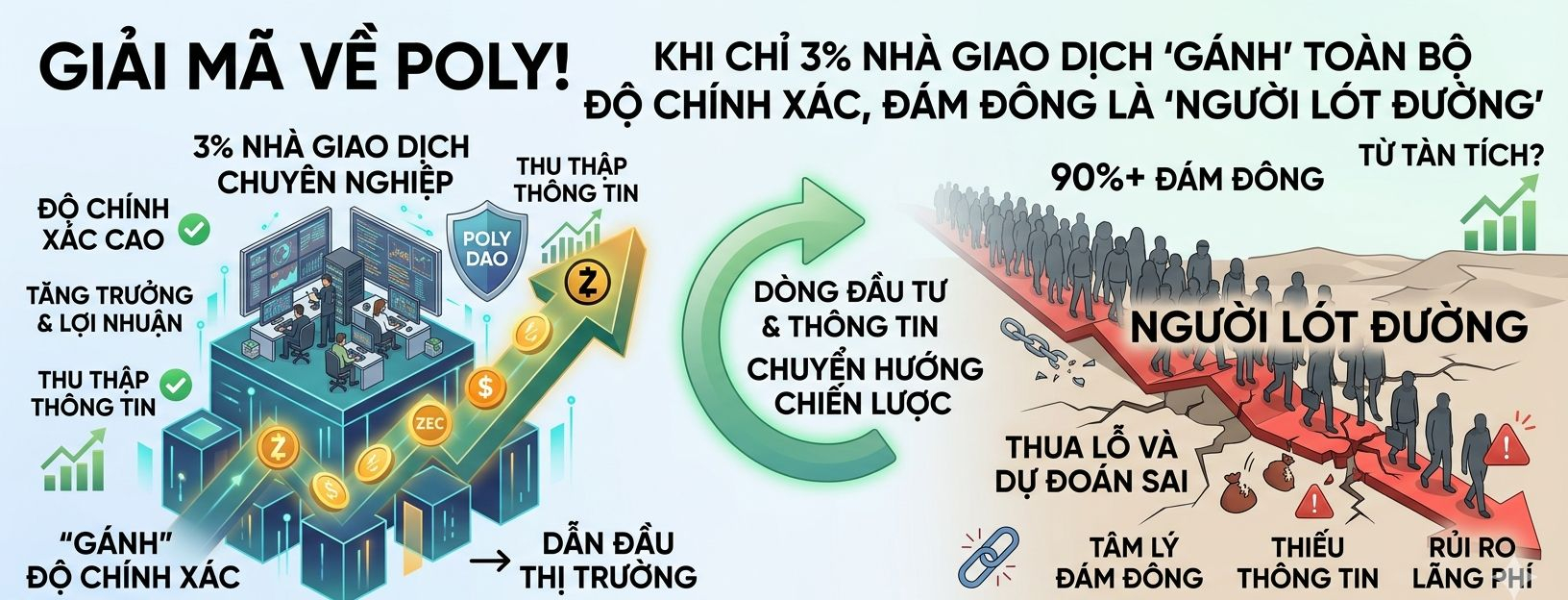
The prediction market is indeed a formidable information synthesizer. But that 'machine' doesn't run on the wisdom of the masses; it's operated by a small group of elites and sometimes even individuals holding insider information. For the average user, this remains a high-risk arena where they are more likely to become 'the bill payers' than the winners.