
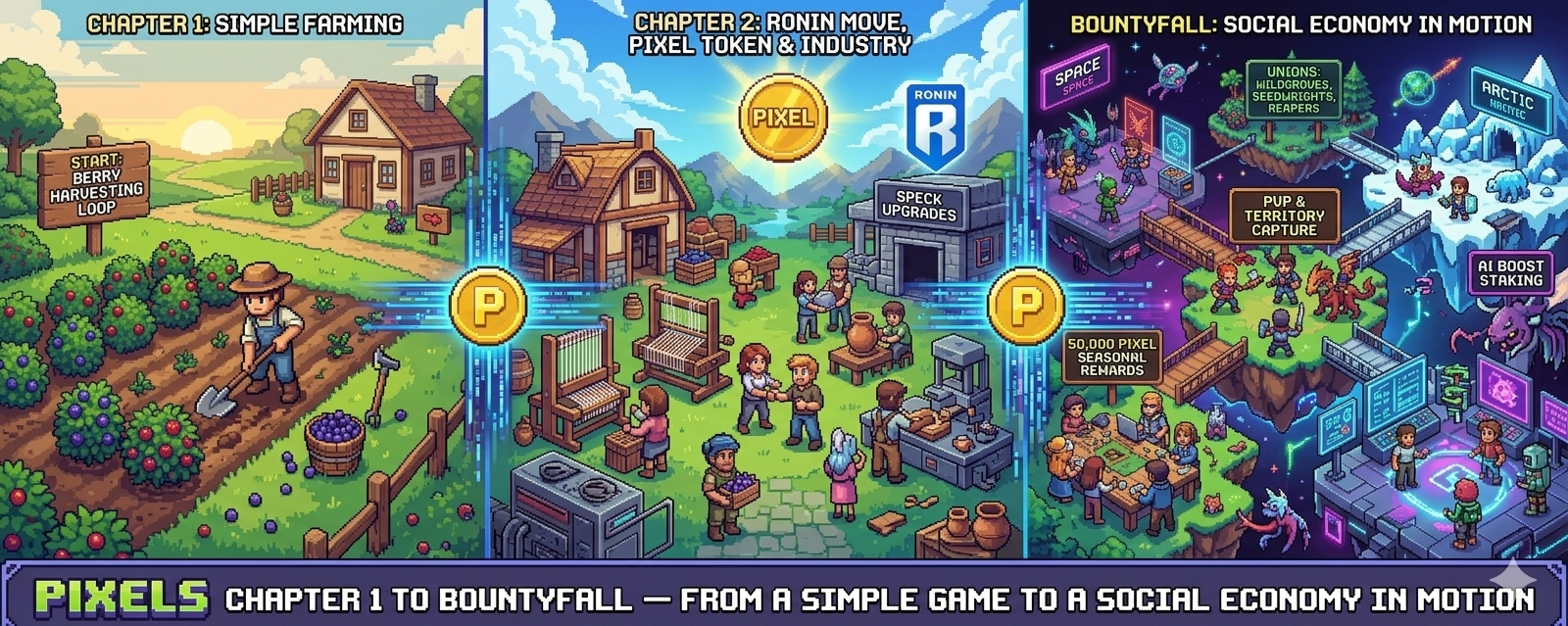
When I think about @Pixels , I do not see just a game timeline. I see a strange kind of evolution, something that starts off looking light, familiar, even harmless, and then slowly begins to feel much bigger than what it first appeared to be. At the beginning, everything was simple in the most convincing way. Chapter 1 was farming, land, and that Berry-style earning loop that made the whole thing easy to understand from the outside. You clicked, collected, returned, repeated. Nothing looked complicated, and maybe that is exactly why it worked. It had the kind of simplicity that quietly turns into habit, and for many players it became more than a game session. It became a routine, a rhythm, almost a small part of daily behavior.
Then Chapter 2 arrived, and the mood changed. The move to Ronin, the introduction of the PIXEL token, and the rise of industry-related progression and Speck upgrades made it clear that Pixels was no longer just a relaxed time-pass experience. The structure became more serious, more layered, and more connected to systems that felt larger than the farm itself. At that point, it was hard not to wonder whether the game was slowly becoming an ecosystem, or whether we were simply watching complexity grow in real time. The experience was still familiar, but it no longer felt flat. Something deeper was beginning to take shape underneath the surface.
And then Bountyfall changed the conversation again. This was not just another update in the usual sense. It introduced a different kind of energy, one that felt more collective, more strategic, and more socially charged. The union system immediately stands out because it shifts the player’s role from an individual farmer into something closer to a member of a living group identity. Wildgroves, Seedwrights, Reapers — these names sound like fantasy, but the system behind them points to something far more practical. The player is no longer working alone in isolation; their effort is now part of a shared outcome. That changes the emotional structure of the game. It stops being only about what one person earns and starts becoming about how a group performs together. That is where the idea of a small social economy begins to feel less exaggerated and more natural.
What makes Bountyfall even more interesting is that it does not stop at collaboration. The addition of PvP, combat, territory capture, and competition brings a different pressure into the system. Pixels used to feel calm and self-contained: come in, farm, leave. Now the player is entering an environment where strategy matters, timing matters, positioning matters, and other people are no longer just neighbors in the system — they are rivals, opponents, and sometimes the main obstacle between you and progress. Once competition enters a game, behavior changes immediately. Players stop simply participating and start optimizing. That is where depth appears, but so does risk. A deeper system can create stronger engagement, but it can also create tension, exclusion, and a constant need to keep up.
The reward structure only adds to that feeling. Around 50,000 PIXEL tokens per season sounds significant, but the number itself is not the real story. The real question is who captures those rewards, under what conditions, and whether the distribution actually reflects balance or simply rewards the most active and organized participants. That question matters because it tells you whether the ecosystem is healthy or whether it is gradually tilting toward a very specific type of player. The new lands, like Space and Arctic, should also be seen as more than just new maps. They are new behavioral environments. New areas create new strategies, new risks, new forms of competition, and new ways for players to define themselves inside the system. Expansion in a game is never just about geography; it is about how player psychology expands with it.
One of the most striking parts of the whole direction is the AI boost feature. On the surface, it sounds technical, almost mechanical, but the underlying idea is actually very simple: the more you commit, the more you may gain in return. That idea can be powerful because it gives players a reason to invest more deeply. At the same time, it can also create pressure, because once productivity becomes tied to staking or commitment, the line between progression and obligation starts to blur. That is why the system feels both promising and slightly uneasy at the same time. It has the potential to reward dedication, but it can also become another intelligent layer designed to keep engagement rising.
And maybe that is the real identity of Pixels now. It is no longer just a farming game in the old sense. It is becoming a living system where rewards, strategy, identity, competition, and group behavior all shape one another. The fun is still there, but it is not the same kind of fun anymore. It is less casual, less frictionless, and much more connected to how players position themselves inside a changing economy. That creates a real dilemma. When a game evolves into a system that behaves like an economy, does it remain fun in the same way, or does the meaning of fun itself change? Maybe the answer is that it becomes something else entirely — deeper, more demanding, less comfortable, but also more interesting.
That is why Pixels feels difficult to define now. It is not just a farming loop anymore, and it is not quite a finished economy either. It sits in that in-between space where games, incentives, communities, and systems all start to blend. And maybe that uncertainty is part of the experience. Maybe the real story is not about fully understanding Pixels right away, but about watching it evolve and feeling the shape of that evolution before the final form is even visible. The old simplicity is still somewhere inside it, but now it works differently. It moves slower, perhaps, but it reaches deeper.