
This morning, I logged into Pixels earlier than usual, not to farm, craft, or do anything special. I just stood near the edge of the map, watching players run back and forth between plots like a habit repeated so many times that I'm no longer sure if it's a deliberate behavior or just inertia.
One thing made me pause a bit. No one mentions $PIXEL while playing at all. At least in what I observed directly. Everything happens as if the token only exists 'outside the game session', while in the game, there are only resources, crafting, moving, and trading.
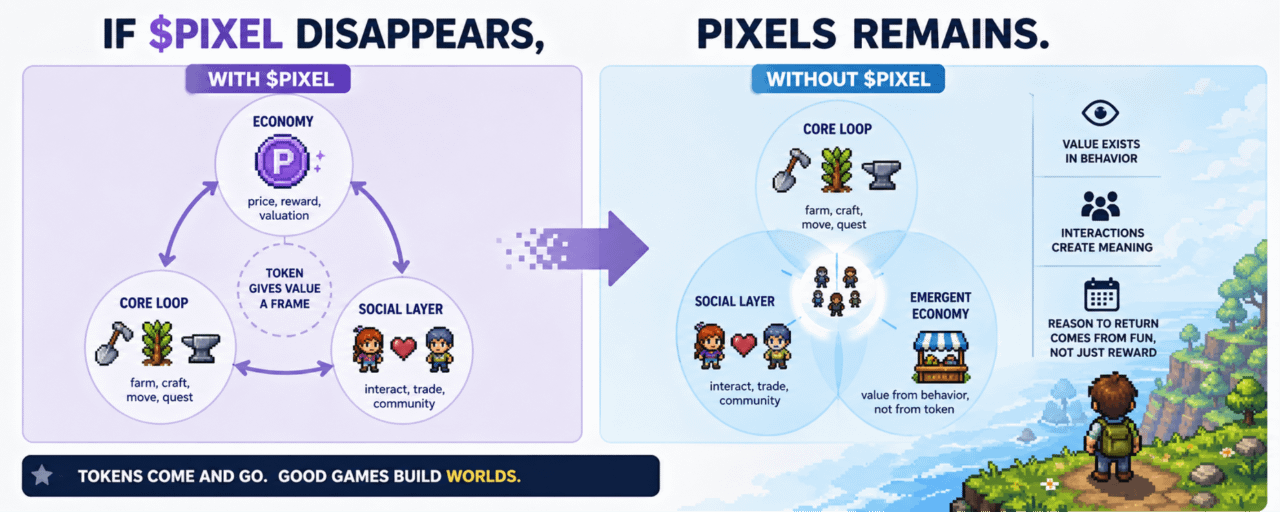
That got me wondering: if one day $PIXEL completely disappears, what will Pixels have left?
Previously, I thought it was straightforward. GameFi that loses its token is doomed. Incentives disappear, players leave, liquidity dries up. Axie Infinity at its peak reward phase is the clearest example, where almost all behavior was pulled towards ROI: breeding, farming SLP, cost arbitrage and rewards. When this incentive collapses, the core loop collapses as well.
But Pixels give me a different feeling.
I tried to break it down into three layers: the core loop is farming, crafting, moving, and small quests; the social layer is short interactions, quick trades, standing close together in the same area; the economic layer is where the PIXEL token plays a role in valuation and rewards.
But the more I observe, the more I see that these three layers aren't as distinctly separable as the theory suggests.
The last time I was in the farming area, I realized resources don't carry value on their own. They only mean something when they go through the harvest, storage, craft chain and touch the needs of other players. But this chain isn't always complete. Many resources stop midway just because they lack the next touchpoint.
I tried crafting a glass bottle from materials bought in the market. On the surface, it looks like a simple loop: buy, craft, sell. But where the value comes from is unclear. Is it from the token, or from many people running the same recipe at the same time?
If you take the PIXEL token out of the system, the market still exists. But it no longer has a clear price system; it resembles a network of overlapping behaviors, where value is formed from the density of interactions rather than a fixed valuation unit.
What stops me is the opposite possibility: PIXEL might not create social or economic layers, but merely 'names' the interactions that have already occurred in the core loop. Farming, crafting, and trading can generate relative value if the density is high enough. The token at this point is just a layer that helps the system be easily read from the outside.
In GameFi environments, this isn't unreasonable. There's a constraint that almost always exists: the rate of token sink must be large enough to absorb emissions. Otherwise, value doesn't just disappear; it gets diluted in behavior. In fact, many early GameFi models often have emissions 1.2x to 2.5x higher than sinks to maintain activity. When sinks weaken compared to activity, value gradually shifts from the token to the behaviors within the game.
The key point isn't in the numbers, but in the consequences: the economic layer is no longer central but becomes a layer that records behaviors.
If that's the case, social and economic layers aren't two separate layers. Social is when observing behavior between people. Economy is when attaching a unit of measure to that behavior. If you remove $PIXEL , social still exists, but the economy loses the ability to frame it, and value returns to a pure behavioral state.
Compared to Axie, the difference lies in the fact that Axie allows the economic layer to pull all behaviors. Players enter the game to optimize profits. The core loop gets bent according to token flow. When the incentive disappears, the system collapses very quickly.
Pixels don't give me that feeling. The core loop still runs even when $PIXEL is separated. Farming, crafting, and trading still create a stable rhythm, like a self-sustaining behavioral system before the pricing layer.
There are times when I stand in the trading area and observe players exchanging resources. No one mentions $PIXEL, but the price is still present through their reactions. One person trades quickly or slowly, another accepts or retreats. Price doesn't need to be named.
At this point, I started to doubt the initial assumption: the economic layer is not a coordinating layer, but just a way the system clarifies what has already happened in the core loop and social interaction.
If the PIXEL token completely disappears, the core loop still exists. The social layer won't vanish immediately either. But the economic layer doesn't disappear; it dissolves into the social layer. The system doesn't collapse but shifts from a measurable state to a state that can only be observed through behavior.
And the final question still lingers: can a system like this maintain a reason for players to return every day when there's no clear incentive layer at the center anymore?
