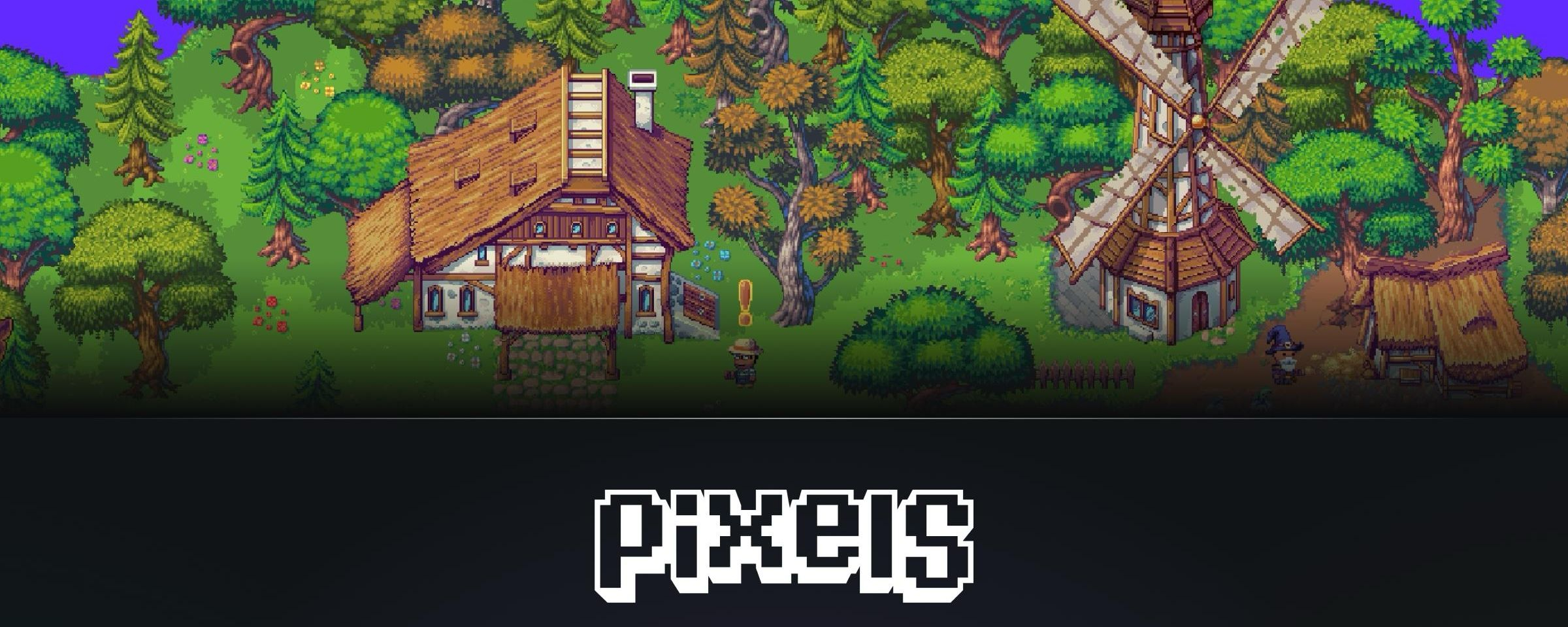
Honestly, I've been logging into Pixels every day for almost a year now. From not knowing much beyond just planting crops to now focusing on the map to track land transactions, calculating resource yields, and adjusting my staking positions, the biggest takeaway for me is: most people still don't get the value of this land.
A lot of folks treat Pixels like a casual game, just logging in daily to water their crops and feed their pets for ten minutes. That's totally fine; games are meant to be relaxing. But if you're willing to dig a little deeper, you'll realize that the virtual land you're stepping on every day might actually be the hardest asset in the entire game.
Let’s start with the basics. The total number of land parcels in Pixels is fixed at 5,000, and it won't increase. Each piece of land is an independent NFT with its own fixed coordinates, resource types, and upgrade potential. If you check the map, you'll see that locations near guild battle entrances, teleporters, and player-formed trading hotspots have listing prices significantly higher than the wild lands. I know a veteran player who bought a piece of land close to the main teleport point for less than $500 last year. He leveled it up and built a processing facility on it, and this year someone offered him nearly $3,000 to buy it, but he didn't sell. This isn't just a story; many people in the community know about this.
However, if you only see the fixed total land supply and scarce locations, you're only scratching the surface. The real power of land lies in its role as a production asset in the game economy, not as a consumable.
People with land can plant high-margin crops, build processing lines, or even set up a small resource synthesis station on their plots. Those without land can still participate; you can help out on others' lands by harvesting, watering, and fertilizing, earning some labor rewards in return. This creates a natural hierarchy: those with assets tend to focus on management and rental income, while those without assets start from labor. I don't see this as exploitation; rather, I believe this design injects vitality into the game. If you want to scale up production, you'll need more land; if you want a good piece of core land, you'll have to go to the market and use $PIXEL to buy it. Every bit of activity in land trading rigidly increases $PIXEL consumption.
Now, let’s talk about staking. I've participated in several rounds of staking in Pixels, and my biggest takeaway is that this mechanism is more user-friendly than many think. It's not the kind of design where your money is locked away forever; you can initiate an unstaking request at any time, but the funds won't arrive instantly—you need to wait 72 hours. I think this 72-hour waiting period is quite clever; it can prevent impulsive sell-offs while ensuring you don’t feel trapped. Especially during times of high market volatility, the staking pool acts like a shock absorber for the game.
Another thing that many people may not realize is the cross-game aspect. The officials have made it very clear that $PIXEL is set to become a multi-game token. Currently, external games like Pixel Dungeons and Forgotten Runiverse are already integrating. This means that your piece of land might not just help you make money in this farm; the resources it produces might one day be usable in another game. The value of land expands from a single game to the entire ecosystem—this logic holds.
Of course, talking about the good stuff isn't enough; we need to discuss the real issues too. The official sources haven't fully disclosed the real-time data panel for land transactions, so most of the time, we rely on third-party markets and community listings to guess the market trends. The transparency of information definitely has a lot of room for improvement. Furthermore, the resources required for land upgrades and facility construction are quite substantial, making it really tough for casual players who only log in for a short while each day to level up their land. As a result, veteran players keep getting stronger, while the entry barrier for newbies is being raised unconsciously. If the project team doesn't pay attention to this issue, it could affect the influx of new blood in the long run. And then there's the Gas fees; the Ronin chain is significantly cheaper than the Ethereum mainnet. Currently, the minimum Gas is 20 Gwei, which fluctuates based on network conditions, but even so, if you're making a lot of trades in one day, the accumulated costs still need to be calculated.
When you compare Pixels with other similar blockchain games, the differences are quite apparent. Many projects come out swinging with gold farming, but their economic models collapse within three months. Pixels stands out because its land is solidly backed by NFTs, and the total of 5,000 parcels is a hard cap. Moreover, in the entire economic cycle, it's not just a decorative asset; it's a core asset essential for scaling operations. With the added control from staking and cross-game expansion, this model is indeed pretty solid.
Finally, back to myself. After playing for a while, I no longer view Pixels as a game I must log into daily just to harvest. I prefer to see it as a small experimental ground in a pixelated world. Some people come here to unwind, some to make friends, and others to gradually manage their own piece of land. I think the latter suits the long-term rhythm of this game better. I won't advise anyone to buy anything or predict price movements. Just based on the mechanics, data, and what I see in the game every day, that piece of digital real estate, which many only see as a farming grid, might actually carry more weight than it appears.