
I often catch myself wondering what it really means to own something in a game. I can spend weeks building progress, collecting items, or shaping a digital space, but at the end of the day, it all exists on someone else’s terms. That realization isn’t new, but it still feels unresolved.
For most of my experience with online games, I’ve understood that everything I earn is temporary. My account can be restricted, the rules can change, or the game itself can disappear. None of it is technically mine. I’ve accepted that reality, but I’ve also seen how much value players attach to what they create inside these worlds.
Before blockchain was introduced into gaming, I noticed how players tried to solve this problem on their own. There were forums, trading groups, and unofficial markets where people bought and sold items or entire accounts. It showed that digital ownership mattered to people, even if the systems supporting it were unreliable. There was always a sense of risk, like participating in something that wasn’t fully recognized.
When blockchain started entering the space, it felt like a possible shift. The idea that I could hold digital assets independently of a game sounded logical. Instead of everything being locked inside a platform, ownership could extend beyond it. But the early versions I saw didn’t quite work for me. They often focused too much on earning and not enough on playing, which made the experience feel less like a game and more like a system.
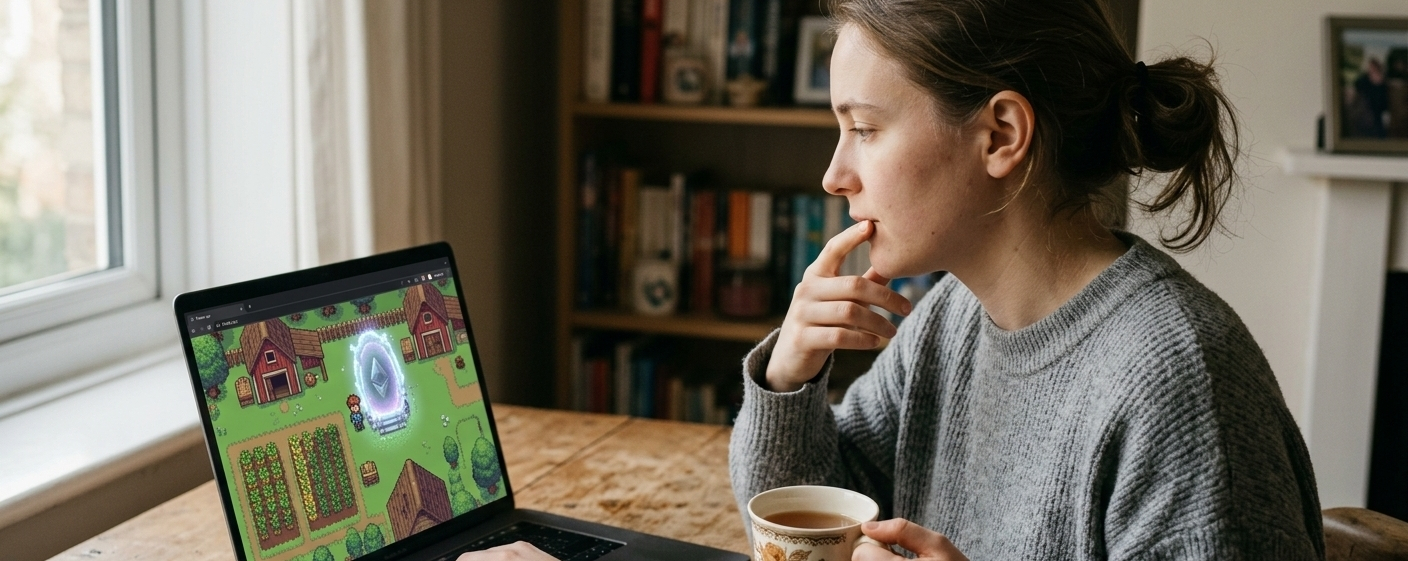
Pixels.xyz seems to approach things in a quieter way. When I look at it, I don’t immediately feel like I’m stepping into a complex financial environment. It looks and feels like a simple farming and social game. I can plant crops, move around a shared world, and interact with other players. That familiarity makes it easier to engage without overthinking it.
At the same time, I know there’s another layer underneath. Some of the things I interact with in the game can exist beyond it. Land, items, and progress can be connected to blockchain assets, which changes how I think about what I’m doing. It’s not just about passing time; it’s about participating in something that might persist outside the game itself.
What stands out to me is how the project tries not to overwhelm me with technical details. I don’t need to understand everything from the start. I can just play, and if I want to go deeper, I can. That approach feels more natural compared to other systems that expect immediate understanding of wallets and transactions.
I also get the sense that Pixels.xyz is trying to become more than a single experience. It hints at a future where different games or environments could connect through shared assets. The idea that something I earn in one place could have meaning somewhere else is interesting, though I’m not sure how practical it is yet.
As I think about it more, I start to see the complications. Ownership sounds simple in theory, but in practice, it creates new challenges. If too many assets exist, they lose their value within the game. If too few exist, it becomes harder for new players to feel included. Balancing that over time seems difficult.
There’s also the question of whether I actually want to deal with the extra responsibility. Traditional games let me focus entirely on the experience. Here, even if it’s subtle, I’m aware that there are systems behind the scenes that require attention. For some players, that might be empowering. For others, it might feel like unnecessary effort.
Trust is something I keep coming back to as well. I’ve seen projects in this space build excitement and then fade away. That history makes me cautious. Pixels.xyz feels more grounded than some others, but it’s still part of an environment where long-term outcomes are uncertain.
From a gameplay perspective, I find the simplicity both appealing and limiting. It’s easy to get into, but I wonder how it holds up over time. If the core loop doesn’t stay engaging, the idea of ownership alone might not be enough to keep me interested.
I also think about who this is really for. Even though the game tries to be accessible, there’s still a gap between players who understand blockchain and those who don’t. Not everyone wants to learn these systems just to play a game, and that could limit how widely it’s adopted.
At the same time, I can see why some people are drawn to it. The idea of having more control over digital assets changes how I relate to the game. It feels less temporary, even if that feeling comes with trade-offs.
What I see in Pixels.xyz isn’t a finished solution. It feels more like an ongoing experiment, trying to find a balance between familiarity and change. It doesn’t fully solve the problem of ownership, but it does explore it in a way that feels more grounded than earlier attempts.
I also notice how the project continues to evolve. It’s not presenting itself as something complete. Features are added over time, and the system adjusts based on how people use it. That flexibility is interesting, but it also means I’m engaging with something that’s still taking shape.
In a way, the design feels cautious. It doesn’t try to reinvent everything at once. It keeps the gameplay simple and introduces new ideas gradually. That makes it easier to approach, but it also raises the question of whether it goes far enough to stand out.
When I step back, I don’t see Pixels.xyz as a clear answer. I see it as part of a larger conversation about how digital worlds might change. It suggests a different way of thinking about ownership, but it doesn’t claim to have solved it.
And I’m left thinking about something simple: do I actually need to own what I build in a game, or do I just want those experiences to feel real enough that ownership becomes less important?
