
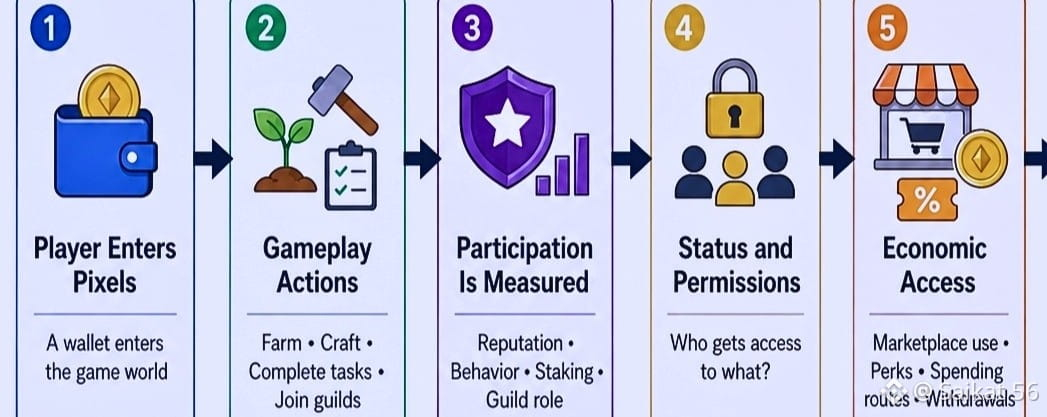
When I opened PIXEL today, at first it felt like any other crypto game check the chart, notice a bit of up and down, then scroll away. But after a few minutes, something shifted. I wasn’t just looking at price anymore; I started noticing the environment itself.🤔
At a surface level, Pixels doesn’t look complicated. A virtual world, some farming, tasks, upgrades, and a token that moves with the market. But inside that simple structure, something more layered is forming a system that feels less like a game and more like an economic filtering space.
Most people still label Pixels as just a “play-to-earn game with a token.” But that label is starting to feel too narrow. Because what’s actually happening isn’t just gameplay it’s structured participation. The system quietly tracks how people engage, how consistently they show up, and what kind of behavior they display. Think of it like a city. Everyone enters through the same gate, but they don’t all end up in the same place.
Some people just wander, some work regularly, some start building their own position inside the system. The city doesn’t explicitly tell anyone what to do but it naturally shapes who belongs where.
Pixels is slowly becoming a kind of “value embedded environment.” Meaning value isn’t just added at the end as a reward it’s already built into the structure from the start. Every action you take doesn’t just produce points or tokens; it also shapes your position within the ecosystem.
From a design perspective, that’s interesting. Because it shifts the game from pure entertainment into a participation framework. Not every user is equal. Not every action carries the same weight. Not every wallet gets the same level of access. Over time, it forms a kind of participation hierarchy. From a trader’s perspective, this is where things get complicated. Markets prefer simple stories.
But Pixels is not simple. It includes off-chain activity, in-game currency systems, permission-based access, staking incentives, and layered rules. It’s a multi-system environment rather than a single-loop token game.
And that’s important. Because the real question is no longer just “is the game good?” The question is: can this system make people come back again and again? If users only show up for rewards, the system eventually becomes an extraction loop people take and leave. But if players start forming guilds, participating in long-term in-game economies, and building social and economic identity inside the world, then it can evolve into something more persistent. That’s Pixels’ real test. Because building a game is one thing, but getting people to stay in a virtual economy is something completely different.
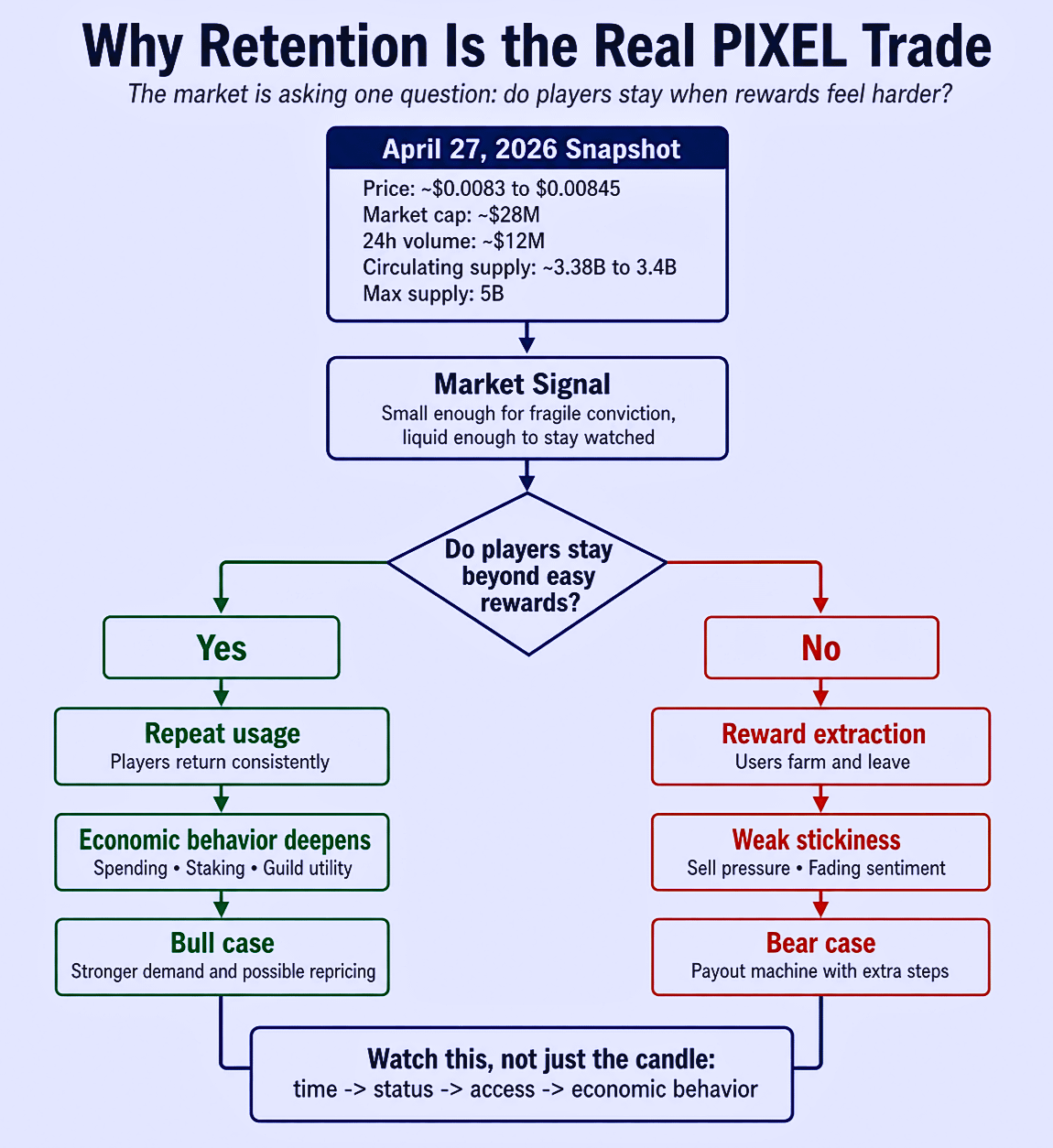
Another key point is that the system is neither fully open nor fully closed. Some parts are permissioned, some are open, some depend on reputation. This mixed structure feels intentional it helps prevent pure exploitation while still keeping onboarding possible for new users. That tension is actually the design.
If everything is open, extraction dominates. If everything is closed, adoption slows down. @Pixels is sitting somewhere in between, trying to balance both sides. In the end, the most important question isn’t about price or charts. It’s whether this environment can truly sustain human behavior over time. Because markets don’t reward design they reward behavior.
If people return, if participation deepens, if engagement becomes sticky, then value eventually follows. And if not, even the smartest design eventually fades into noise.
So the real thought I’m left with isn’t about price at all it’s something simpler: Is this world something people will only visit… or a place they will actually stay in?
Because maybe the real divide in the future won’t be between games and tokens but between what people play… and what they never leave.🫡
