
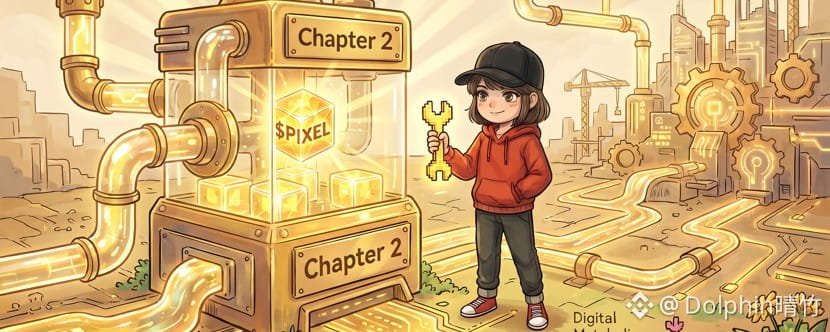

If you're still asking 'what to plant for the most profit' today, it means you haven't grasped the ongoing 'Digital Niche' revolution. The launch of Chapter 2 marks the official evolution of this world from 'linear harvesting' to 'multidimensional gameplay.'
1. Redefining scarcity: from 'resources' to 'pathways'
In Chapter 1, scarcity is tokens; in Chapter 2, scarcity is 'pathways.'
By introducing mutually exclusive skill trees and complex synthesis logic, the devs have essentially created an 'asymmetric information field' in the pixel world. Choosing to become a master carpenter means giving up the chance to be a top chef. This design forces every player to seek out their own 'ecological niche.' The system no longer needs thousands of identical 'farming bots'; it requires a complex society made up of carpenters, chefs, miners, and merchants with complementary skills.
2. The anti-fragility brought by 'interaction friction'
Many people complain that Chapter 2 has become harder and more complex. But from a system designer's perspective, this 'interaction friction' is the strongest moat against automated scripts (Bots).
When synthesizing a high-tier item requires crossing multiple skill levels, consuming various prerequisite resources, and involves random probabilities, the algorithmic complexity for scripts will rise exponentially. This artificially created 'trouble' is actually protecting the interests of real players. It makes 'simple and brute force mining and selling' lose its space, allowing those willing to study the rules and find optimal solutions to gain 'gaming dividends'.
3. Personal thoughts: The 'de-financialization' paradox of Web3 games
#pixel is attempting an extremely dangerous yet alluring balance: it is diminishing the 'financial attributes' by increasing 'game difficulty'.
This sounds ridiculous— a blockchain game actually wants players to focus less on money? But the deeper logic is: only when players start to think about 'how to optimize production paths' instead of 'how much the tokens dropped today' does this economy truly gain 'intrinsic motivation'. It’s selecting a new type of 'digital citizen', who are not just investors but also participants and maintainers of this ecosystem.
My take:
$PIXEL is transforming Web3 games from a 'one-size-fits-all' into a 'Nash equilibrium' laboratory. In this maze, there is no absolute 'wealth code', only a constant 'dynamic balance'. The depth at which you position yourself in this ecosystem determines your survival height in the next cycle.
Stop asking if tomorrow's price will go up. First, ask yourself: where is your irreplaceable 'ecological niche' in this complex society of Pixels?