
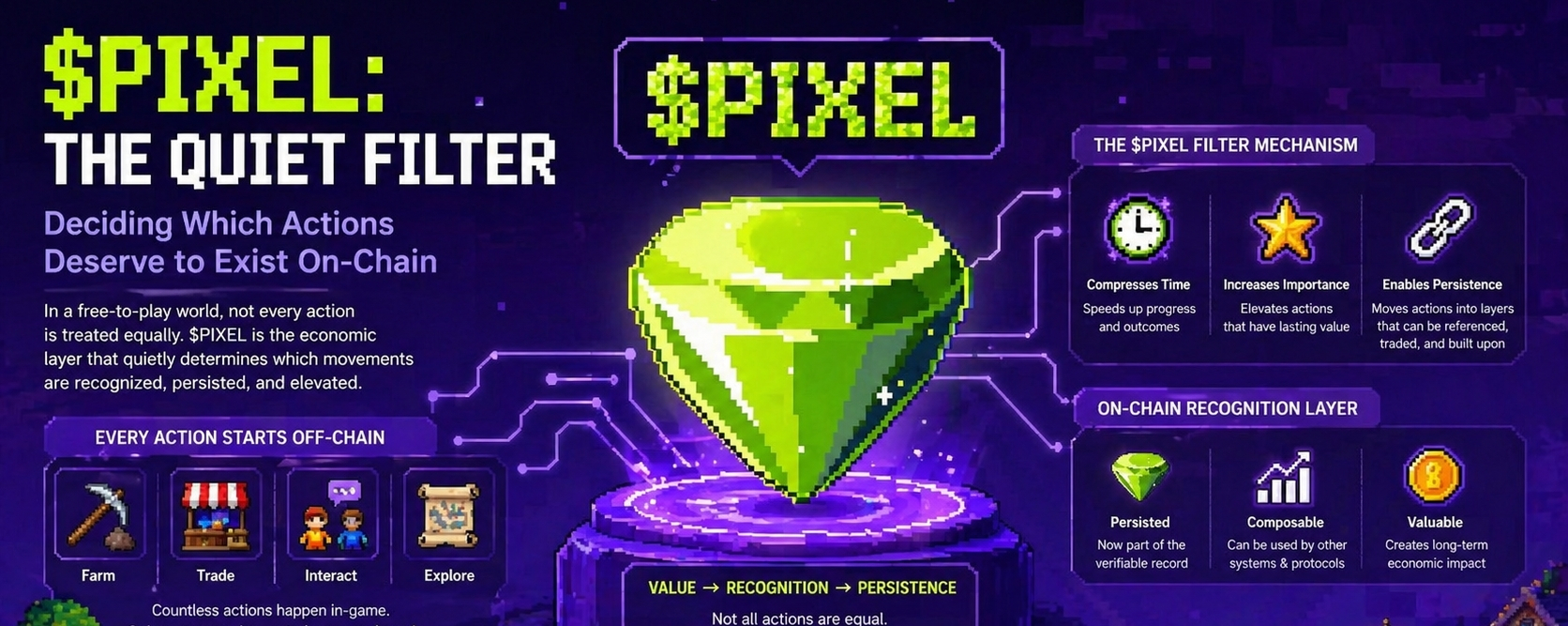

I used to think “on-chain” was a kind of finish line. You do something, it gets recorded, now it counts. Simple. Lately that framing feels off... Not wrong, just incomplete. Most of what people do in these systems never touches the chain at all, and yet somehow the economy still feels active, even meaningful. That gap is where things start getting interesting.
Pixels sits right in that space. On the surface, it feels open. You log in, you farm, you trade a bit, maybe you optimize your loop over time. Nothing really stops you. It doesn’t push you aggressively toward spending either, which is unusual. It gives off this impression that everything you do has equal weight. But after spending more time watching how players actually move through it, I don’t think that’s true.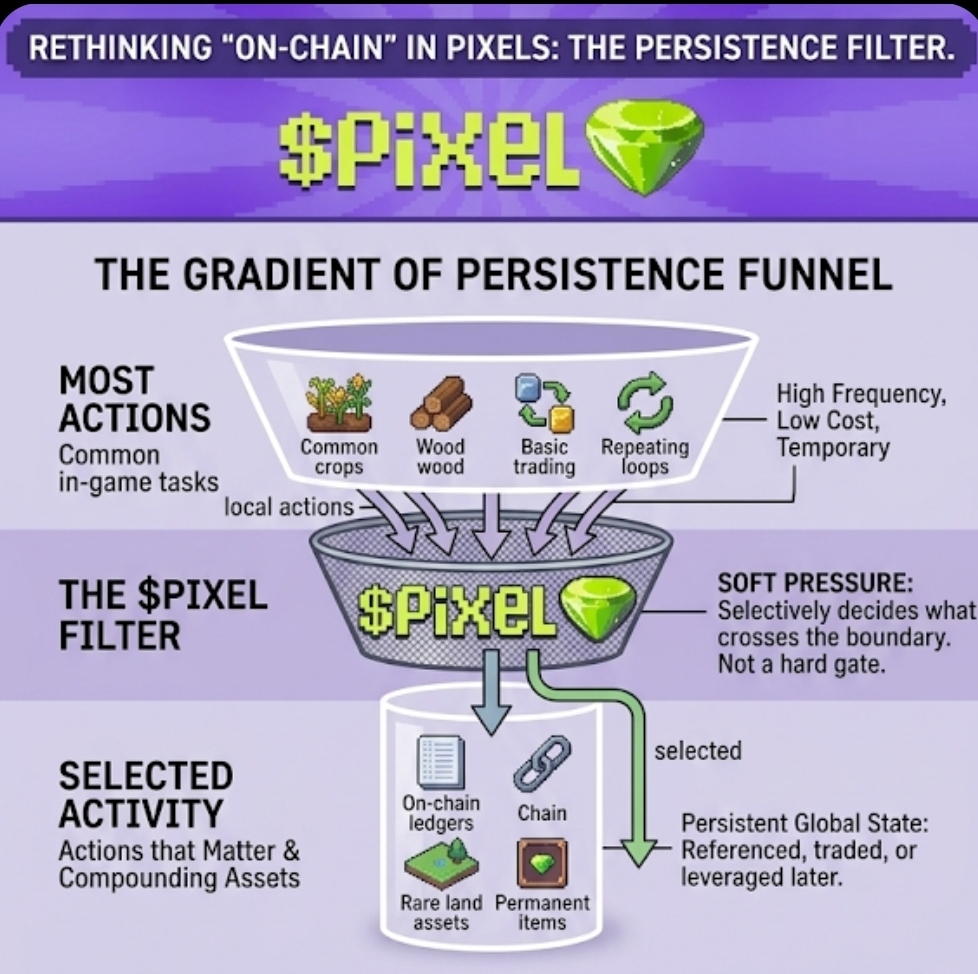
Some actions seem to echo. Others just… disappear.
That’s not obvious at first. You only notice it after a while, when two players put in similar effort but end up with very different kinds of outcomes. Not just in rewards, but in what actually persists. One player’s progress feels like it compounds, like it can be referenced later, maybe even traded or leveraged. The other stays stuck in a loop that resets quietly, even if it looks productive in the moment.
I don’t think this is accidental. It feels designed, but in a way that doesn’t announce itself.
There’s a constraint underneath all of this that people don’t really talk about. You can’t record everything on-chain. Not because it’s philosophically wrong, but because it’s expensive, slow, and in some cases just unnecessary. If every in-game action was pushed onto a blockchain, the system would choke. So something has to decide what crosses that boundary.
In Pixels, I keep coming back to $PIXEL when I think about that decision.
At first I treated it like any other in-game token. A way to speed things up, maybe unlock certain paths. That’s the usual pattern. But the more I watched, the less it felt like a simple utility. It behaves more like a filter. Not a hard gate where you’re blocked without it, but a soft pressure that nudges certain actions toward becoming “real” in a broader sense.
You can still play without it. You can grind. Wait longer. Repeat loops. Nothing breaks. But when $PIXEL gets involved, something shifts. Time compresses, yes, but that’s not the part that stuck with me. What changes is the likelihood that what you’re doing actually gets recognized in a way that lasts.
That word, “recognized,” is doing a lot of work here.
In most systems, recognition is tied to visibility or rewards. Here it feels tied to persistence. Whether an action stays local, inside the game loop, or gets lifted into a layer where it can matter later. Maybe that’s on-chain directly, maybe it’s just structured in a way that other systems can use it. Either way, it stops being temporary.
It reminds me a bit of how privacy systems handle data. They don’t reveal everything. They reveal just enough for a specific purpose. The rest stays hidden, or at least uncommitted. Pixels isn’t about privacy in that sense, but the selectivity feels similar. Not every action is worth exposing to the “global state” of the system.
And exposure has a cost.
So instead of a binary system where everything is either recorded or ignored, you get this gradient. Some actions are cheap, frequent, forgettable. Others require a bit more intention. Maybe a bit more resource. And those are the ones that start to accumulate outside the immediate loop.
If that’s right, then the idea of a “free economy” needs a second look. It’s free in terms of access. Anyone can participate. But economically, it’s still deciding what matters. It just doesn’t do it through obvious restrictions. It does it through incentives that are easy to miss if you’re not looking for them.
From a market perspective, that changes how I think about the token. It’s not just tied to how many players are active, or how much they’re spending in a traditional sense. It’s tied to how often players feel the need to push their actions across that boundary. To turn effort into something that persists.
If that happens once, demand is shallow. If it becomes a habit, something players rely on repeatedly, then it’s different. Then the token starts to sit inside a loop, not outside it.
There’s a version of this where it works really well. Studios get a way to manage what gets recorded without shutting users out. Players still feel free, but the system stays efficient. Over time, you could even see patterns emerge where certain types of behavior are consistently “promoted” because they’re more valuable to the ecosystem.
But it can go the other way too. If players start to feel like their actions only matter when they use the token, the whole thing becomes fragile. The openness starts to look cosmetic. People are sensitive to that, even if they can’t always explain why.
And there’s another risk that’s less obvious. What if most players are fine staying in the local loop? Just playing, not caring whether their actions persist beyond the session. In that case, the demand for pushing things on-chain, or into any persistent layer, might never really build. The system would still function, but the token’s role would shrink.
I don’t have a clean conclusion here. It’s more of a shift in how I’m looking at these systems.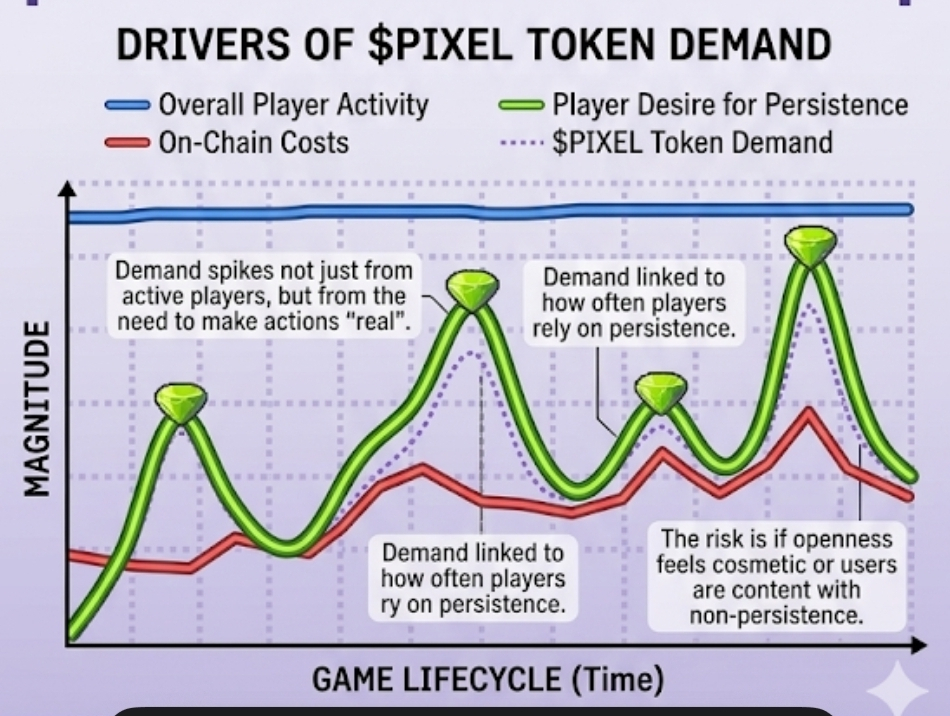
We used to think the important question was how much gets recorded on-chain. Now it feels more like a question of selection. Which actions are worth carrying forward, and which ones can be left behind without anyone noticing too much.
Pixels doesn’t answer that question directly. It sort of lets behavior answer it over time.
And $PIXEL, whether intentionally or not, seems to be sitting right at that boundary, quietly influencing what the system decides to remember.