

If players slow down, increase incentives. If activity drops, add more campaigns. Keep the system active by continuously feeding it value.
It sounds logical.
But the more I look at how systems like the one behind $PIXEL actually behave, the more that idea starts to feel… self-defeating.
Because rewards do not just attract attention.
They consume it.
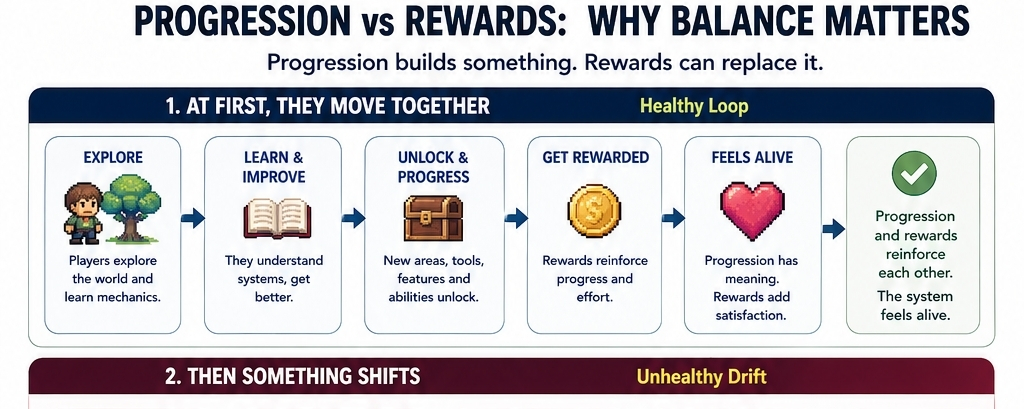
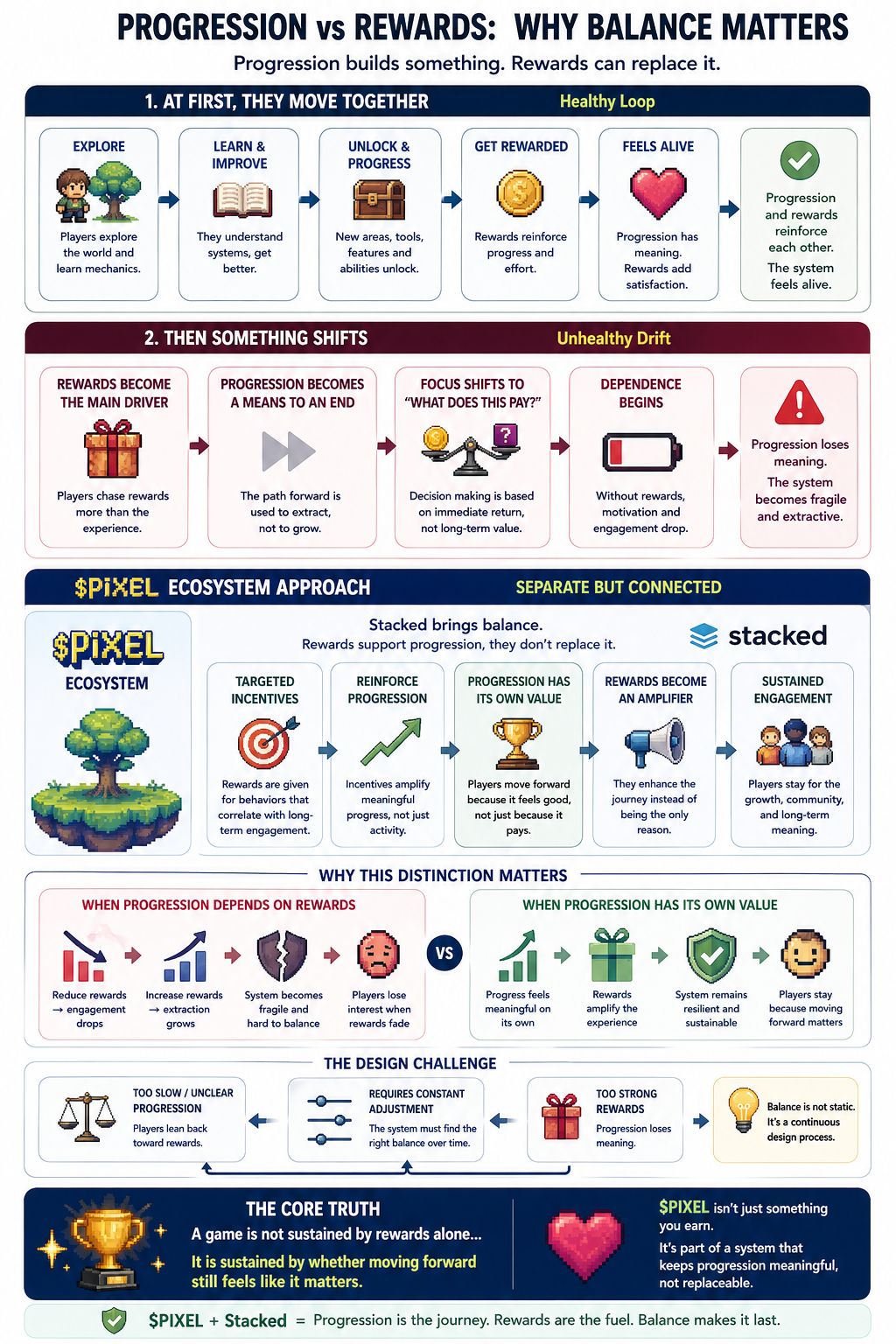
At first, incentives work. Players respond, activity rises, engagement looks healthy. But over time, something subtle happens. What once felt rewarding starts to feel expected. Then it starts to feel routine. Eventually, it stops feeling like a reward at all.
That’s where fatigue begins.
Not because rewards disappear…
but because they lose meaning.
What stands out in the Pixels ecosystem is that it does not treat rewards as something to constantly increase.
Stacked operates in that restraint layer.
Instead of flooding the system with incentives, it tries to place them where they still matter. Timing, context, and player state all influence whether a reward feels meaningful or just another expected output.
In simple terms, the system is not asking “how do we give more?”
It is asking “how do we keep rewards from becoming invisible?”
And that changes how engagement is sustained.
Because once players become conditioned to constant rewards, removing or reducing them feels like a loss, even if the underlying experience has not changed. The system becomes dependent on its own incentives to maintain activity.
That dependency is hard to reverse.
In my view, reward fatigue is one of the quiet risks in GameFi.
Not a sudden collapse…
but a gradual decline in impact.
Pixel sits inside a structure that tries to avoid that path.
Not by eliminating rewards,
but by preserving their significance over time.
Because in the long run, it is not how often you reward players…
it is whether those rewards still feel like something worth responding to.
