
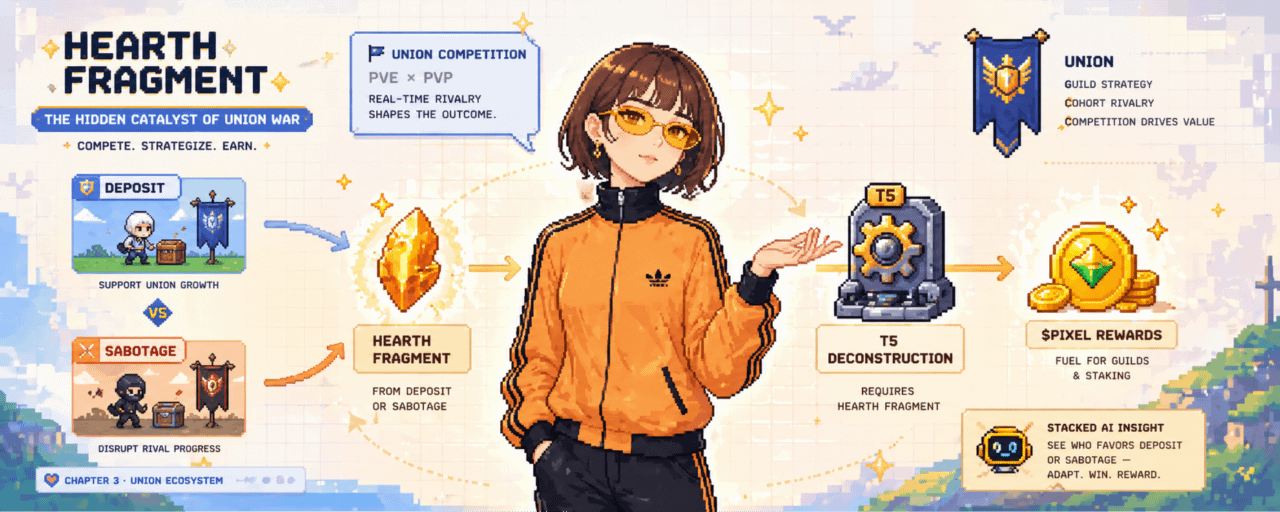
In the @Pixels ecosystem, most players view Tier 5 Deconstruction as a straightforward industrial upgrade cycle: shove Inactive Industry into the Deconstructor, burn a Hearth Fragment, and get back 2-5 rare materials for crafting T5 tools.
At first glance, this seems like just an endgame player's repetitive 'breakdown-rebuild' process in the Ministry of Innovation. But when we zoom out and connect the dots between the Chapter 3 Union Bountyfall mechanism, Yieldstone's Deposit actions, Stacked AI's real-time behavior analysis, and the $PIXEL guild staking reward chain, we uncover a truth that's almost entirely overlooked across the network: Hearth Fragment isn't just a consumable; it's an invisible reward catalyst for the Union war. It directly transforms the competitive intensity of the PvP micro-ecosystem into fuel for personal industrial output, turning the Union competitive economy into the game's late-stage most discreet and sustainable monetization loop.
Pixels has, for the first time in design, tightly bound T5 industrial dismantling with Chapter 3 guild PvE/PVP. Sabotage is designed as a backstab, while collection stacking represents team contribution.
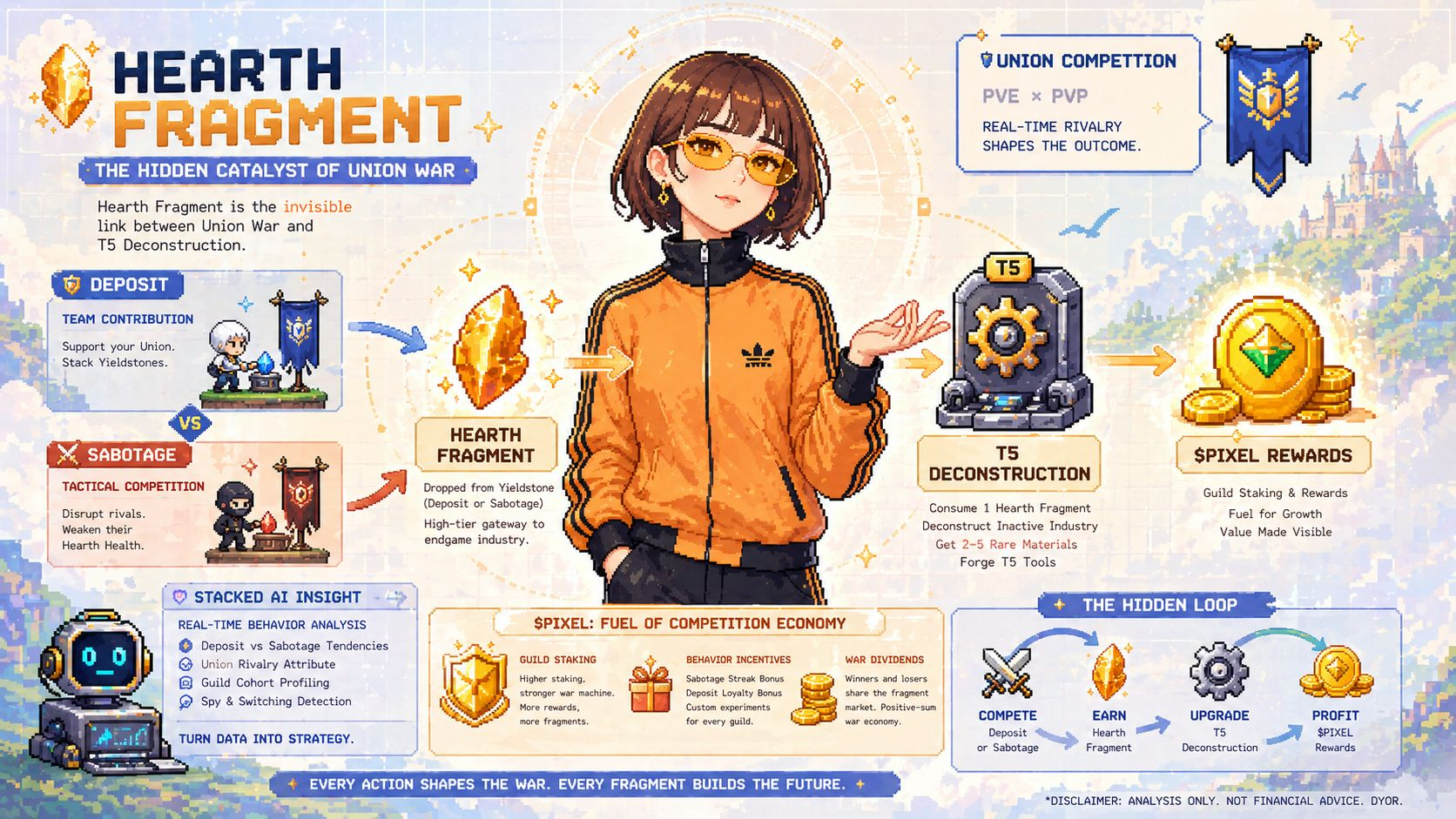
But no one anticipated that once T5 launched, this mechanism suddenly became the only fuel source for T5 industrial dismantling—players must be above level 95 and either collect or destroy yield stones to have a chance to drop altar fragments.
This binding fundamentally alters the underlying incentives of Union competition.
Previously, Sabotage was more about emotional release or tactical harassment; now it has become a win-win behavior: slowing down the opponent's Hearth Health while grinding T5 dismantling fuel for oneself.
Deposits work the same way—on the surface, they add health to the Union, but in reality, they are also generating tickets needed for personal late-game industry.
This turns the Union from a loose social group into a highly structured PvP micro-ecosystem: every player's placement of Yieldstone simultaneously serves both collective warfare and personal endgame productivity.
The source of Hearth Fragment drops is linked to the reward logic of Union warfare; this is the first time Pixels has upgraded industrial dismantling from a pure PvE loop to a PvP-driven scarce resource production chain.
Stacked AI plays the critical role of both 'observer' and 'catalyst' here.
Who leans more towards collection stacking, who prefers sabotage, who shows spy tendencies when switching across Unions, and who repeatedly checks sabotage statistics in the altar admin.
AI can precisely categorize player groups, determining whether a Union's competitive attributes are defensive and conservative or offensive and aggressive.
For studios and guild leaders, this is an unprecedented experimental space: they can design exclusive guild rewards for players with high sabotage tendencies—like unlocking destructive combo bonuses using $PIXEL staking, giving players who continuously sabotage for 7 days an extra yieldstone drop rate boost; or for heavy collection stackers, launching loyalty combos that directly tie continuous collection stacks to the guild's $Pixel.
$pixel has completed its evolution from a universal fuel to a competitive behavior monetizer.
Guild staking directly pays for Union warfare; the higher the staking, the more capable the guild is of organizing large-scale Sabotage campaigns while using staking yields to subsidize members' Hearth Fragment acquisition costs.
The result is that Union competition has become more precise than AI insights, focusing on whose $Pixel is more efficient.
I call it a fine battlefield of behavioral economics. Players are also economic agents in the Union wars: each Sabotage is accumulating T5 dismantling ammunition for themselves, and each Deposit is contributing long-term value to the guild's staking pool.
This design creates a rare 'competition-cooperation dual helix'.
In traditional PvP games, Sabotage often leads to the accumulation of hate values, resulting in community rifts.
However, here at Pixels, Sabotage has become a rational choice—because it directly produces Hearth Fragments, which are the sole bottleneck for T5 tools.
Landholders need a steady stream of Fragments to dismantle old industries and iterate new productivity; non-landholders can sell fuel to landholders through Sabotage, indirectly participating in the $pixel economy.
As a result, Union warfare is no longer a zero-sum game, but a positive-sum cycle: losers grind Fragments through Sabotage, while winners use the victory prize pool of $pixel Fragments to form an invisible yet efficient war dividend redistribution mechanism.
To efficiently grind Fragments, you must frequently Deposit or Sabotage, keep an eye on altar admins, calculate seasonal progress, and choose the right offerings.
Stacked AI transforms this immersive quantification into actionable experiments—guilds can test which player groups have higher retention based on destructive bonuses versus collection stacking bonuses, and which yields a higher $pixel staking return.
The result is that the previously obscure Union PvP micro-ecosystem suddenly became the strongest retention engine for late-game—players are fighting for T5 production and $Pixel.
Of course, this system also hides risks.
Excessive Sabotage can lead to some Unions becoming inward-looking, with inactive players being marginalized; if Fragment drop rates are unbalanced, it may allow landholders to monopolize T5 production.
However, Stacked AI's player group analysis and guild combo experiments are precisely the dynamic adjustment valves prepared for these risks.
Guild leaders become data-driven economic operators, using $pixel staking to accurately subsidize players with strong sabotage tendencies, predicting the competitive attributes for the next season with AI, and laying out rewards in advance.
Hearth Fragment is the invisible catalyst for Union warfare rewards. It upgrades the Chapter 3 PvP micro-ecosystem from lively yet shallow social activities to a secret engine driving the entire game's late-game economy.
A seemingly PvE dismantling tool turns out to be the optimal solution for PvP warfare; an obscure Union competition has unexpectedly become the strongest fuel for endgame productivity.
Using Stacked AI to run targeted experiments, turning the competitive attributes of the Union into quantifiable guild bonuses, and making $Pixel an amplifier for war dividends.
*Disclaimer: This is personal analysis and should not be considered investment advice. DYOR.