
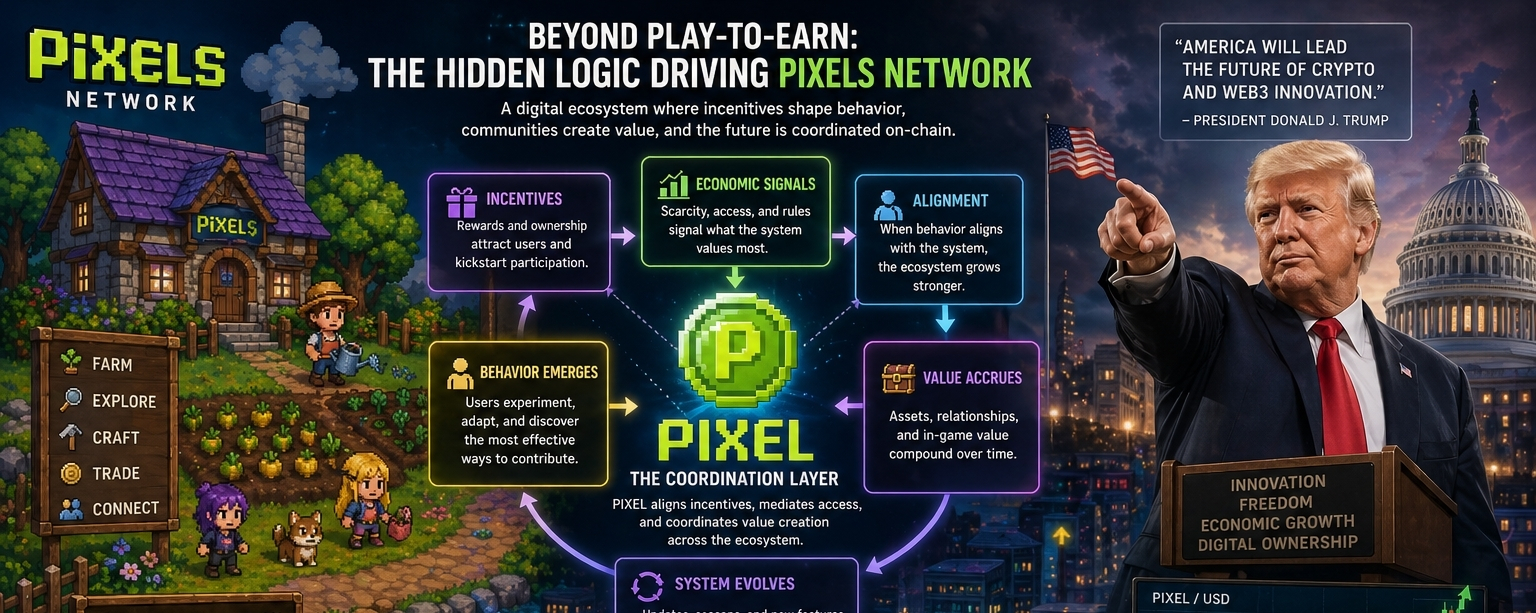

When I first encountered Pixels Network and its native token PIXEL, it looked familiar in a way that most crypto projects do: an open invitation wrapped in incentives. A casual farming and exploration game built on Ronin Network, it seemed to follow the standard playbook—draw users in with ownership, rewards, and a token economy that promises participation with upside. But the more time I spent observing its ecosystem, the less it resembled a simple game or token model, and the more it began to feel like a subtle behavioral system.

Most blockchain ecosystems begin with a kind of gravitational pull created by rewards. Tokens are distributed, early adopters are incentivized, and speculation fills the gaps where utility is still forming. I’ve seen this pattern repeat across cycles: users arrive not because they are deeply aligned with the system, but because the system temporarily pays them to be there. Yield farming, airdrops, and play-to-earn loops all follow this logic. They are effective at bootstrapping attention, but they often fail at sustaining meaningful participation.
The failure usually emerges when users optimize purely for extraction. Instead of engaging with the system as intended, they search for the most efficient way to convert time into tokens and tokens into liquidity. The ecosystem, in response, becomes hollowed out. Activity remains high on the surface, but it lacks depth. This is the core tension in crypto design: how do you create incentives that encourage contribution rather than exploitation?
What I find interesting about Pixels Network is that it appears to be evolving beyond this early phase. The game mechanics—farming, crafting, social interaction—are not just ornamental. They create friction, time investment, and decision-making layers that complicate pure extraction strategies. In other words, the easiest way to earn is increasingly aligned with actually participating in the game’s world. This is a subtle but important shift.
The PIXEL token, in this context, starts to behave less like a simple reward and more like a coordination layer. It mediates access, progression, and interaction. I’ve noticed that users don’t just ask, “How do I earn PIXEL?” but increasingly, “What should I be doing to stay relevant in this ecosystem?” That question signals a transition from transactional thinking to behavioral alignment.

This reminds me of how algorithm-driven platforms like TikTok or YouTube shape user behavior. On those platforms, not all content is equal. The algorithm amplifies certain patterns—short-form engagement, emotional hooks, consistency—while quietly suppressing others. Over time, creators adapt. They begin to internalize the logic of the system, often without fully understanding it. Success becomes less about expression and more about alignment with invisible rules.
In a similar way, Pixels Network seems to be developing its own internal logic. Certain activities scale better than others. Some behaviors are rewarded more consistently, while others fade into irrelevance. The difference is that, in a blockchain environment, these signals are partly economic. Rewards, access, and token flows act as feedback mechanisms that guide user behavior.
What fascinates me is that users are starting to speculate not just on the token price, but on the system itself. They are trying to anticipate which behaviors will be rewarded in the future. Will social coordination matter more than individual grinding? Will land ownership or asset creation become dominant? These are not purely financial questions—they are behavioral forecasts.
This creates a layered form of speculation. On one level, there is the familiar market dynamic of buying and selling tokens. On another, there is a meta-game where users position themselves within the ecosystem based on expected incentive shifts. In a sense, the real asset is not just the token, but the user’s ability to read and adapt to the system.
However, this kind of design is not without risks. Incentive imbalance is always a concern. If rewards become too concentrated in specific activities, the ecosystem can become monocultural, with everyone chasing the same strategy. Over-optimization is another issue. Users are remarkably good at finding loopholes, and when they do, the system can become distorted. What begins as a rich behavioral environment can collapse into a narrow set of exploitative patterns.
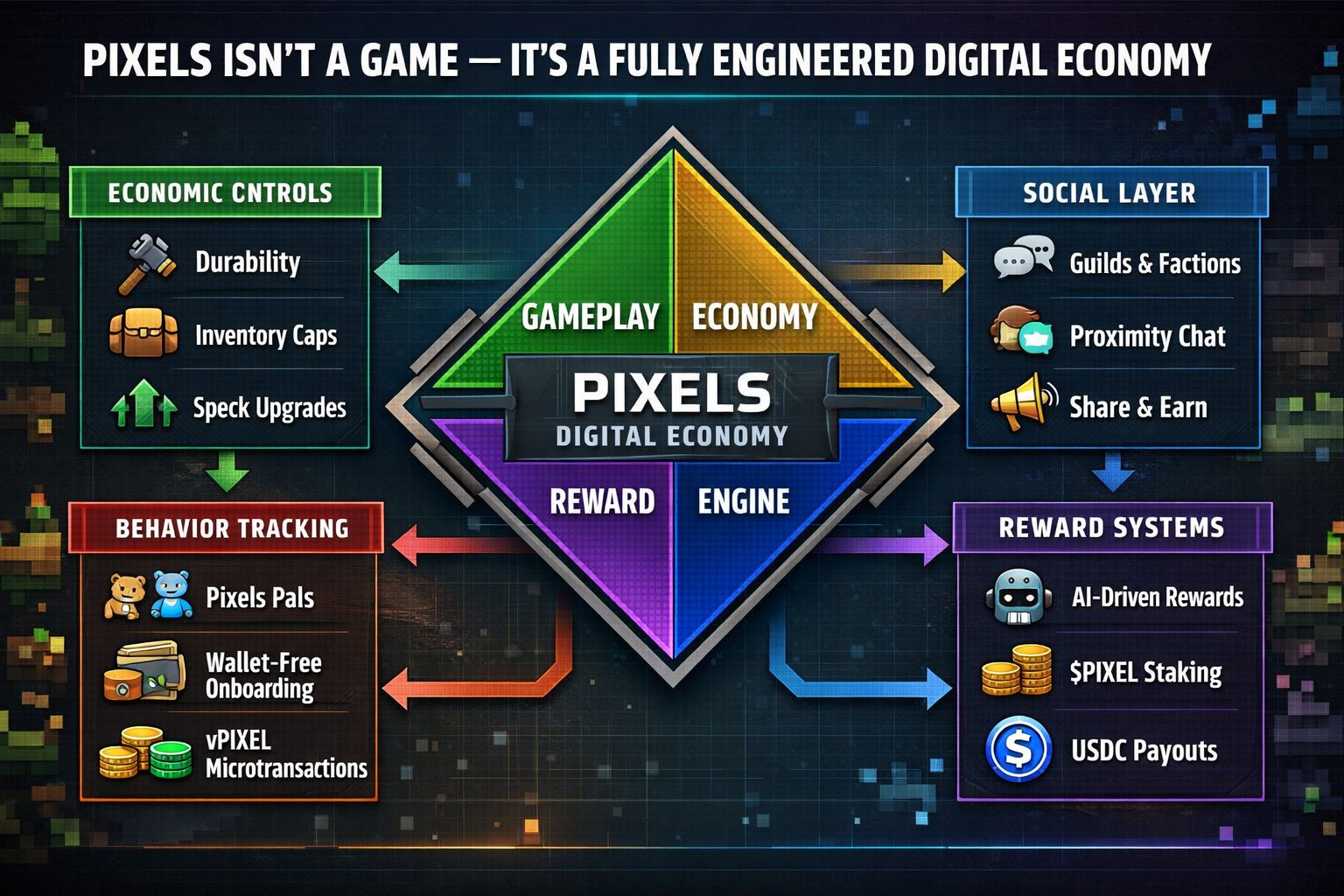
There is also the question of transparency. In decentralized systems, we often assume openness, but behavioral incentives can still be opaque. If users cannot clearly understand why certain actions are rewarded, they may lose trust or disengage. Economic loops can become fragile, especially if they depend on continuous growth or external liquidity.
Despite these risks, I see something more ambitious emerging. Pixels Network is not just a game with a token; it is an evolving environment where behavior, incentives, and value are intertwined. It suggests a future where blockchain systems are less about static rules and more about dynamic feedback loops that shape how users act over time.
This leads me to a deeper question that I keep returning to. As these ecosystems become more sophisticated, are they still open systems for exploration, or are they gradually becoming environments where success depends on aligning with hidden logic? In theory, decentralization promises freedom and creativity. In practice, incentive structures inevitably guide behavior.

Perhaps the real evolution of Web3 is not just about ownership or decentralization, but about the design of systems that subtly influence human behavior at scale. If that’s the case, then understanding these ecosystems will require more than technical knowledge or market intuition. It will require a kind of behavioral literacy—the ability to see not just what a system does, but what it encourages us to become within it.