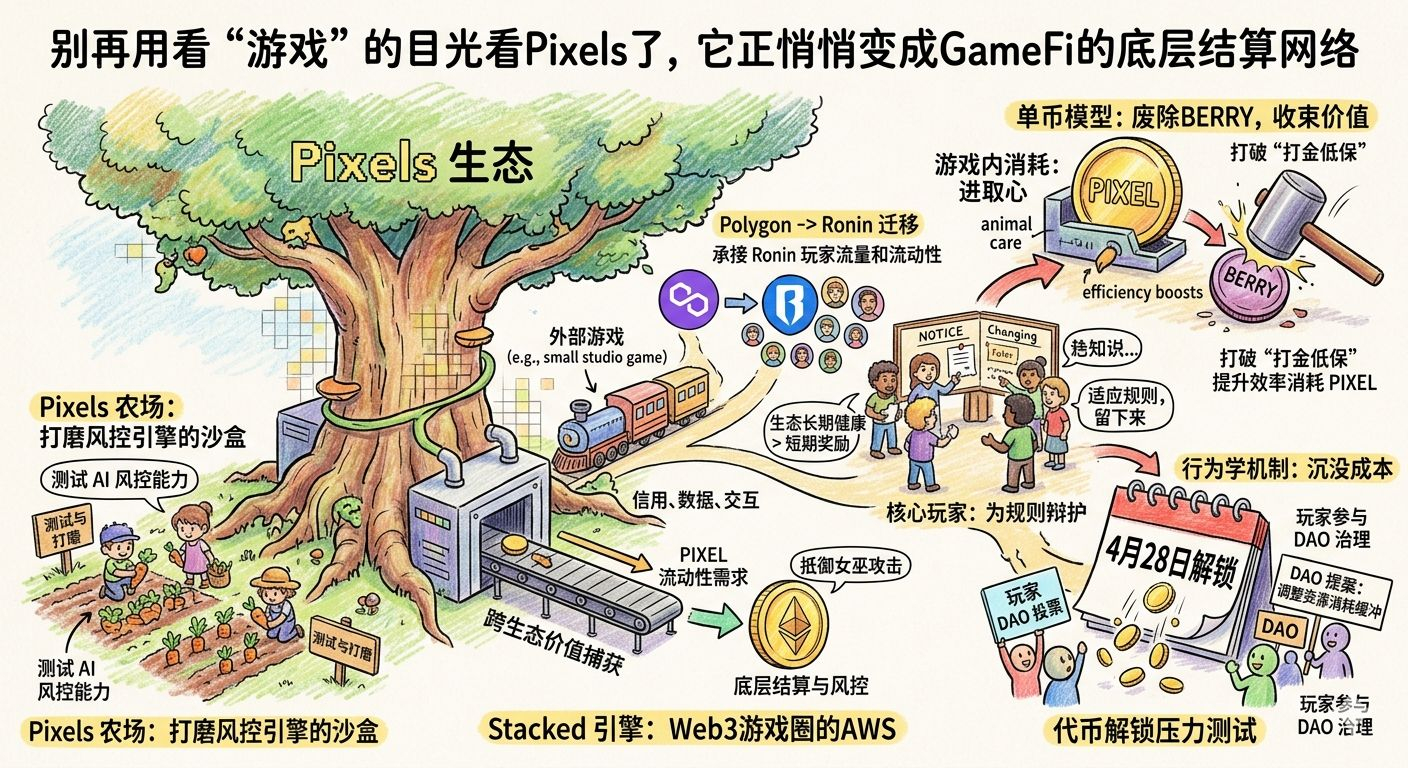
A few days ago, a friend asked me: "Do you think Pixels is worth it? I see the data looks good, but it feels like it doesn't really stand out from other blockchain games." I thought about it and told him a perspective: you're looking at it the wrong way. You're analyzing it with a gamer’s lens, but they're already thinking beyond the "game" box. The value anchor at @Pixels isn't about whether that pixel farm is fun or not; it's hidden behind the Stacked engine, which is quietly becoming the underlying settlement network for the entire GameFi sector. I've been through the last bull run and seen too many projects that were just flashes in the pan. Pixels feels different to me, not because its games are so stunning, but because its economic model and infrastructure thinking give it the potential to survive this winter.
Today, let's follow this line of thought and discuss whether Pixels is worth paying attention to.
Stop using outdated GameFi valuation models to look at $PIXEL . Think of Stacked as the AWS of the Web3 gaming space. It's not just a feature; it's a moat that’s already proven in a production environment. Do you know how cold the crypto gaming track has become? Most small to medium studios have zero risk control against bots. To keep their projects alive, they have to integrate the core reward distribution and settlement layer with Stacked, which is powered by this battle-tested AI engine.
But there’s no such thing as a free lunch. Once you get involved, the users brought in by external games, the interaction data accumulated, and the credit built will all be converted into liquidity demand for PIXEL. This is a cross-ecosystem value capture mechanism. The farm game of Pixels itself is just a sandbox used to test and refine this risk control engine. When Stacked becomes a must-have for the industry to defend against witch hunts, it will possess the underlying capabilities for cross-ecosystem settlement. The more competitors integrate, the stronger the liquidity linkage with PIXEL will ultimately become. Transitioning from a single game token to a cross-ecosystem settlement medium is what capital truly values.
Let’s talk about the community ecosystem. In traditional games, if the developers cut rewards or tweak parameters, players would be outraged. But in Pixels, whenever task difficulty is adjusted or resource acquisition becomes harder, there’s always a core group of players who come out to defend the changes, arguing that it’s necessary for the ecosystem's long-term health. Sometimes, you can even see someone complaining about reduced rewards, and the first reaction of the veteran players is not to agree but to remind them to 'try harder to adapt.' From a behavioral economics perspective, this is the effect of sunk costs. After investing so much time and effort, when the rules change, continuing to adapt often has a lower psychological cost than completely exiting. Thus, many choose to stay and seek long-term value. This mechanism, combined with the infrastructure of the Ronin ecosystem, has indeed allowed Pixels to maintain a rare level of activity and resilience in the current bear market.
Let's talk about the adjustments in BERRY and the single-token model. Most GameFi projects like to use dual tokens: one main token to pull liquidity and one sub-token for rewards. It sounds great, but they often face severe inflation pressure in the end. The Pixels team's solution is straightforward: proportionally convert BERRY to PIXEL, abolish the unlimited issuance of the sub-token, and consolidate all value into a single token. I spent time testing the animal care system, pulled data to build a model, and found that the output pressure was indeed significant before the adjustment. After the adjustment, the 'gold farming infinite safety net' model was disrupted, shifting the ecosystem towards a more concentrated value game. Plus, migrating from Polygon to Ronin captured the traffic from Ronin's native players and more concentrated liquidity, making the single-token model cleaner and easier for big money to participate. Now, when you play Pixels, you can clearly feel that to boost efficiency, you need to spend PIXEL. The system directly converts your 'ambition' into fuel for maintaining the value of the single currency.
The real pressure test is coming on April 28th. Right now, the whole community is focused on the upcoming early investor token unlock window on April 28th. This is a significant test for the economic model. The single-token mechanism relies on friction costs and system updates to maintain balance; with such a large unlock volume, can internal consumption effectively hedge against selling pressure? We need the market to validate this. Last month, I submitted a proposal to the DAO regarding the resource consumption ratio, suggesting dynamic adjustments to the synthesis costs of higher-tier resources before and after the unlock to enhance the system's buffer capacity. The proposal passed preliminary review, and I participated in the subsequent voting. Honestly, when more players focus not just on short-term gains but are willing to engage in DAO governance and pay attention to overall economic parameters, the ecosystem's anti-fragility will be stronger.
Brothers, in this market, facing reality and focusing on actual mechanisms is the way to survive long term. In the coming days, those holding PIXEL should keep an eye on on-chain data: active addresses, large transfer anomalies, and so on. Stay rational and be prepared. The Pixels mechanism acts like a mirror, reflecting our adaptability and resilience in the market as long-term players. It also reminds us that the long-term value of any project ultimately hinges on whether the economic closed loop and community consensus can be sustained. (This article is a platform task and does not constitute any investment advice.)