

I was just sitting one night and scrolling through a few Web3 games. Nothing serious. Just passing time. I opened Pixels again without expecting much. I thought I would leave quickly. But I stayed.
Something felt different.
At first it looked like a simple game. Farming. Moving around. Small tasks. Nothing complex. But after some time I noticed something deeper. It was not about rewards. It was about attention. How long I stayed. What I focused on. How often I came back.
That made me think.
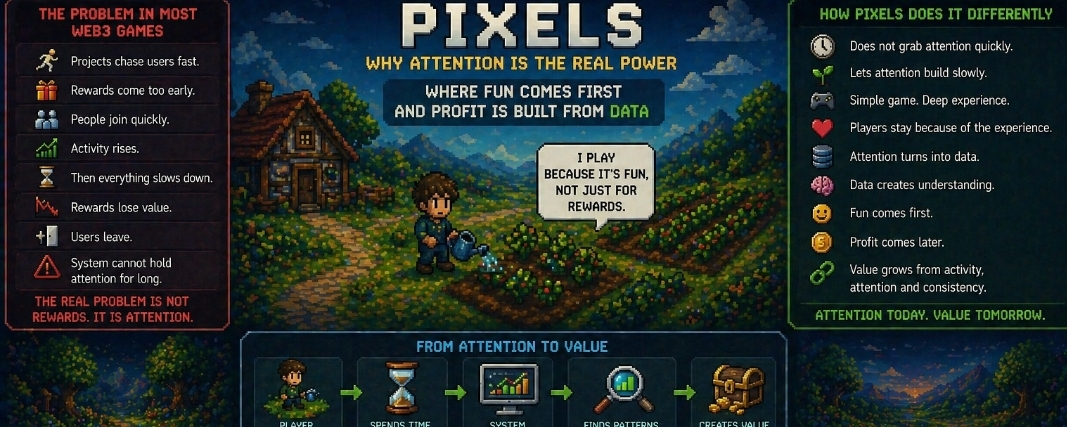
In most Web3 games I have seen one clear pattern. Projects chase users fast. They push rewards early. People join. Activity rises. Then everything slows down. Rewards lose value. Users leave. The system cannot hold attention for long.
That is the real problem.
Not just rewards. Not just tokens. It is attention. Systems fail because they cannot keep people engaged in a natural way. They try to buy attention instead of building it. And that never lasts.
That is where Pixels started to feel different to me.
It does not try to grab attention quickly. It lets it build slowly. The game feels simple on the surface. But it gives you reasons to stay. Not because of rewards. But because of the experience. Because of the rhythm.
And over time that attention starts to turn into something else.
Data.
The idea is simple when I think about it. If players stay longer the system learns more. It sees patterns. It understands behavior. It tracks how people interact with the game. That data becomes a layer under the gameplay.
So fun comes first.
Profit comes later.
That is what feels different.
Instead of forcing value into the system it lets value grow from activity. From attention. From consistency. That makes the system feel more stable. Less forced. More natural.
It also changes how I behave.
I do not feel like I am chasing rewards. I feel like I am just playing. And somehow that makes me stay longer. It makes me more engaged without thinking too much about it.
That is where attention becomes power.
Because if the system can hold attention it can build something stronger over time. It can create value that is not based on quick actions. But on long term behavior. That is harder to fake. Harder to break.
But I stay careful.
Because turning attention into value is not easy. If the system pushes too much it can feel manipulative. If it is too loose it can lose direction. Balance matters here more than anything.
And pressure will test it.
When more users join the system changes. More attention. More data. More complexity. If the structure is weak it becomes noise. If it is strong it becomes a foundation.
That is what I am watching.
Right now the market is still moving in cycles. Some projects get attention quickly. Then they lose it just as fast. Activity spikes. Then it fades. Nothing feels stable for long.
Pixels is also moving through these phases.
There are moments where activity feels strong. Then quieter periods. It is not constant. But that is normal. What matters more is whether it can hold attention over time. Not just attract it.
Because attention that stays becomes value.
Attention that leaves becomes nothing.
I do not see Pixels as just a game anymore. But I also do not see it as a fully proven system. It feels like something in between. A system that is trying to understand how attention turns into value.
Maybe it works.
Maybe it faces the same problems as others.
It is still early.
For now I am not making strong conclusions. I am just observing how it holds attention. How it builds from it. How it reacts when things slow down.
Because in the end.
The systems that survive are not the ones with the biggest rewards.
They are the ones that people do not want to leave.
So I keep watching.
Still learning.
Still cautious.
