

I keep thinking most Web3 games did not fail because players rejected ownership, tokens, or digital economies. They failed because too many of them tried to subsidize emptiness. There is no elegant way to say that. Paying people to stay inside a world they would not visit freely is like handing out free coffee in a shop no one wants to sit in. You can create a queue.
You cannot create belonging.
That is why Pixels keeps returning to my mind. Not because it is flawless, and not because one project can redeem a category, but because it seems to begin with a rarer question. Before rewards matter, why would someone come back tomorrow?
That question is heavier than it sounds.
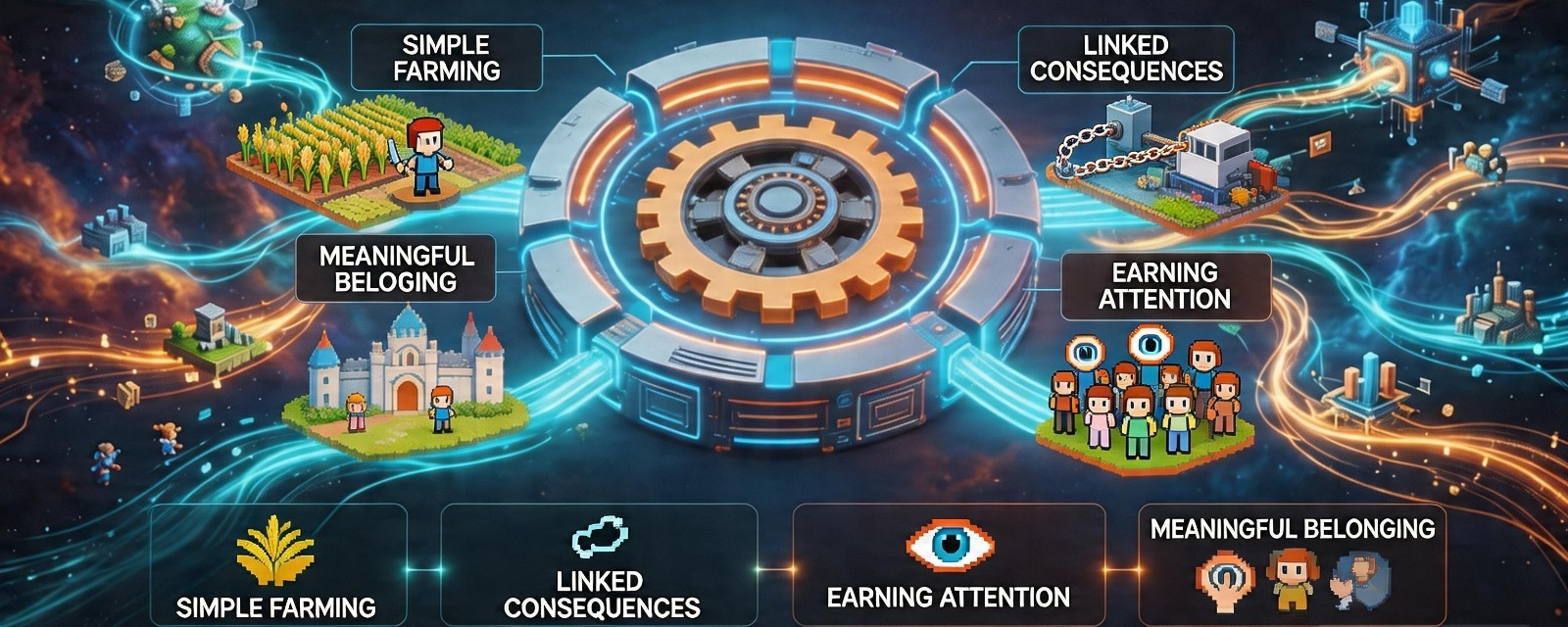
On the surface, Pixels feels simple. Plant crops. Gather materials. Craft items. Trade goods. Improve land. Return later. The loops are readable quickly. In my experience, that kind of clarity is often dismissed by builders who confuse friction with depth.
Most people do not leave because something is difficult.
They leave because something is draining.
A lot of Web3 games made the first hour feel like administration. Wallet steps. Nested currencies. Explanations before enjoyment. Effort before curiosity had time to grow. By the time the game asked for commitment, it had not yet earned attention.
Pixels appears built from the opposite instinct.
Let the user move first. Let understanding arrive through action. Let momentum begin before complexity appears. That sounds obvious only after someone does it well. Simplicity is usually the expensive choice.
But a clean first session is only the surface layer. Many products can feel pleasant once. The harder challenge is whether session twenty feels more meaningful than session one.
That is where many systems quietly break.
Underneath the farming loop, Pixels seems to rely on linked consequences. Timers create return points. Upgrades create unfinished intentions. Scarcity creates planning. Markets create judgment. Better tools purchase future time. Familiar names make the world feel inhabited instead of staged.
None of those pieces are extraordinary alone.
Together they create continuity.
And continuity changes behavior faster than rewards do.
A visitor asks what can be earned today. Someone with position asks what can be improved next week. I have watched this shift happen across crypto products again and again. If users feel they are only harvesting payouts, they become temporary and rational. They compare yields, rotate quickly, and leave cleanly. The system taught them to behave like contractors.
Pixels may be teaching something closer to stewardship.
When actions connect across days, people begin protecting momentum. They keep materials because tomorrow has value. They upgrade tools because future hours matter. They learn prices because better judgment compounds. Missing a day feels costly, not because of punishment, but because continuity was interrupted.
That is a different kind of retention.
I keep thinking about a small scene that says more than charts do. Someone logs in late at night for ten minutes, not to chase a jackpot, but to harvest crops, reset a timer, check prices, and keep progress moving before sleep. That person is not responding to hype. They are maintaining position.
That is when a product becomes part of life.
Many projects never reached that threshold. They optimized launches instead of routines. They celebrated spikes instead of habits. They counted wallets while ignoring whether anyone would return once the noise faded.
Numbers can applaud while a product quietly empties.
Pixels seems more interested in steady texture than spectacle. If this holds, that may be why it has a better chance than louder projects ever had. A living world does not require everyone to be obsessed. It requires enough people returning naturally for the place to keep breathing.
Breathing worlds recruit quietly.
There are risks, and they are real. Routine can harden into chore. Skilled players can widen gaps too far. Open markets can discourage late arrivals. Teams can mistake active users for satisfied users. It is still unclear how any live economy balances fairness, depth, and freedom over long stretches.
No one solves that permanently.
Users optimize faster than designers expect. Communities compress margins, expose loopholes, and turn elegant theory into messy reality. Every successful system eventually meets people trying to bend it.
Pixels will meet that too.
Still, I think the central bet matters more than any single mechanic. It does not seem to ask how much reward is needed to hold attention. It seems to ask how much meaning can fit inside a return visit.
That is the wiser question.
Most users do not actually want ownership. They want progress they can feel, decisions that matter, and time that leaves a mark. Ownership is only useful when it carries those things.
That truth gets missed often.
The wider industry still chases giant launches, celebrity moments, cinematic trailers, and short waves of excitement. Some of that matters. But many enduring businesses were built more quietly, through places people revisited so often they stopped calling it a decision.
That pattern repeats everywhere.
So when people ask why Pixels might win where most Web3 games collapse, I do not start with farming, tokenomics, or hype cycles. I start with whether the product gives people something harder to replace than rewards.
Because money can rent attention for a moment, but only meaning can make return feel natural.
And the rarest products are the ones that give time back heavier than they received it.
