I used to think “on-chain” was the finish line—like once something gets recorded, it suddenly becomes real, meaningful, permanent. That framing felt clean. Simple cause and effect.
But lately, that idea feels incomplete. Not wrong, just too narrow. Because in practice, most of what happens inside these systems never touches the chain at all. And yet the economy still feels alive. Active. Sometimes even more meaningful than what actually gets recorded.
That gap is where things start to matter.
Pixels lives right inside that space.
On the surface, it feels open. You log in, you farm, you trade a bit, you optimize your loops over time. No real pressure. No heavy push toward spending or committing. It gives this impression that everything you do carries equal weight.
But after watching it longer, that doesn’t really hold up.
Some actions seem to echo forward. Others just disappear.
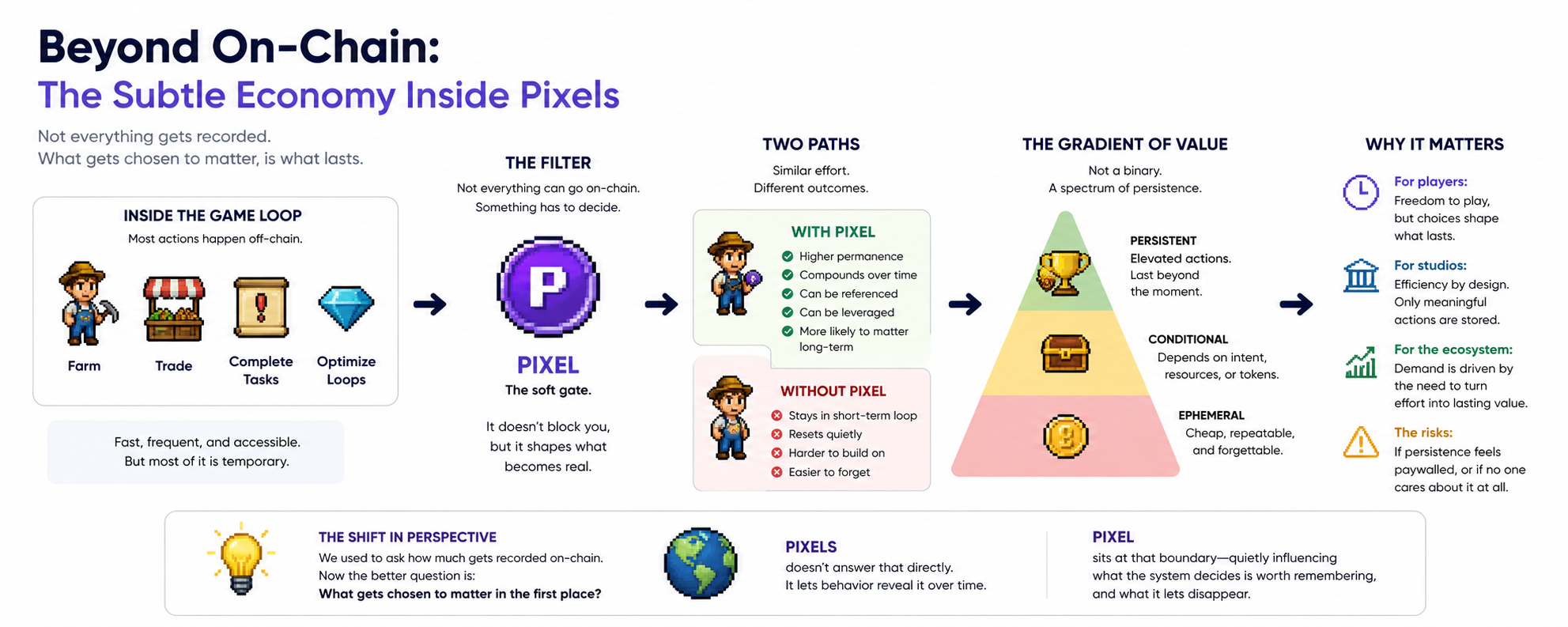
You don’t notice it immediately. It becomes clear only after repetition—when two players put in similar effort but end up in completely different positions. Not just in rewards, but in what actually persists. One player’s progress compounds. It can be built on, referenced later, sometimes even leveraged. The other player stays stuck in cycles that feel productive but reset quietly in the background.
It doesn’t feel random. It feels selected. But not in an obvious way.
There’s a constraint underneath all of this that people don’t talk about enough: you can’t put everything on-chain. Not because of ideology, but because of cost, speed, and practicality. If every action was recorded, the system would collapse under its own weight. So something has to decide what crosses that boundary—and what doesn’t.
In Pixels, I keep coming back to PIXEL when I think about that filter.
At first, it just looked like a normal utility token. Something to speed things up or unlock convenience. But the more you pay attention, the more it stops behaving like a simple tool. It feels more like a soft gate—one that doesn’t block you, but subtly shapes which actions become “real” in a longer-term sense.
You can still play without it. You can grind, repeat loops, move forward slowly. Nothing breaks. But when PIXEL is involved, something shifts. Not just speed—but permanence. The likelihood that what you’re doing will actually matter beyond the immediate moment increases.
That word—“matter”—is doing a lot of work here.
Because in most systems, value is tied to visibility or reward. Here, it feels tied to persistence. Whether an action stays inside the short-term loop or gets elevated into something that can exist outside of it—something others can build on later.
That starts to change how you see the economy.
It stops being a simple “on-chain vs off-chain” divide. It becomes a gradient. Some actions are cheap, frequent, and forgettable. Others require intention, resources, maybe even tokens—and those are the ones that tend to survive beyond the moment.
In that sense, “free to play” doesn’t mean neutral. It means accessible—but still selectively structured. The system quietly decides what deserves to continue existing, and what is allowed to fade.
And PIXEL sits right in that selection layer.
Not as a hard requirement, but as a pressure point. A mechanism that nudges behavior toward actions that are more likely to persist, more likely to be recognized beyond the immediate game loop.
From a market perspective, that changes how the token should be understood. It’s not just about activity or spending. It’s about how often players feel the need to cross that boundary—to turn effort into something that lasts.
If that behavior is rare, demand stays shallow. If it becomes habitual, it starts embedding itself into the system’s core loop.
There’s a version of this where it works well. Players stay free, studios stay efficient, and only meaningful actions get elevated. Over time, the ecosystem becomes self-selecting in a way that feels almost natural.
But there’s another version too.
If players start to feel like nothing really “counts” unless PIXEL is involved, then the openness becomes cosmetic. The freedom starts to feel conditional, even if nothing is explicitly blocked. And people tend to notice that, even if they can’t clearly explain why.
There’s also a quieter risk: what if most players don’t care about persistence at all? What if they’re perfectly fine staying inside the local loop—playing, repeating, logging off—without ever trying to push anything beyond it?
In that case, the system still functions, but the role of the token becomes much smaller than expected.
I don’t think there’s a clean conclusion here.
It feels more like a shift in how to look at these systems.
We used to ask how much gets recorded on-chain.
Now the more interesting question might be: what gets chosen to matter in the first place?
Pixels doesn’t answer that directly. It lets behavior reveal it over time.
And PIXEL—whether intentionally or not—sits right at that boundary, quietly influencing what the system decides is worth remembering, and what it lets disappear.