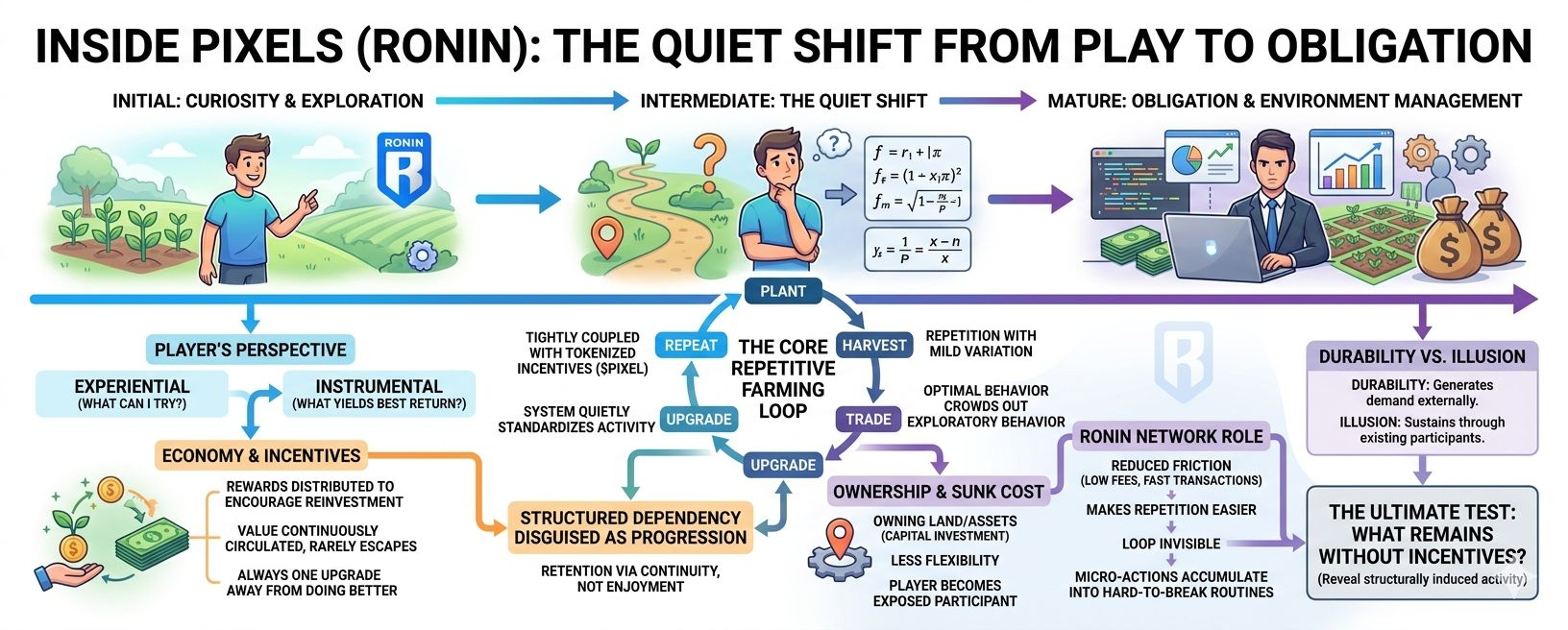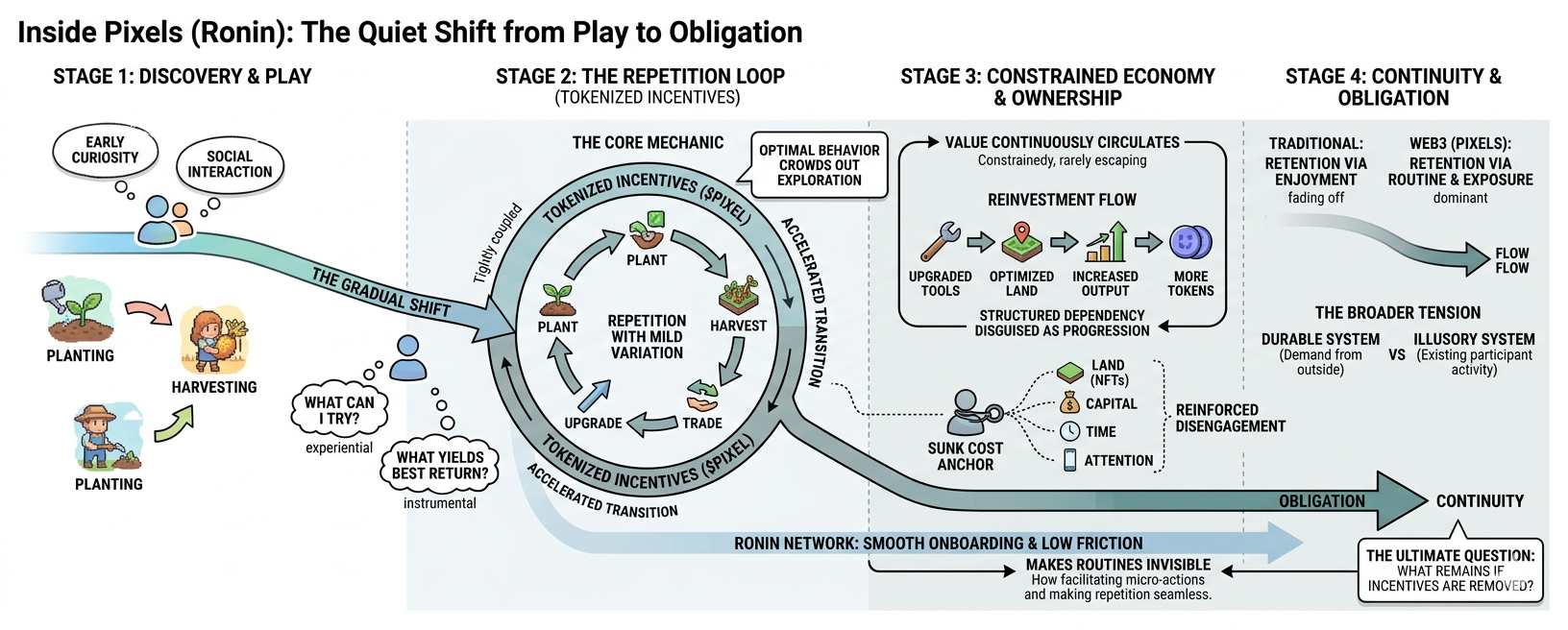

I’ve spent enough time around Web3 systems to recognize a familiar rhythm: early curiosity, rapid engagement, then a slow shift where participation becomes less about discovery and more about maintaining position. It’s not unique to DeFi or NFTs games follow the same arc. What begins as play gradually reorganizes itself into obligation. The mechanics don’t change overnight; what changes is the player’s relationship to them. Somewhere along that curve, systems like Pixels running on Ronin Network start to feel less like worlds to explore and more like environments to manage.
At a surface level, Pixels presents itself as a soft, inviting farming game low friction, socially oriented, visually harmless. But the interesting question isn’t what it looks like; it’s what it makes easy. And what it makes easy, over time, is repetition with mild variation. Plant, harvest, trade, upgrade, repeat. None of these actions are inherently problematic most games rely on loops but here the loop is tightly coupled with tokenized incentives. The system doesn’t just reward activity; it quietly standardizes it.
After a few weeks of consistent play, the pattern becomes clear: optimal behavior begins to crowd out exploratory behavior. You stop asking “what can I try?” and start asking “what yields the best return per unit time?” That shift is subtle but important. It marks the moment when a game stops being primarily experiential and becomes partially instrumental. The presence of $PIXEL tokens doesn’t force this transition, but it accelerates it.
The economy inside Pixels is where this becomes most visible. On paper, it’s a player-driven system with resource flows, crafting, and trading. In practice, it behaves like a constrained loop where value is continuously circulated but rarely escapes. Rewards are distributed in ways that encourage reinvestment buy better tools, optimize land, increase output. The system rarely incentivizes withdrawal, either emotionally or economically. You’re always one upgrade away from “doing better.”
This creates a specific kind of engagement: not quite fun, not quite labor, but something in between. A structured dependency disguised as progression. You’re not stuck, exactly but leaving feels inefficient. That’s a different kind of retention than what traditional games aim for. It’s less about enjoyment and more about continuity.
Ownership, often framed as a core Web3 advantage, adds another layer to this dynamic. Owning land or assets in Pixels does create a sense of control, but it also introduces sunk cost in a more tangible way. Once you’ve invested capital whether small or significant your decision-making changes. You become less flexible. You’re no longer just a player; you’re a participant with exposure.
This is where time, capital, and effort begin to converge. Hours spent optimizing your farm, tokens spent upgrading assets, attention spent tracking returns they all reinforce each other. The system doesn’t need to trap you; it only needs to make disengagement feel like a loss. And often, that’s enough.
What’s interesting is how this plays out on Ronin Network itself. Ronin was designed to reduce friction lower fees, faster transactions, smoother onboarding. And it succeeds at that. But reducing friction doesn’t just make entry easier; it also makes repetition easier. The more seamless the system, the more invisible the loop becomes.
You don’t notice how often you’re interacting with the system because each action feels trivial. A quick harvest here, a small trade there. But over time, these micro-actions accumulate into a routine. And routines, once established, are hard to break not because they’re compelling, but because they’re familiar.
This brings up a broader tension that I keep noticing across Web3 systems: the difference between durability and illusion. A durable system generates demand from outside itself it attracts users who aren’t already invested. An illusory one sustains activity primarily through existing participants who continue engaging because they’ve already committed resources.
Pixels sits somewhere in between. There is genuine engagement people do enjoy the social and creative aspects but there’s also a noticeable reliance on ongoing participation from invested users. The economy doesn’t collapse, but it doesn’t fully stand on its own either. It leans on continuity.
And to be fair, this isn’t a failure unique to Pixels. It’s a pattern that appears whenever incentives are layered on top of gameplay. The system becomes self-referential. Value is created, distributed, and consumed within the same loop. The challenge is whether that loop can sustain itself without constant reinforcement.
Comparing Pixels and Ronin at a structural level, what stands out is not a difference in intent but in awareness. Ronin, as infrastructure, is relatively neutral it enables behavior without strongly shaping it. Pixels, as an application, defines the behavior more explicitly. It sets the loops, the rewards, the expectations.
But both exist within the same broader pattern. Neither fully escapes the gravitational pull of incentive driven design. They don’t necessarily fall into it blindly, but they don’t completely avoid it either. There’s a sense that both systems are still negotiating their identity are they building for play, for profit, or for something in between?
I find myself returning to a simple question: if the incentives were reduced or removed, what would remain? Would players still log in, still engage, still care? Or would the system gradually quiet down, revealing how much of its activity was structurally induced?
There isn’t a clear answer yet. And maybe that’s the point. Systems like Pixels and Ronin Network aren’t finished products; they’re evolving environments. Their real test isn’t happening now, while incentives are active and attention is high. It will happen later, when participation becomes optional in a more meaningful sense.
Until then, what we’re observing isn’t just a game or a network it’s a set of behavioral experiments unfolding in real time. And like most experiments, the most important results won’t be visible until the conditions change.