
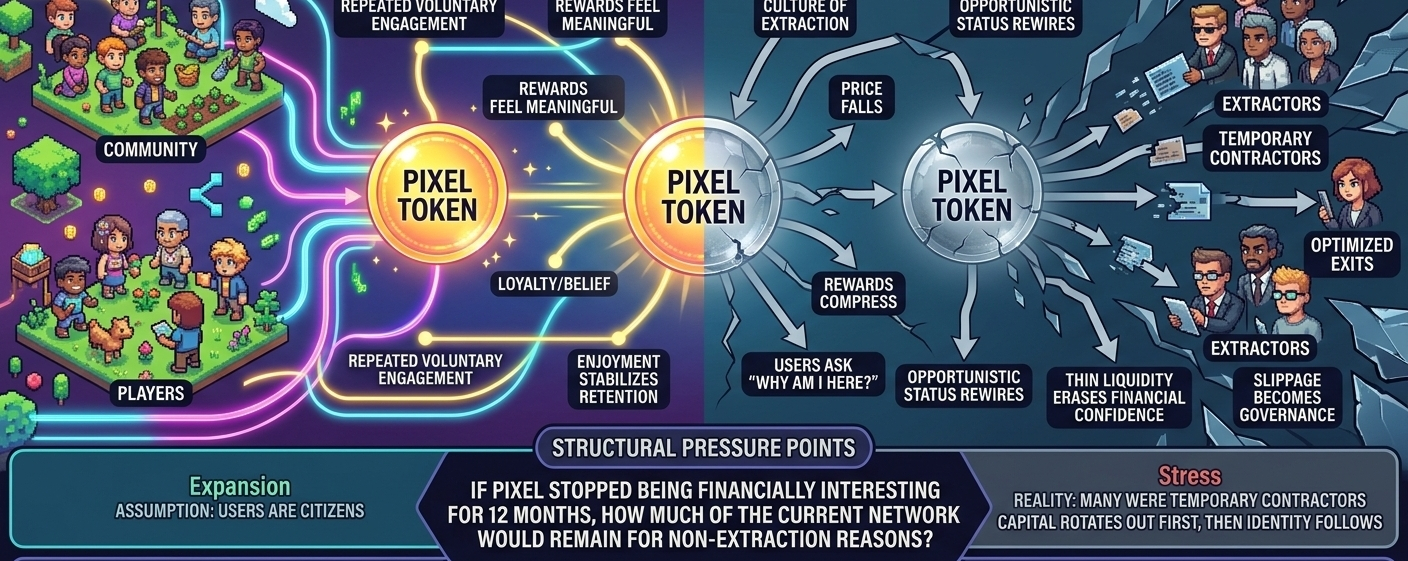
I look at Pixels through one lens only: coordination under economic stress. Not gameplay quality, not community sentiment, not the aesthetics of farming loops. Those matter in calm markets, but they become secondary when price falls, rewards compress, and users begin to ask a harder question: what am I still doing here? Pixels runs on Ronin and uses PIXEL as coordination infrastructure, which means the token is not just an asset. It is the mechanism that links time, attention, progression, and belief. When stress arrives, that linkage is tested more honestly than any whitepaper ever could. The market price has fallen sharply from earlier highs, which matters less as a number than as a signal that expectations have already been repriced.
The first structural pressure point is the conversion of participants into extractors. In expansion phases, users tolerate friction because nominal gains hide inefficiency. When rewards feel meaningful, many behaviors look like loyalty even when they are simply profitable patience. Under stress, the same population changes character. Players optimize exits, shorten time horizons, and treat every in-game action as inventory management. This is where many coordination systems reveal a misunderstanding: they assumed users were citizens when many were temporary contractors. I have watched this pattern across cycles. Capital rotates out first, then identity follows. The Discord language stays optimistic for a while, but behavior has already turned defensive.
In Pixels, this matters because a game economy depends on repeated voluntary engagement. If the average participant starts measuring every session against token emissions, then enjoyment no longer stabilizes retention; spreadsheets do. Once that threshold is crossed, even genuine players inherit the culture of extraction. They feel foolish for playing “inefficiently.” A market can teach cynicism faster than any tutorial can teach fun. That is a behavioral consequence of tokenized coordination that is rarely stated clearly: once value becomes legible, opportunism becomes socially contagious.
The subtle issue is not that users sell rewards. Selling is normal. The issue is that visible monetization rewires status. Efficient farmers, arbitrageurs, and multi-account operators often become the new reference class. Their behavior is rational, but their incentives are different from those needed for durable world-building. A protocol can say it values community while economically rewarding throughput. Incentives settle the argument quickly. I tend to trust payout tables more than mission statements.
The second structural pressure point is liquidity depth versus narrative breadth. Systems like Pixels often appear larger than they are because many users can participate while relatively little capital determines token price. That creates an asymmetry. It can take months to build a story of adoption, but only days of thin exits to erase the financial confidence supporting that story. When liquidity thins, every treasury decision, unlock schedule, market-making choice, and reward emission becomes more sensitive. Participants who never cared about tokenomics suddenly care intensely because slippage becomes governance by other means.
I have seen communities mistake activity for resilience. Daily actions, quests completed, social chatter, wallet counts—these are useful metrics until they are asked to absorb real selling pressure. Then the question changes from “How many are here?” to “Who will hold risk voluntarily?” Those are different populations. Many systems discover too late that the second group was much smaller than the first.
The structural trade-off is clear: broad accessibility often requires frequent rewards and easy onboarding, but those same features can attract transient capital that destabilizes the economy when conditions worsen. If rewards are reduced to preserve the treasury, participation can fade. If rewards continue to defend participation, token pressure can intensify. Either path extracts something valuable. There is no elegant version of this choice.
Pixels also inherits a deeper challenge common to tokenized games: players can leave faster than institutions can adapt. Governance mechanisms, community consultation, balancing patches, and economic redesign all move slower than panic. During stress, latency itself becomes a cost. By the time consensus forms, the most price-sensitive cohort may already be gone. This is where decentralization can become performative rather than practical. Inclusive process sounds strong until speed becomes necessary.
The uncomfortable question I would ask is simple: if PIXEL stopped being financially interesting for twelve months, how much of the current network would remain for reasons unrelated to extraction? Not the loudest supporters, not the most committed core, but the median participant. Coordination systems survive when the median user still has a reason to stay after incentives weaken.
I do not think Pixels is unique in facing this. It is simply honest enough as a case study because games expose preference quickly. People do not pretend for long inside leisure environments. They either return or they do not. They either hold value inside the system or route it elsewhere. Under economic stress, the token stops being a symbol and becomes an instrument. That is usually the moment a community learns whether it was organized around play, around profit, or around a temporary overlap between the two.