
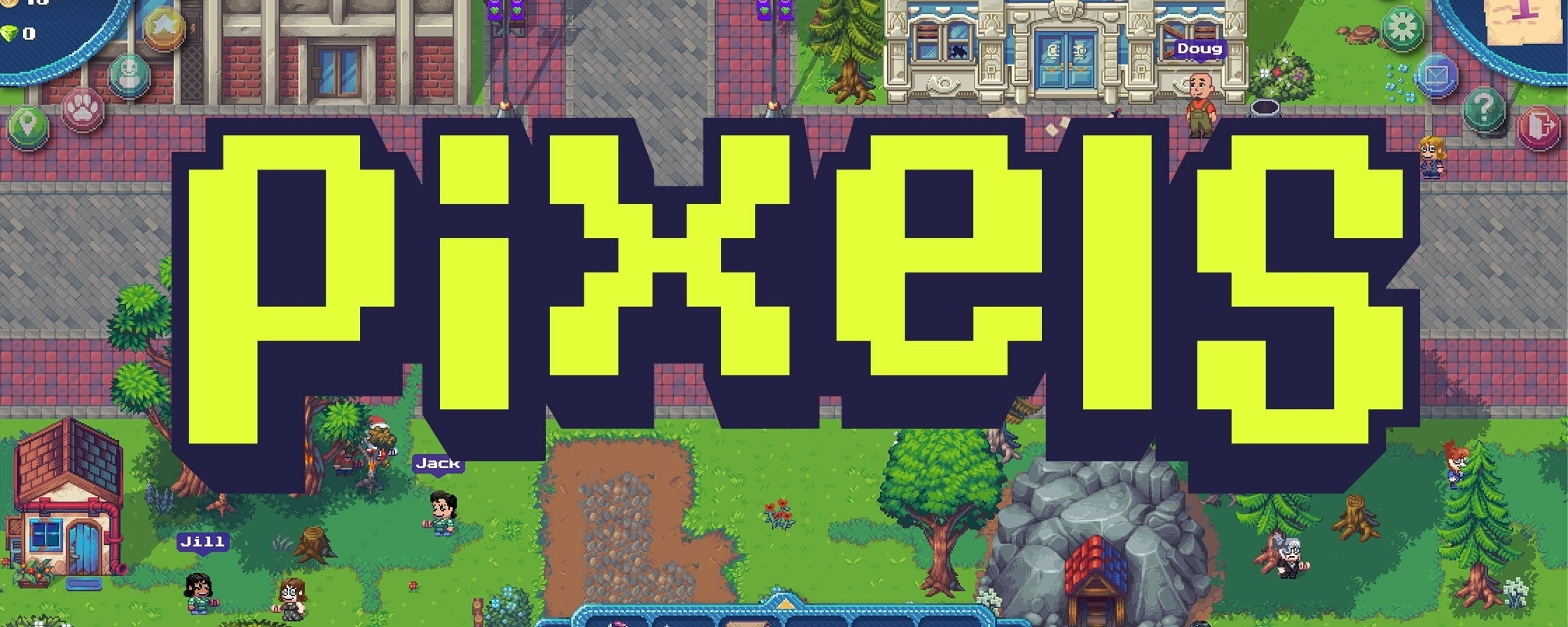
Honestly, I've been tracking a trend over the past few years: how are traditional gaming giants entering Web3? The conclusion is a bit surprising—most are stumbling, while the ones truly paving the way are the grassroots pixel farms like @Pixels .
Let's take a look at the current state of the big players.
Square Enix, a veteran in the RPG scene, made a splash in 2023 with their Web3 game called Symbiogenesis, touted as a 'flagship Web3 entertainment project' that blends interactive storytelling, NFT ownership, and immersive experiences. What’s the outcome? By March 2025, the official announcement stated that the project would only have six chapters, and once updates stopped, production was halted. Over a hundred million bucks poured in, resulting in a cold shoulder from the community and total indifference from players.
Ubisoft hasn't fared much better. They were the first in the AAA space to take a leap, launching the NFT platform Quartz at the end of 2021, aiming to sell 'Digits' in Ghost Recon: Breakpoint. The result was a strong backlash from players, with some even stating, 'Players just can’t understand why they would spend real money on an NFT in a game.' Since then, Ubisoft has mostly remained silent in the Web3 space, barely keeping up through a partnership with Immutable.
Back in the day, when major companies stepped into Web3, they brought along shiny IP libraries and established distribution channels, which theoretically gave them a big edge. But the problem lies here—they were trying to shove NFTs down the throats of players used to traditional payment models, ignoring the fact that the core soil of Web3 gaming isn't in the existing traditional player pool but in a new batch of users eager to co-build and have assets that truly belong to them. It's like bringing your family recipe to a completely different country to open a restaurant; the ingredients just don’t match, and neither do the tastes.
Pixels' 'comeback' has perfectly highlighted this contrast.
Within three years, @Pixels transformed from a barely surviving farming game into something traditional giants must take seriously: the team made a bold move at the end of 2023, migrating from the Polygon full chain to the Ronin chain. The results were jaw-dropping, with daily active users skyrocketing from 4,000 before the migration to 180,000, peaking above one million daily active users. What’s even more enviable for the big players isn't just the data, but the solid player base Pixels has established in countries like the Philippines and other Southeast Asian nations—around 30% of players come from the Philippines, composed of guilds making a living grinding and mid-tier players willing to log in daily to complete tasks, forming a vibrant ecosystem.
Let's take a look at the case of Forgotten Runiverse. This fantasy MMORPG, after running on the Ronin chain, didn't just go off on its own but teamed up with Pixels to introduce $PIXEL as a cross-game token into its ecosystem. On the Pixels side, they also opened up early pink bunny avatars to the Runiverse community players. This is the first time in the Web3 gaming space that true cross-game token interoperability and asset linkage have been achieved, connecting two originally independent virtual economies through a single token.
What really astonishes me is the revenue report Pixels delivered—the entire ecosystem generated over $25 million in protocol revenue, processed hundreds of millions of reward distributions, and the team never wasted their ad budget on purely external traffic. Instead, they directly converted ad money into player rewards, with every $PIXEL distributed backed by the RORS internal loop. This is precisely the kind of micro-practice that many traditional giants lack when entering Web3: it's not about throwing money and shouting slogans, but meticulously calculating every little economic inflow and outflow.
When a project that grew organically from the community and pixel land can use real daily active growth, cross-game token practices, and solid revenue generation to make Square Enix and others pause and carefully compare and study, it shows that the development path of Web3 games is quietly reversing. Pixels didn't enter the market with a family heirloom IP but has built a narrative that truly deserves the title of 'benchmark' over three to four years of continuous effort.