
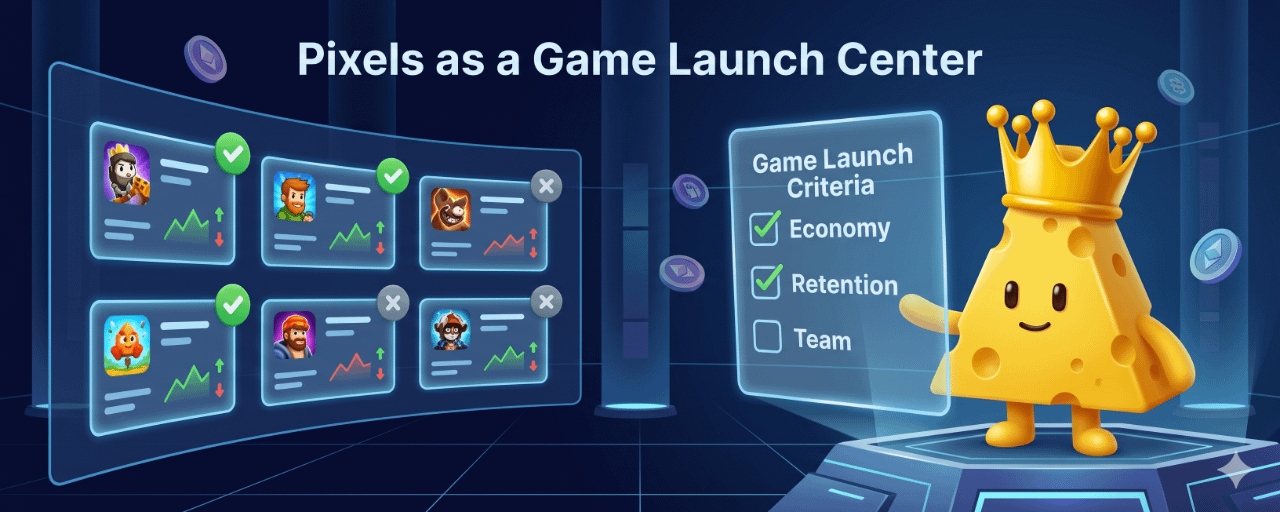
In most chain games, 'issuing tokens' is still a one-off event:
When a game launches, a token drops, and after a TGE or Launchpad, the story wraps up.
Pixels is taking a different route now. It’s building the main game into a highly engaging town while connecting at the protocol layer with exchanges, other projects, and partners. The overall structure is increasingly resembling a more ambitious role: a hub for chain games - in a sense, a 'chain game exchange.'
🧩 1. Why do we say Pixels meets the criteria for a '发行中心' (Issuing Hub)?
From a design perspective, it actually hits several typical foundational conditions that an '发行中心' (Issuing Hub) needs:
1. A stable pool of player traffic.
After migrating to Ronin, Pixels has maintained relatively high activity and wallet numbers in the Web3 gaming space, no longer relying solely on single events for traffic, but supported by daily usage scenarios.
2. A clear player stratification mechanism.
In-game designs include land, guilds, reputation/credit scores, which have effectively segmented players into:
Casual players, long-term active players, landowners, core guild members.
These dimensions can all become the basis for allocating 'new game initial quotas' and 'cooperation weights' in the future.
3. External cooperation and funding entry.
As a large chain game project, Pixels itself is a target for exchanges, wallets, and other project collaborations. Once these partnerships are integrated into a 'new project issuance process', it will naturally transition from being 'the one being listed' to 'the one helping others get listed'. In other words, it already possesses the three legs typical launch centers need: traffic, stratification, and funding entry.
🏛️ 2. If Pixels becomes a 'chain game exchange', how long would the issuance process take?
You can imagine a path for Pixels using a traditional issuance mechanism framework:
First layer: Entry review ✅
• It is not open issuance for all chain games, but rather setting a baseline first:
o Is there a sustainable economic model, rather than relying solely on short-term high APR to support the data?
o Is there a retention mechanism designed (chapters, guilds, community tasks) to prevent 'playing through and leaving'?
o Is there a clear token utility and recycling mechanism to reduce pure inflation?
Second layer: Quota allocation logic 📊
• The initial quota for new games should not be solely determined by 'who grabs it fastest', but should reference internal Pixels indicators:
o Land ownership, reputation/credit score, guild contribution, long-term mission participation.
This allows new games to stand on existing trust structures and prioritize allocation to already verified 'core residents'.
Third layer: Behavioral constraints after issuance 🔄
• Issuing does not mean the relationship ends; it should be through joint tasks, cross-game events, governance agreements, etc., and must continue to follow up:
o Does the new game truly keep players within the ecosystem?
o Does it continue the player structure that Pixels desires, rather than just drawing traffic and leaving?
Essentially, this is about migrating the 'listing review + allocation + subsequent operational management' from Web2 into the chain game scenario.
🚫 3. The true value lies not in 'how much it can issue', but in 'what it dares not to issue'.
Many people intuitively think that a 'launch center' that can issue many projects equals greater capability. However, from the perspective of design and economic stability, the core value of a launch center actually lies in 'what it rejects':
1. Do not touch purely speculative games without retention designs.
Relying solely on extremely high APR to attract short-term players, without chapter/community/credit score designs, will drain speculative funds from the ecosystem in the short term and leave behind a negative memory of 'chain games only being a one-time scam' in the long term.
2. Avoid massive 'skin swaps + co-branding' that dilute the brand.
If any project of unclear quality can issue with the Pixels name, the brand will soon be diluted, burying well-designed games in the noise.
3. Check the 'reward model and inflation control capabilities' before issuance.
It's not about fixing things after issuing; it's about examining during the review stage:
o Can the reward expenditure of this game be roughly offset by player behavior and income?
o Is there a reward investment monitoring mechanism and adjustment framework similar to RORS?
As long as one of the bottom lines is loosened, the launch center will degrade from a 'filter' to a 'garbage stock market'.
🌐 4. What is the economic significance for different roles?
For Pixels itself:
Once it takes on the role of a launch center, its value comes not only from 'how fun this game is' but also from 'how many new games it can help complete cold starts and build trust'. The pricing of tokens and land will gradually reflect this 'issuance weight', not just the monetization of in-game production.
To new chain game teams:
Leveraging Pixels' accumulated player stratification and credit system allows for more precise allocation and risk filtering at the initial launch. However, the price is: a stricter economic model and retention design review must be accepted; one cannot just rely on a high APR roadmap to get through.
For the overall chain game ecosystem:
If there is a relatively rigorous launch center, speculative funds and long-term investments will naturally flow separately; those wanting to gamble short-term will go to regular Launchpads, while those looking for longer-term investments will prioritize projects that can pass this set of audits.
From this perspective, Pixels' ambition is not just to 'play well itself', but to attempt to become:
In the entire chain game world, it serves as the first layer filtering node for players and projects.
🔚 Which points would you include in the 'issuance review checklist'?
If you agree that the role of a 'chain game exchange' will eventually emerge, then the next question becomes:
In your standards, what must a project meet to be endorsed by the 'launch center'?
You can share in the comments:
• What three design conditions (economics, gameplay, community, transparency, etc.) do you think a chain game worthy of being named by the launch center must meet?
• Or, from your experience, what do you think was the most failed issuance case, and which condition, if someone had upheld it back then, wouldn't look so bad today?
I will compile the most frequently occurring conditions into a 'minimum standard checklist for chain game launch centers', so that later, regardless of players, creators, or teams, everyone can use the same standard to check: does this game really deserve to be labeled 'issued by the Pixels ecosystem'?
$PIXEL @Pixels #pixel #Web3 #GameFi #Launchpad