@Pixels #pixel $PIXEL When I first began spending time inside Pixels, the world felt alive with growth. Farms were constantly expanding, players moved across the land in every direction, and the task board refreshed with endless new activities. From the surface, everything looked like a rapidly growing ecosystem. More crops were planted, more items were crafted, and more players seemed to participate every day. The natural assumption was simple: activity meant growth, and growth meant value.
But the longer I observed the system, the more I began to question whether that apparent expansion was truly economic growthor something else entirely.
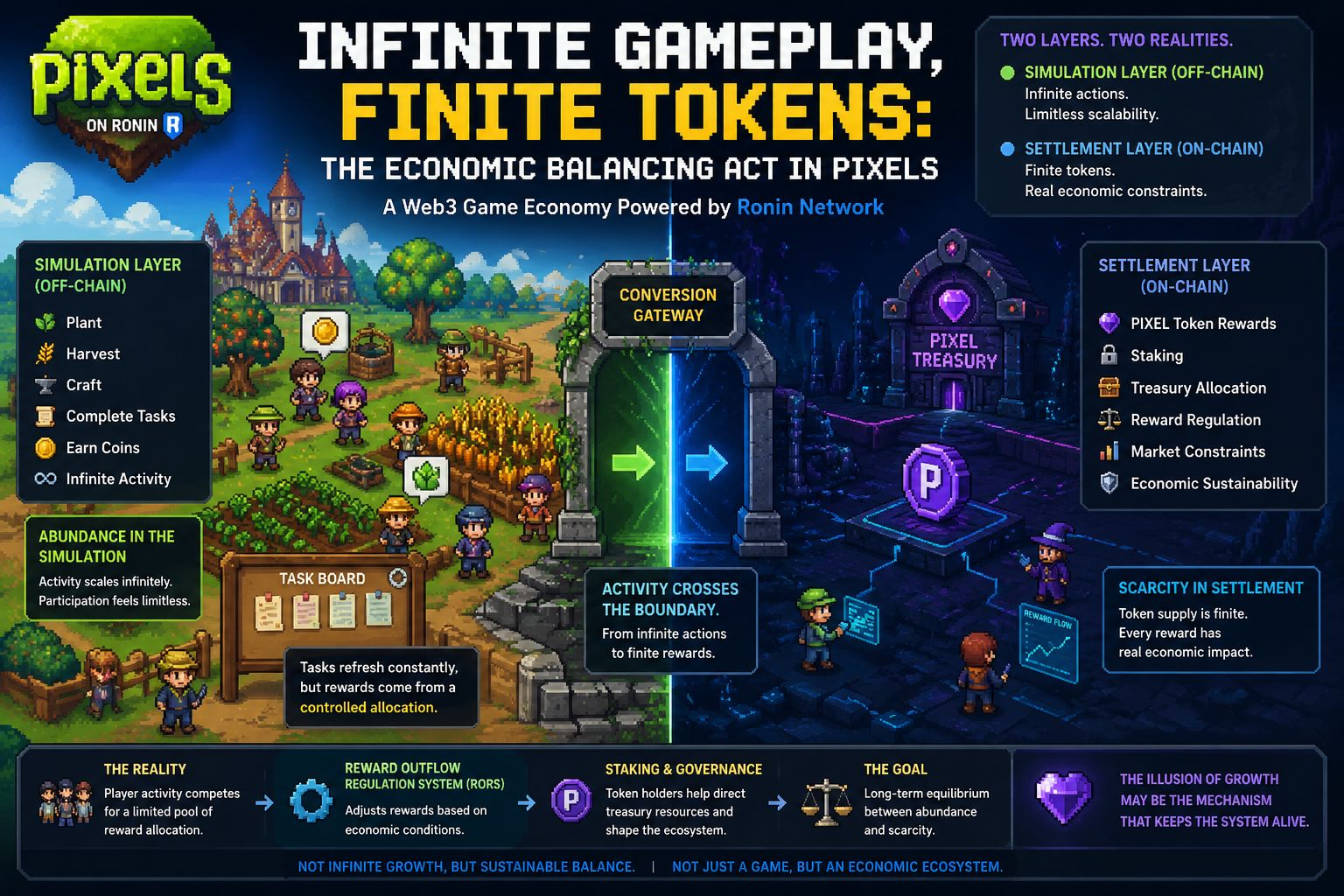
At first glance, the structure of Pixels resembles a typical farming simulation. Players plant crops, harvest them, craft materials, and complete tasks that reward them for their effort. Yet behind this familiar gameplay loop lies a more complex economic architecture powered by Ronin Network. What fascinated me most was how the game separates two different layers of activity: the simulation layer and the settlement layer.
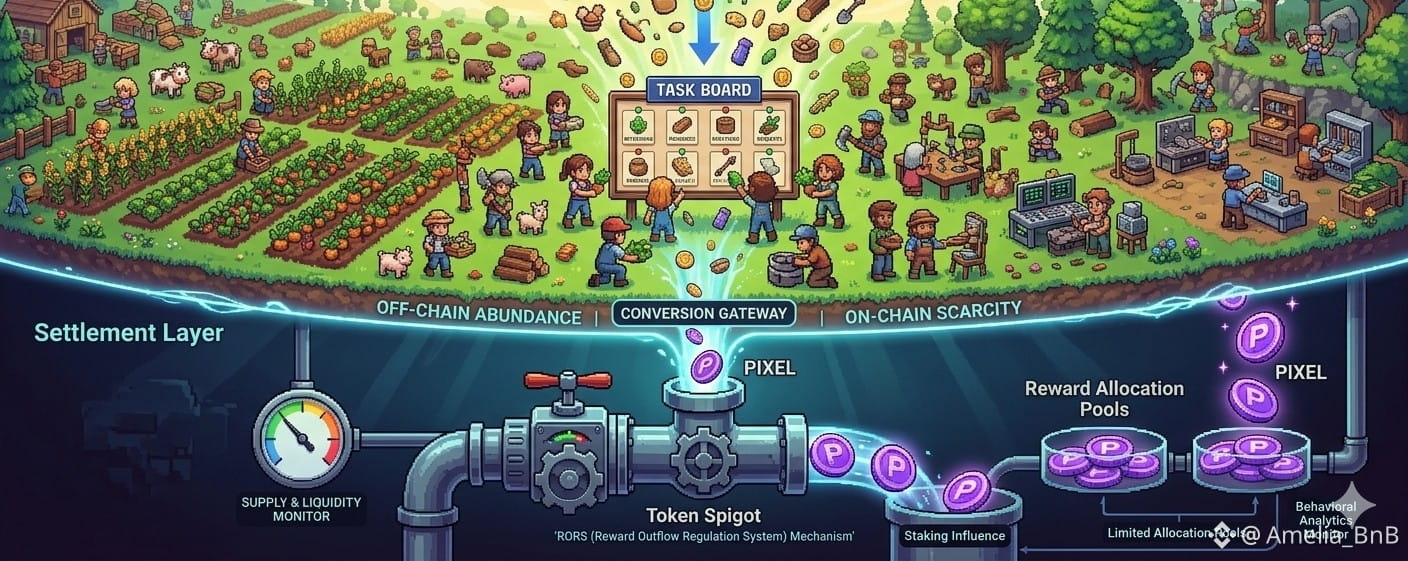
Most of the gameplay takes place off-chain. Planting seeds, harvesting crops, crafting items, managing energy cycles, and circulating Coins inside the world all happen within a low-cost computational environment. Because these actions are off-chain, they can scale almost infinitely. Thousandsor even millionsof players can perform actions simultaneously without generating the heavy transaction costs that blockchain systems usually impose.
Inside this off-chain layer, the world feels abundant. Activity multiplies easily, and participation appears limitless. Every harvest feels productive, every crafting loop feels like progress. But this abundance exists largely within the simulation.
The real constraint appears when the system attempts to convert gameplay activity into the on-chain token economyspecifically the PIXEL token.
The moment rewards cross from off-chain activity into on-chain settlement, they enter a completely different economic environment. Blockchain tokens cannot be produced infinitely without consequences. Token supply, liquidity, and market demand all impose strict limits. Every token distributed represents real economic outflow from the system.
This boundarybetween infinite gameplay activity and finite token settlementis where the true mechanics of the ecosystem become visible.
One of the clearest gateways between these two worlds is the Task Board inside Pixels. At first glance, the board looks like a constant source of opportunity. Tasks refresh frequently, encouraging players to gather resources, craft items, or complete specific objectives in exchange for rewards. The continuous refresh cycle creates the powerful impression that new economic value is constantly entering the system.
But after watching the patterns for long enough, I began to suspect something different.
The rewards often feel less like newly generated value and more like allocations drawn from a predetermined budget. Tasks appear abundant, but their payouts fluctuate in ways that suggest underlying controls. Certain loops suddenly become highly profitable, only to cool down later as rewards shift elsewhere.
This pattern reveals what I think of as the economic pressure points of Web3 games—the moments when simulated activity attempts to extract real value from the blockchain layer.
If too many players successfully convert in-game effort into token rewards, the system risks destabilizing its economy. Excessive token outflow can create inflationary pressure, reducing the long-term sustainability of the ecosystem. To prevent this, many Web3 games implement internal balancing systems that regulate reward distribution.
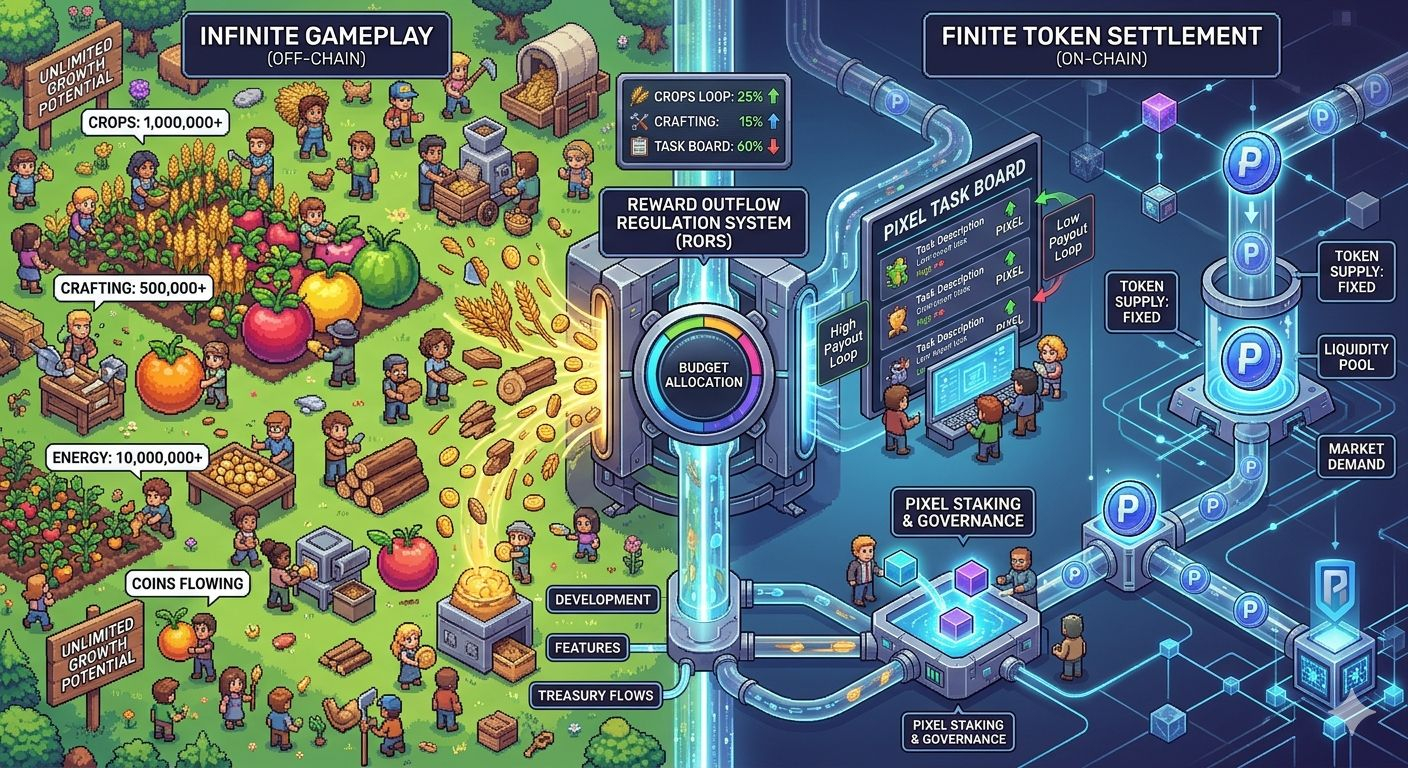
In the case of Pixels, there are indications that mechanisms similar to a Reward Outflow Regulation Systemoften discussed in the community as RORSmay help maintain this balance. These systems quietly adjust reward flows based on overall economic conditions.
When too much value is being extracted, rewards can be reduced or redistributed. When activity slows down, rewards may increase to encourage participation.
The result is not a traditional open-growth economy but something closer to a controlled ecosystem.
Within this structure, player activity does not necessarily create new value. Instead, it competes for a limited pool of reward allocation. The economy behaves like a closed loop where rewards circulate between participants rather than expanding indefinitely.
Another interesting layer appears through the staking mechanics of the PIXEL token. Staking can function as a capital allocation system inside the broader ecosystem. Token holders may indirectly influence where treasury resources are directedtoward specific experiences, features, or infrastructure connected to the game.
In this sense, the token begins to resemble a governance tool for directing economic energy rather than simply a reward currency.
At the same time, modern Web3 ecosystems increasingly rely on behavioral analytics to monitor player activity at scale. Systems embedded within platforms like Ronin Network can observe millions of in-game actions across the network. These analytics layers may help determine where rewards should be concentrated to maintain healthy participation and economic stability.
If certain gameplay loops generate stronger engagement without destabilizing token flows, the system can quietly shift incentives toward those areas.
From the outside, this looks like organic growth. From inside the system, it begins to resemble dynamic reward allocation.
This realization changed how I interpret progression inside Pixels. When players feel that a certain activity is suddenly “hot,” it may not represent the discovery of a fundamentally better strategy. Instead, it may indicate that the reward system has temporarily allocated more budget to that area of the ecosystem.
As one loop becomes stronger, another may quietly lose reward depth to preserve overall balance.
This is where the game diverges sharply from traditional online economies. In many conventional games, growth usually means expanding opportunities for everyone. More content, more quests, and more resources generally increase the total available rewards.
But in a token-regulated Web3 economy, true expansion is harder to sustain. Off-chain gameplay can grow infinitely, but on-chain rewards remain scarce.
The system must constantly rebalance the relationship between abundance and scarcity.
After spending enough time observing these dynamics, I started to rethink what effort means inside the ecosystem. Grinding more crops or completing more tasks does not necessarily create new economic value. Instead, it increases the probability that my activity intersects with wherever the reward allocation currently flows.
From that perspective, progression becomes less about producing value and more about navigating the reward system itself.
And perhaps that is the real design philosophy behind Pixels. The goal may not be infinite economic growth, but long-term equilibriuman ecosystem that sustains itself by carefully regulating token outflows relative to the inflow of player attention, participation, and capital.
In such a world, the illusion of growth is not necessarily a flaw.
It may be the mechanism that keeps the entire system alive.