


Most Web3 games I’ve played run into the same problem. Early on it feels exciting, mid-game becomes repetitive, and late-game usually turns into either endless grinding or just farming tokens until it stops making sense. I’ve seen that cycle enough times that I kind of expect it now.
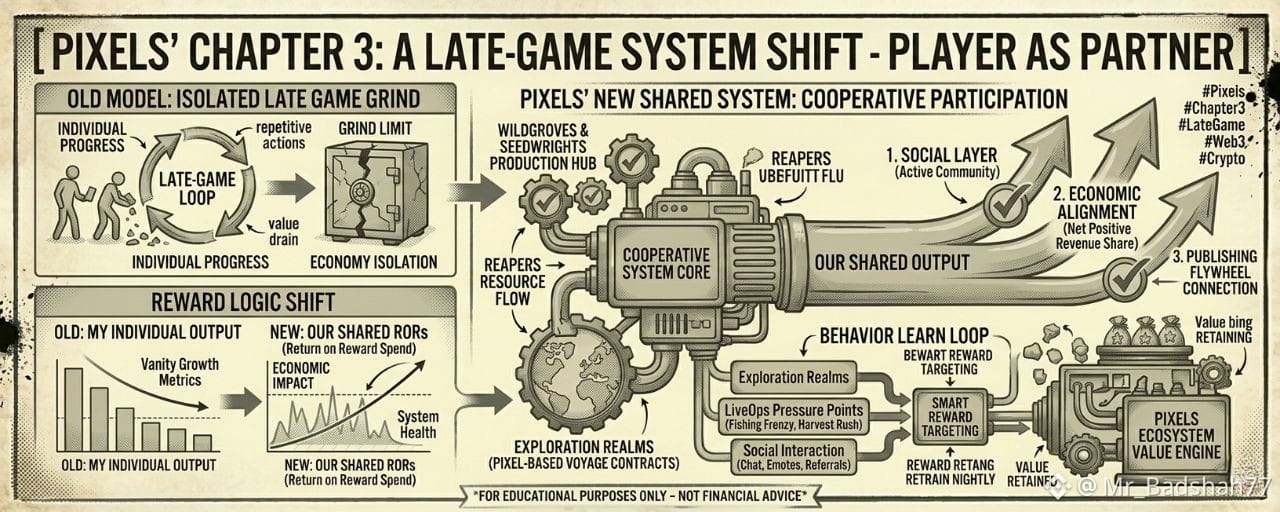
But what’s different here is how Pixels is trying to shift the late-game away from being an individual grind and more into something social and structured.
With things like Wildgroves, Seedwrights, and Reapers, I’m not just playing my own loop anymore. I’m basically part of a larger system where my actions contribute to a group outcome. And that changes how I think about progress. It’s not just “what did I earn today,” it becomes “what did my side actually produce because I showed up.”
What makes this even more interesting for me is how it connects back to the economy itself. I’ve been watching how Pixels pushes toward improving Return on Reward Spend (RORS), and from what I understand, it’s already crossing above 1 in some cycles. That sounds technical, but the way I interpret it is simple: rewards are no longer just handed out—they’re being tied to actions the system actually considers useful.
Then I look at Exploration Realms, and it clicks a bit more. Access tied to Voyage Contracts purchased with $PIXEL means progression isn’t just time-based anymore. There’s a cost, a decision, and a reason behind participation. It connects token flow directly with gameplay activity instead of separating them.
And the LiveOps stuff like Fishing Frenzy and Harvest Rush doesn’t feel like “events” in the traditional sense. It feels more like pressure points that keep the system active and moving. Even the social features—chat, emotes, referrals, share-to-earn—feel less like add-ons and more like tools to keep people interacting instead of playing alone in silos.
But the part I keep thinking about is this: it’s not any single feature that matters. It’s how everything connects into a loop that keeps adjusting itself based on what players actually do.
Because at that point, I’m not just reacting to the game anymore. I’m feeding data into something that is constantly learning what to reward next.
And that’s where the real question shows up for me:
If my actions are shaping the system, and the system is shaping my actions… then where exactly do I stop being a player and start becoming part of the economy itself?
That line feels less clear every time I look at it.
What matters more in Web3 gaming: optimizing my own output, or influencing what the system decides is valuable in the first place?
This is for educational purposes only, not financial advice.