
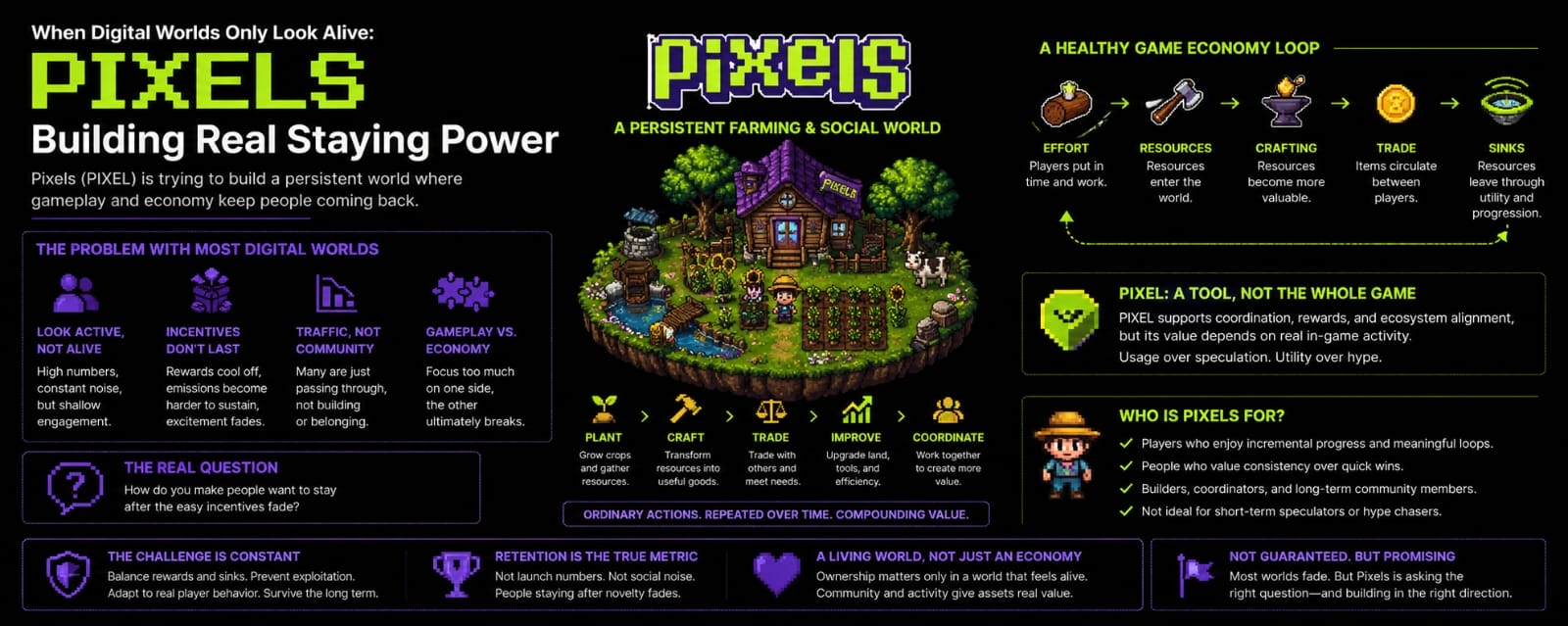
I keep coming back to this question: why do so many digital worlds feel active, but not actually alive? You can open a game, see thousands of wallets moving, markets ticking, rewards being claimed, and still sense that nobody is really there in the deeper sense. People are present, but only temporarily. They are not inhabiting the world so much as passing through it. That difference matters more than most token charts ever will.
I’ve watched enough blockchain games follow the same pattern to stop being surprised by it. The early phase usually looks strong. Rewards are attractive, user numbers rise, social feeds become loud, and every mechanic gets described as revolutionary. Then incentives cool down. Token emissions become harder to sustain, asset prices soften, and the mood changes quickly. What looked like community often turns out to be traffic. What looked like loyalty was sometimes just yield with a character skin attached.
The structural problem is difficult because games and economies obey different emotional rules. A game needs curiosity, mastery, identity, and reasons to return even when nothing is being paid out. An economy needs balance, sinks, scarcity, circulation, and defenses against exploitation. When teams prioritize one side too aggressively, the other side tends to weaken. If rewards dominate, gameplay feels like labor. If gameplay ignores economics entirely, the ownership layer becomes decorative. Building both at once is harder than most roadmaps admit.
That is where Pixels becomes interesting to me not as a miracle case, but as a more serious attempt to work inside that tension. Pixels is built less like a speculative storefront and more like a persistent farming and social world where routine actions matter over time. You plant, gather, craft, manage land, coordinate with others, and gradually improve efficiency. None of those actions are individually dramatic. That may be the point.
Many systems fail because they rely on headline moments. Pixels leans more toward repetition with purpose. Farming loops create resource demand. Crafting links one player’s output to another player’s need. Land introduces productive space rather than static ownership alone. Progression gives users reasons to optimize, specialize, and return tomorrow. Social activity matters because coordination often increases value more than isolated grinding does. These are not glamorous mechanics, but stable systems are often built from ordinary habits.
What stands out is that gameplay appears designed to generate economic movement rather than having an economy awkwardly bolted on afterward. Resources enter through effort, get transformed through crafting, circulate through trade, and leave through sinks tied to progression or utility. That loop sounds simple on paper, yet simplicity is often underrated. Complex token systems can hide fragility. Straightforward loops at least reveal where pressure is building.
PIXEL sits inside that environment as a tool of coordination and reward, but the real challenge is not whether a token exists. It is whether the token can remain connected to meaningful in-game behavior. If too much value comes from passive expectations, speculation overwhelms usage. If too little value exists, players disengage. If rewards outpace sinks, inflation arrives. If sinks become too aggressive, progression feels punitive. There is no permanent solution here only constant calibration.
And calibration becomes harder once real players arrive, because players do not behave like design documents. They optimize routes, exploit inefficiencies, copy profitable strategies, and abandon loops that feel slow. They also form cultures the developers did not plan for. A healthy game economy must survive not ideal users, but strategic ones. That is why retention matters more than launch excitement. If people still log in after the novelty fades, the system may be doing something right.
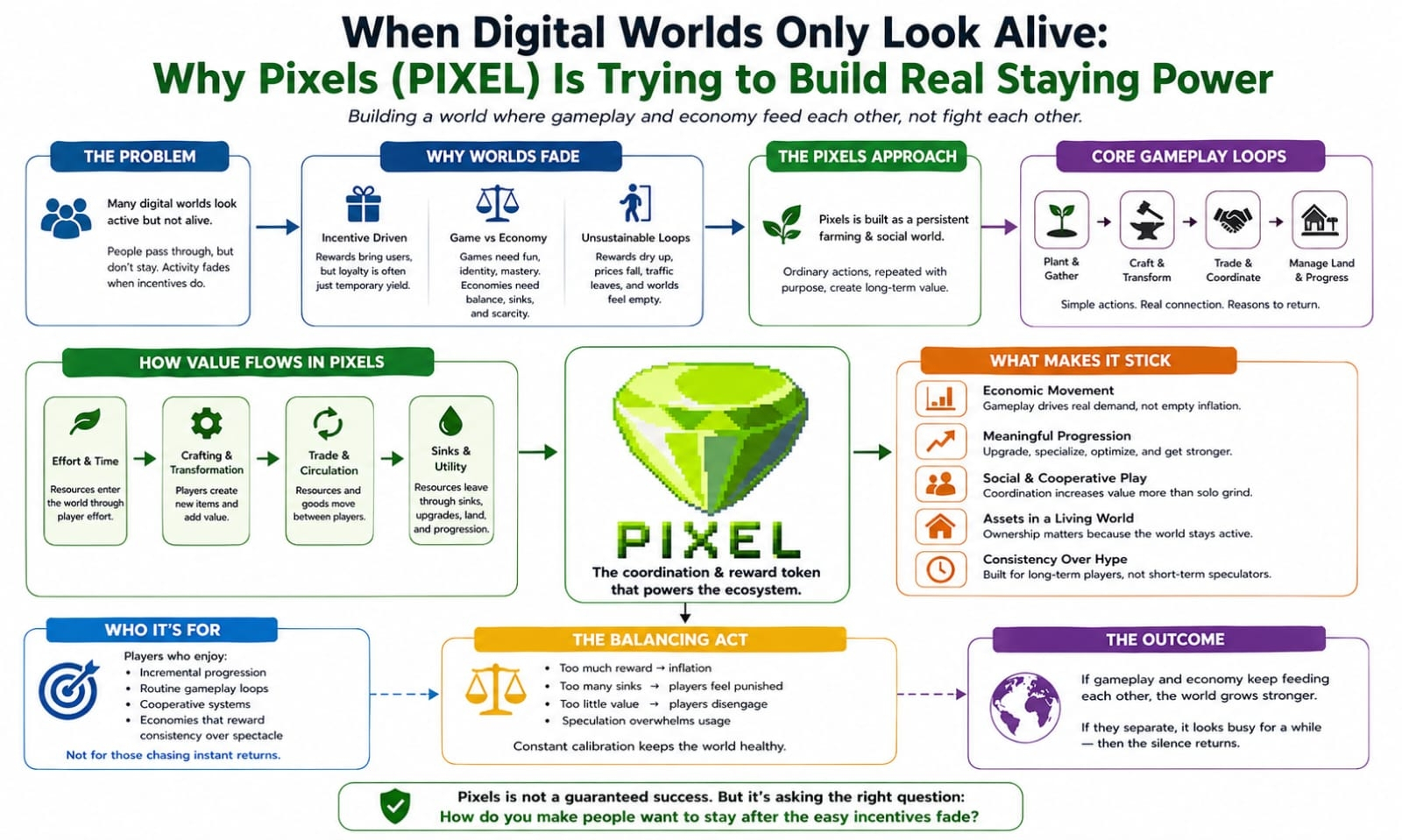
I’m also cautious about romanticizing ownership in games. Owning land or assets only matters if the world around them remains socially and economically relevant. Empty worlds have cheap assets for a reason. Pixels seems aware of this, which is why repeated activity and community interaction may matter more than the ownership narrative itself. Assets need a living context.@Pixels
Who is Pixels really for? Probably not the person chasing instant returns or one week hype cycles. It makes more sense for players who enjoy incremental progression, routine loops, cooperative systems, and economies that reward consistency more than spectacle. That audience can be smaller and still more durable.#pixel
I would not call the outcome guaranteed. Most game economies eventually drift out of balance, sometimes slowly enough that people notice too late. But Pixels at least appears to be asking the right question: how do you make people want to stay after the easy incentives fade? If gameplay and economy continue feeding each other instead of competing, this might work. If they separate, it will look busy for a while and then familiar silence returns.$PIXEL