
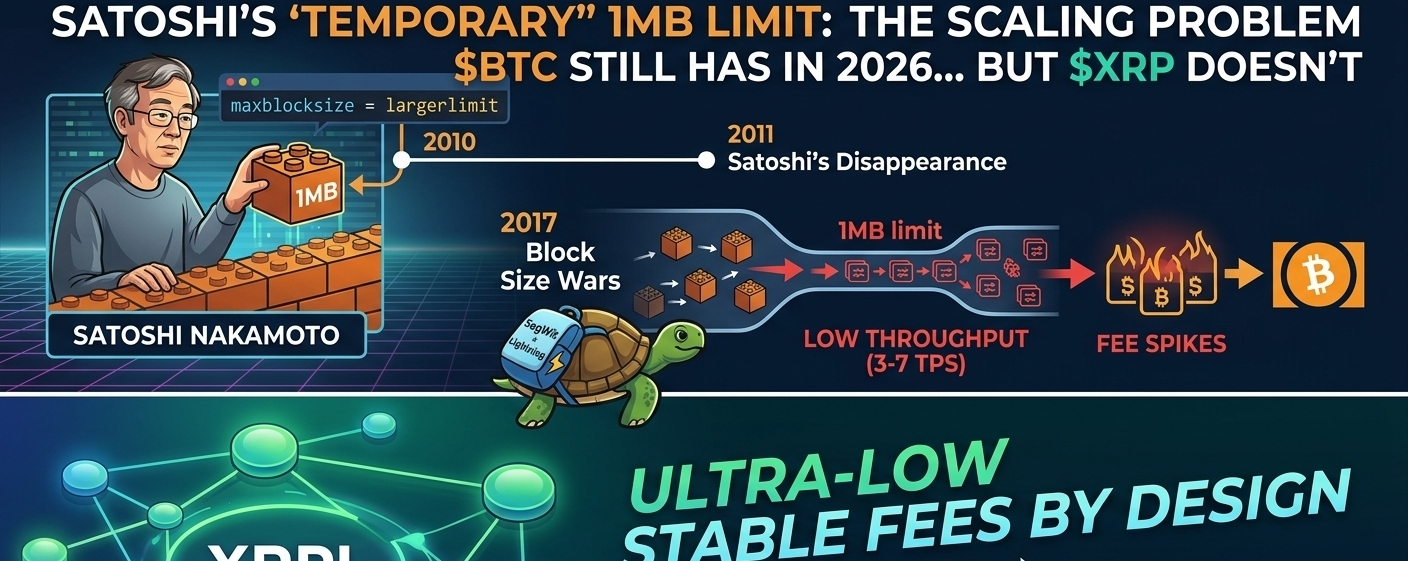
**[0:00-0:10] Visual: A grainy 2010-style computer screen with the code: `maxblocksize = 1000000`.**
**Host:** In 2010, Satoshi Nakamoto added a "temporary" 1MB limit to Bitcoin to stop spam. He even left a plan to raise it later. But then... he vanished.
**[0:10-0:25] Visual: Split screen. Left side: Angry "Block Size War" headlines from 2017. Right side: A turtle labeled "BTC Layer 1."**
**Host:** That "quick fix" became a permanent bottleneck. It sparked the 2017 Civil War and birthed Bitcoin Cash. Fast forward to 2026, and Bitcoin’s base layer is still stuck at 3 to 7 transactions per second. When the market pumps, fees skyrocket.
**[0:25-0:45] Visual: High-speed cinematic transition to a glowing XRP Ledger logo. Motion graphics showing transactions flying at light speed.**
**Host:** But $XRP? It doesn’t have a "10-minute block" problem. While BTC is digital gold, XRP was built for the high-speed rail of finance. We're talking 3-second finality and 1,500 transactions per second—on-chain, by design, with fees that barely move.
**[0:45-0:60] Visual: Side-by-side comparison chart. BTC (Store of Value) vs. XRP (Utility/Speed).**
**Host:** One is a fortress of security; the other is a machine for speed. In a world that needs both, which one are you betting on for 2026?
**[Text Overlay:]** Drop a 💎 for BTC or a 🚀 for XRP in the comments!
---
### **Published Caption:**
The ghost of 2010 still haunts $BTC! 🚨 Satoshi’s "temporary" 1MB limit created the scaling bottleneck we still see in 2026. While Bitcoin relies on Layer 2, $XRP was built for speed from day one—delivering 1,500 TPS and 3-second finality.
Is Bitcoin’s limit a flaw or its greatest security feature? Let’s debate. 👇
#Bitcoin #XRP #CryptoHistory #Scaling #BTC #Crypto2026 #XRPL