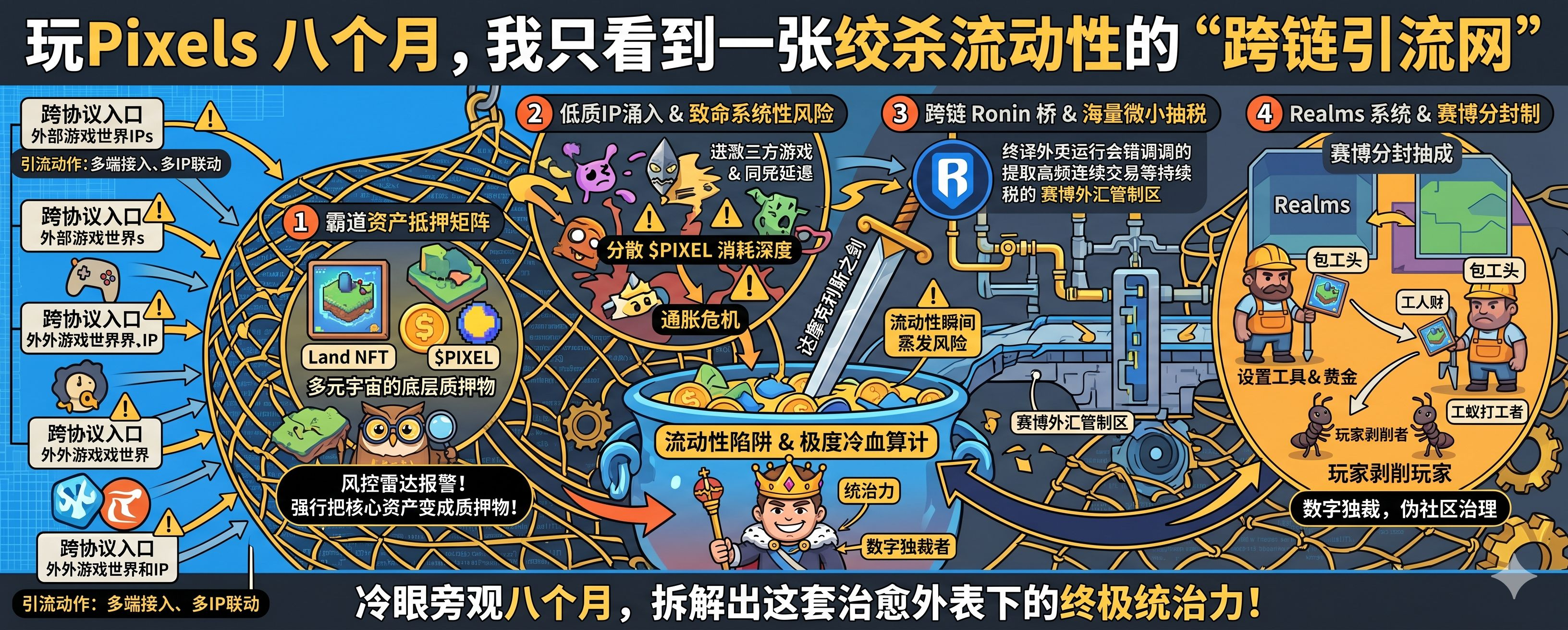
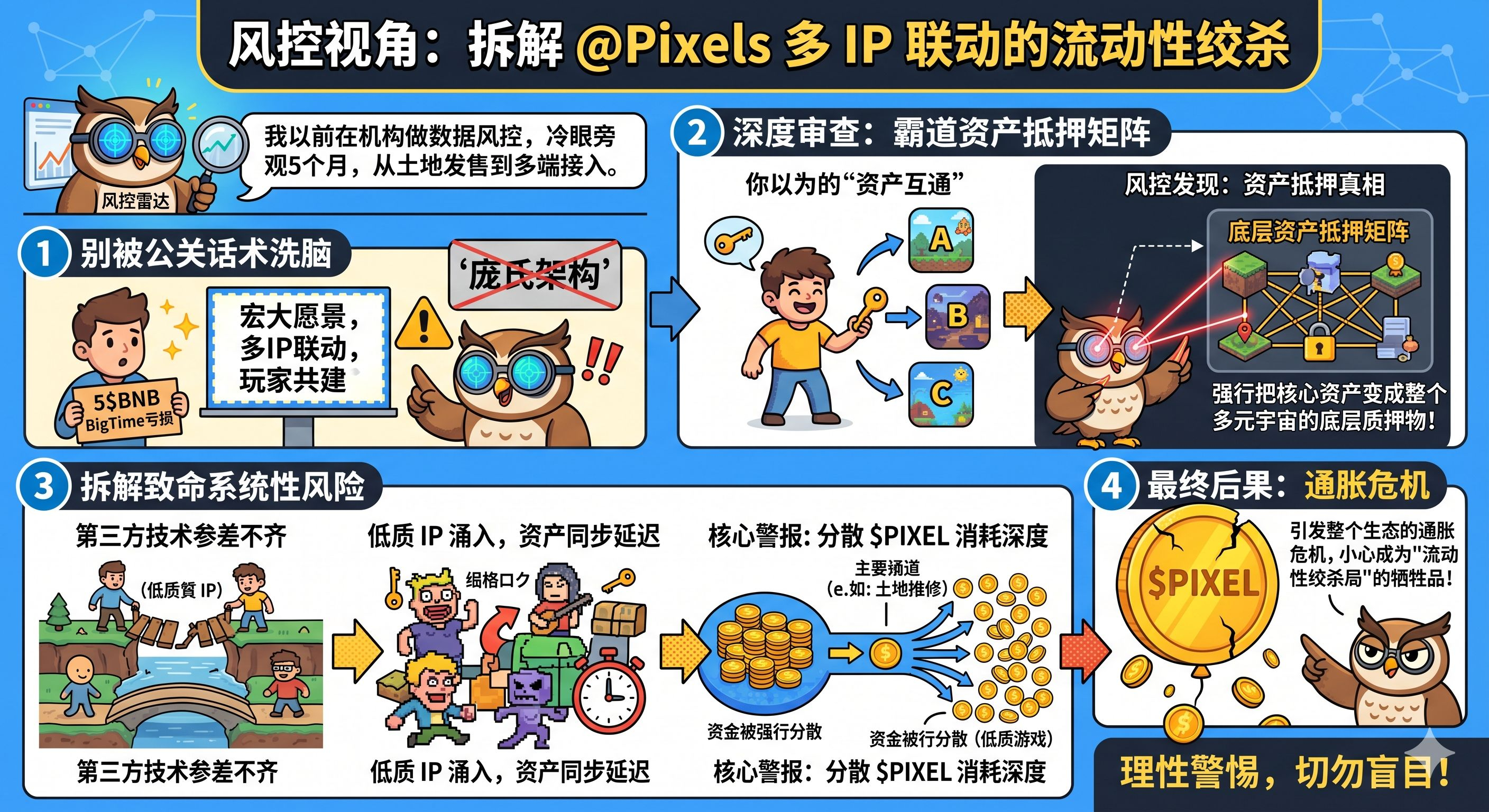
Don’t come at me with grand visions of an open metaverse, and don’t try to brainwash me with that PR jargon about 'multi-IP synergy and player co-creation.' I’ve spent years in institutional data risk management and have seen too many schemes disguised as 'ecosystem empowerment' that are really just asset-backed Ponzi setups with multiple collateralizations and trap doors. I’ve been a cold observer and participant in the @Pixels ecosystem for a full 5 months, from land sales to multi-platform integrations, breaking down their landing strategies daily using risk models. So, while everyone else is cheering for the digital utopia laid out by Pixels and its multi-IP interoperability, my first instinct is extreme caution and a smirk. I believe most retail investors haven’t seen through this; it’s not a thriving game ecosystem but a meticulously designed liquidity squeeze crossing protocol boundaries. I still remember spending 5 $BNB on an NFT plot in bigtime and losing my shirt, which has made me super cautious.
Carrying this malicious intent of seeking system vulnerabilities, I conducted a deep dive into what Pixels calls its "multi-game IP incubation" underlying protocol as part of an internal audit. Don't even get me started on player benefits from asset interoperability; when I saw the land and items in my hands seamlessly transferring to newly integrated battle and nurturing games, my risk management radar went haywire! I found that Pixels isn’t opening interfaces; it’s establishing an extremely domineering "underlying asset collateral matrix." You thought it was cool to hop between different games with the same account? I believe this is essentially Pixels leveraging its first-mover advantage to forcibly turn your core assets into the foundational collateral of the entire multiverse. But at the same time, I discovered a critical systemic risk: those third-party teams have varying technical capabilities, and once low-quality IP floods in, it won’t just cause delays in asset synchronization but will severely dilute the consumption depth of $PIXEL , ultimately triggering an inflation crisis in the entire ecosystem.
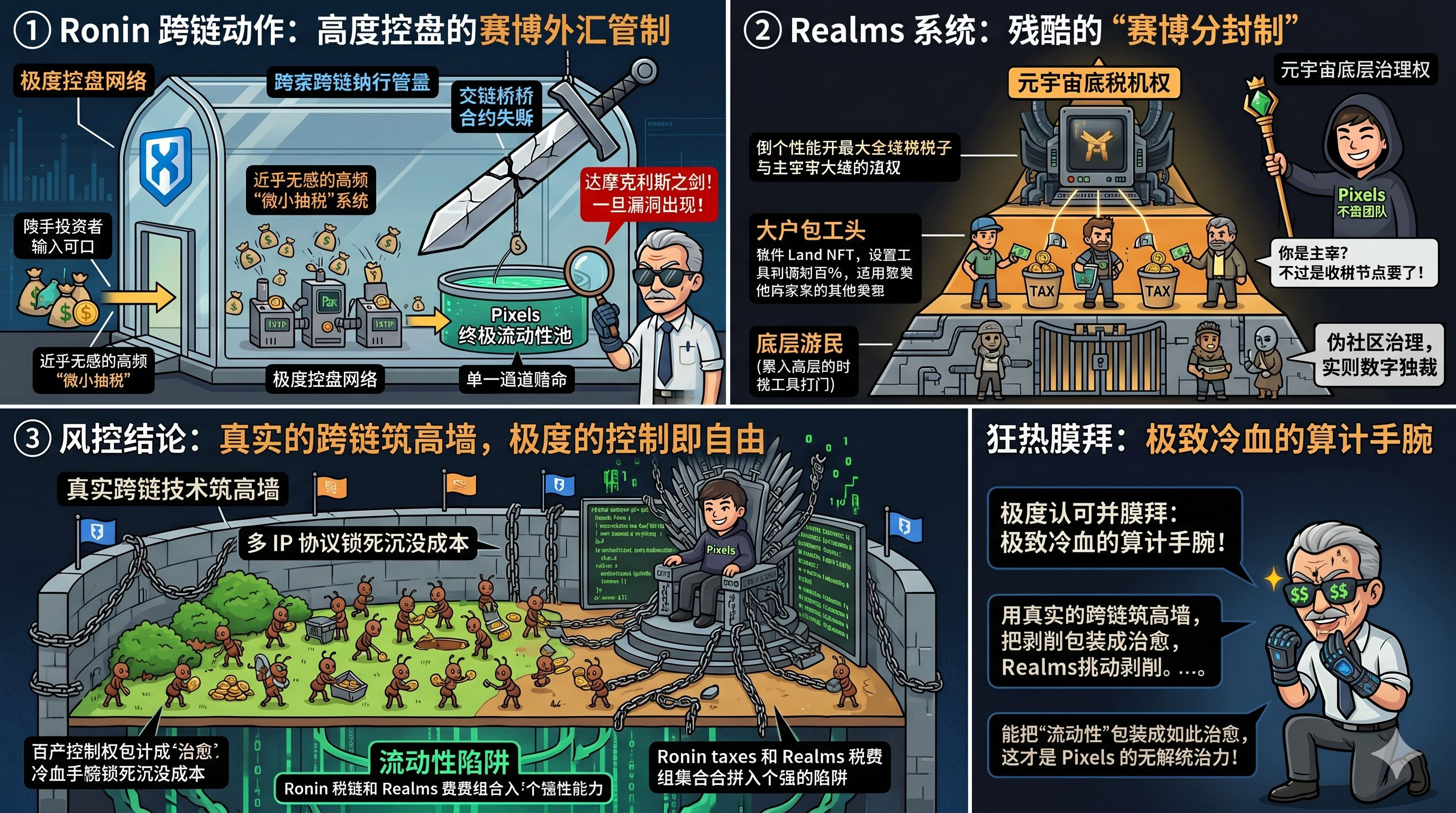
Following the trajectory of asset flow, I further dissected Pixels' crucial "cross-chain Ronin" move. Don’t even get me started on the nonsense about optimizing player experience and reducing gas fees. I personally ran thousands of data interactions on-chain, and I know exactly what this ultra-low friction network means. I believe that Pixels migrating to the Ronin chain essentially establishes a highly controlled "cyber foreign exchange regulatory zone." In this high-throughput, low-friction greenhouse, the system can extract a massive amount of high-frequency "micro-taxes" from players at an almost imperceptible rate. But from a risk management veteran's perspective, cross-chain bridges are always the Damocles sword hanging over our heads. Pixels pools vast amounts of funds on a non-mainstream public chain; once a vulnerability appears in the cross-chain contract, the liquidity of the entire ecosystem will evaporate in an instant. This strategy of betting one’s entire fortune on a single channel is akin to dancing on the edge of a knife.
To thoroughly uncover its bottom line, I applied for Pixels' Realms system with the land NFTs I held, and personally built a private trading space. Don’t even get me started on returning metaverse construction rights to the community; when I was configuring those simple tools and commission ratios in the backend, I felt a suffocating sense of cyber feudalism. I found that Pixels' so-called decentralization actually establishes an extremely ruthless "cyber fiefdom." It filters out the bottom-dwelling players with high tool thresholds, turning asset holders into "contractors" working for it. You think you’re the master collecting fees in your own space? I believe you’re merely a low-tier tax node authorized by Pixels’ ultimate tax machine. What’s even more hypocritical is that the underlying governance rules of the metaverse are still tightly held by the project team, and the community has no real decision-making power; it’s nothing more than a digital dictatorship disguised as openness.
However, just after critically dissecting this multi-IP nesting, cross-chain control, and fief tax system with my risk management model, I found myself developing an extreme, pathological admiration for it! Don’t talk to me about absolute freedom from centralization; I deeply recognize and worship the cold-blooded tactics of the Pixels team in calculating asset control and traffic attraction to the extreme! I know better than anyone that in this mixed market, projects relying solely on conceptual hype can't survive a quarter. And Pixels dares to build high walls with real cross-chain technology, locking in user sunk costs with multi-IP protocols, and using the Realms system to provoke players into exploiting each other. I think the ability to package a "liquidity trap" into such a healing open metaverse and make millions of players willingly work within it is Pixels' most formidable dominance.
These days, I still log into Pixels on time every day, patrolling various IP scenarios and my private space. Don’t talk to me about escaping capital control fantasies; I no longer view this as a mere game. I willingly stay in this cross-chain metaverse network woven by Pixels. Because I believe it's better to play in a cold matrix like Pixels, where risk and reward are controlled to four decimal places, rather than blindly buying into those emotional hype projects that can’t even run their basic logic. Pixels is actually quite fun; I recommend it to new traders to give it a shot! #pixel